
Loading buyer guide
Hurry, don't miss savings on selected furniture & more.* Shop all offers
Brand choice matters because it often decides your app experience, storage route, power setup and future add-ons. Use this comparison to shortlist the right Surveillance Cameras before checking live product offers.
Use our barcode scanner to match products instantly to find the best prices, find products with ease using our voice search and build wish lists and your favourites at the click of a button.
TP-Link Tapo vs Eufy security cameras: storage, specs and value
Tapo looks especially strong when you want low-cost indoor coverage or a specific spec such as pan-and-tilt or 4K solar, while Eufy can make sense if its storage approach and add-on camera format fit equipment you already own.
Ring vs Google nest security cameras: which ecosystem suits your home?
Ring and Google Nest are often compared by shoppers who already own smart speakers, displays or doorbells. The better choice is usually the one that fits your existing home setup, gives you the camera style you need and keeps ongoing costs predictable.
Blink vs Tapo security cameras: best for budget buyers
Blink and Tapo both appeal to shoppers who want home security without overspending, but they suit different buying habits. Blink is often attractive if you want simple wire-free cameras and an Amazon-connected setup, while Tapo is especially strong when you are comparing low-cost indoor cameras, mains-powered options and models with flexible storage choices.
Battery vs mains powered alarms: which should you choose?
Alarm choice is not just about the cheapest unit on the shelf. The right power type affects where it can be fitted, how often you will need to maintain it and what you may spend over the product’s listed life.
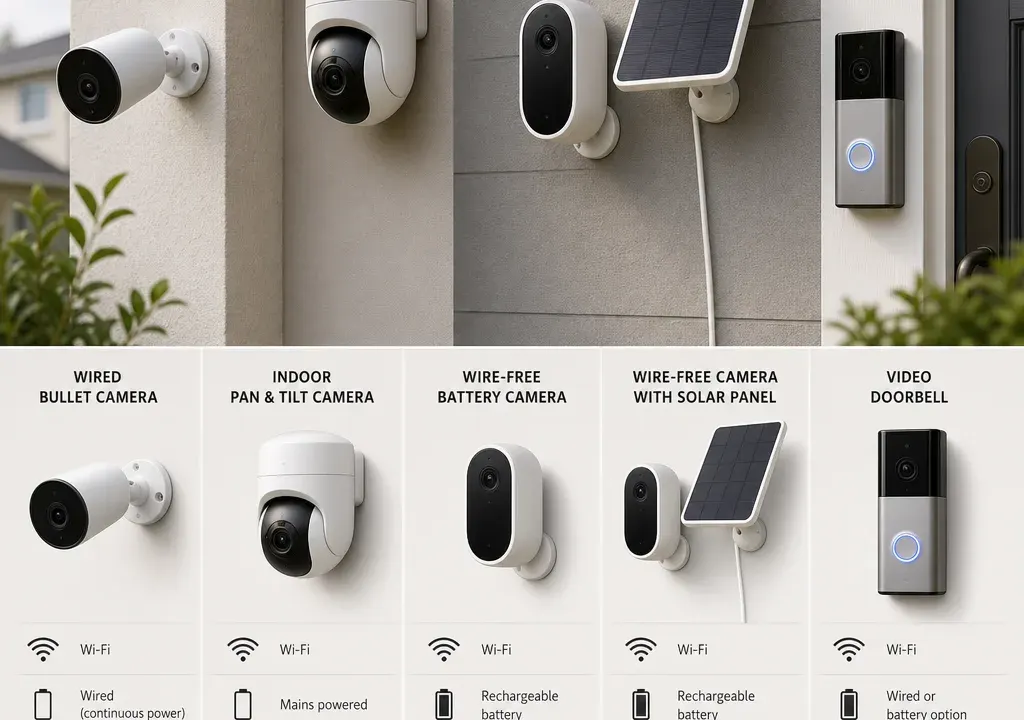
Choosing between Ring, Eufy, Reolink, Tapo and Blink is not just a brand preference. In Surveillance Cameras, the brand you choose can influence how you power the camera, how footage is stored, which accessories are easy to add later and how neatly everything fits into your smart home.
The useful way to compare these suppliers is to start with your home layout, then work backwards to the specification. A front door, shared entrance, driveway, garage, garden and indoor room all put different demands on a camera.
Ring is often worth shortlisting if your main priority is a doorbell-style camera or a camera that sits naturally in an Alexa-led smart home. In the supplied catalogue snapshot, Ring examples include the Ring Spotlight Cam Pro 1080p HDR Video & 3D Motion Detection and the Ring Video Doorbell Pro 2, which shows how the brand spans both camera and doorbell use cases.
Eufy is a sensible brand to compare if you want to look closely at ecosystem-based cameras and add-on options. The supplied snapshot includes the Eufy S210 Add-On Camera, so check whether a listing is a standalone camera or designed to expand an existing setup before assuming it is the whole system.
Reolink is usually one to compare when you are weighing up specification-heavy outdoor coverage, multi-camera systems or recording setups. As with any brand, do not judge it by resolution alone; check power, storage, night vision description, app features and whether extra hardware is needed.
Tapo, from TP-Link, is a strong comparison point for shoppers who want a wide spread of accessible indoor and outdoor options. The supplied products include the TP-Link Tapo C100, Tapo C200 1-pack and Tapo C460 KIT 4K 8MP Solar Panel Security Camera, which illustrates the range from simple indoor cameras to more advanced outdoor-style kits.
Blink is worth comparing if you want a simple home camera setup and are especially focused on compact, low-maintenance monitoring. As with Ring, Eufy, Reolink and Tapo, check what is included in the box and what may require extra accessories or services later.
The lowest camera price is not always the lowest-cost solution. A camera may look inexpensive but need a hub, memory card, subscription, mount, longer cable, solar panel or other Accessories for Surveillance Cameras to work as you expect.
In the current product candidates, there are heavily discounted examples across TP-Link Tapo, Eufy and Ring listings, but discounts should be treated as a prompt to compare rather than a reason to buy immediately. Check whether the reduced item is an indoor camera, outdoor camera, add-on camera, doorbell, recorder or mounting accessory.
For value, compare four things side by side: the camera price, any storage or subscription requirement, the cost of accessories, and whether the camera can be reused if you expand the system. A more expensive camera can be better value if it avoids extra hardware; a cheaper one can still be the right buy if it covers a simple indoor job.
Security camera listings often lead with resolution, such as 1080p, 3K, 4K or an 8MP figure. Higher resolution can help with detail, but only if the camera is placed correctly, has a suitable field of view and records clearly in the lighting conditions you actually have.
For example, the supplied catalogue includes a Ring Spotlight Cam Pro listing described with 1080p HDR video and 3D motion detection, while a Tapo C460 kit listing refers to 4K 8MP and solar panel support. Those headline specifications point to very different buying priorities: one may be attractive for motion-aware spotlight coverage, while the other may appeal if you are seeking sharper footage and a solar-assisted setup.
When comparing Ring, Eufy, Reolink, Tapo and Blink, look beyond the biggest number. Check whether the camera supports the angle you need, whether night footage is described in enough detail, whether audio features matter to you and whether motion alerts can be adjusted to reduce nuisance notifications.
Power is one of the most important differences between security camera brands and models. A wired or plug-in camera may suit an indoor room, shop-style counter, garage or sheltered area where sockets are available. Battery models can be neater where cabling is difficult, but you need to be comfortable with recharging or battery maintenance.
Solar-assisted cameras can be appealing for outdoor locations where regular charging would be inconvenient, but you still need to think about placement, shade and whether the panel can be fitted neatly. Do not assume every outdoor camera is solar-ready; check the product title, specification and included accessories.
For a quick decision, choose plug-in if reliability and low maintenance matter more than flexible placement, battery if you want simpler installation, and solar-assisted options if the camera will be outdoors with suitable light and you want to reduce manual charging.
Before comparing offers, decide how you want footage stored. Some buyers prefer cloud recording for convenience, while others prefer local storage or a recorder-based setup. Each route affects ongoing cost, privacy preferences, installation and how easy it is to retrieve clips later.
The supplied candidates include the TP-Link VIGI NVR1008H, which is not a typical standalone home camera but a network video recorder product. That is a reminder to check whether you are buying a camera, an add-on camera, a doorbell, a mount or part of a recording system.
Ring, Eufy, Reolink, Tapo and Blink can all appear attractive at the product-card level, but storage is where many shoppers discover the real difference. Always check whether recording works out of the box in the way you expect, whether a memory card is supported, whether a hub is needed and whether ongoing plan costs apply.
If you already use smart speakers, displays or other connected devices, brand fit can matter as much as camera specification. A camera that works smoothly with your existing setup is more likely to be used properly, checked regularly and expanded later.
Ring and Blink are commonly considered by shoppers already invested in Amazon-style smart home routines. Tapo may appeal if you already use TP-Link smart home products. Eufy can be appealing when comparing cameras within a single app-based security ecosystem. Reolink is often shortlisted by buyers comparing more specification-led camera and recorder-style setups.
The key is to avoid buying one attractive camera that becomes isolated from everything else. If you may add another outdoor camera, doorbell, indoor camera or Accessories for Surveillance Cameras later, check compatibility before committing to the first purchase.
Brand comparisons become clearer when you define the camera role. A video doorbell is best for callers and parcels at the front door. An indoor camera is usually about pets, entrances or general monitoring. An outdoor spotlight or bullet-style camera is more about approaches, driveways, gardens or side paths. A multi-camera setup is for broader coverage where one device cannot do the job.
The supplied snapshot shows this variety clearly: Ring listings include a spotlight camera and a doorbell, Tapo examples include compact indoor-style models and a solar camera kit, and Eufy appears as an add-on camera. They are all Surveillance Cameras, but they solve different problems.
If your need is simple, do not overbuy. If your need is complex, avoid a one-camera compromise. A cheaper indoor camera will not replace a properly positioned outdoor camera, and a doorbell will not necessarily cover the whole front garden.
Start by filtering for the camera type you need, then compare brands. This stops a low price on the wrong kind of product from distracting you. A mount, recorder or add-on camera can appear alongside complete cameras, so read the product title carefully.
Next, compare like with like. A battery doorbell should be compared with other doorbell cameras, not with an indoor plug-in camera. A 4K outdoor camera should be compared with other outdoor options where power, storage and mounting are similar. This is especially important in Surveillance Cameras because product names can include technical terms that make unlike-for-like comparisons look closer than they are.
Finally, check retailer availability and offer signals together. A strong discount can be useful, but the better buy is the one that meets your installation, recording and feature needs at a fair total cost.
Choose Ring if your shortlist centres on a front door, driveway, spotlight camera or smart home setup where app convenience and familiar doorbell-style monitoring are high priorities.
Choose Eufy if you are comparing ecosystem-based cameras and want to look carefully at whether local-style storage, add-on cameras or brand-specific expansion options suit your home. Check each listing carefully, especially where a product is described as an add-on.
Choose Reolink if your priority is specification comparison, outdoor coverage or the possibility of a more system-based approach. Pay close attention to storage method, power type and whether extra recording hardware is part of the setup.
Choose Tapo if you want to compare a broad spread of accessible Surveillance Cameras, from straightforward indoor monitoring to more advanced outdoor options. It is particularly worth checking Tapo when you want to compare value, resolution and power choices across several product types.
Choose Blink if you want a simple camera shortlist and are comparing compact home monitoring options. As with every brand, check whether the model depends on a hub, subscription, battery format or accessory to deliver the experience you expect.
There is no single best brand for every home. Ring may suit doorbell and Alexa-led setups, Tapo is useful for comparing a wide spread of affordable options, Eufy is worth checking for ecosystem-based cameras, Reolink is often considered for specification-led setups, and Blink can suit simple home monitoring. The best choice depends on placement, power, storage and total cost.
Not automatically. A cheap camera can be a good buy for a simple indoor job, but it may be poor value if you later need a hub, storage plan, mount, memory card or extra camera. Compare the whole setup before deciding.
4K can offer more detail, but it is not always the better buy. Placement, lens angle, night performance, storage needs, Wi-Fi strength and power source all affect real-world usefulness. A well-placed 1080p camera can be more practical than a poorly placed higher-resolution model.
Confirm whether the add-on camera works by itself or needs an existing hub, base station, recorder or app ecosystem. Also check power requirements, storage method and whether any mounting accessories are included.
Possibly. Depending on the model, you may need a mounting bracket, memory card, cable, solar panel, junction box or recorder. Check what is included in the box so you can compare the true cost of each offer.
For most shoppers, the best security camera brand is the one that matches the job rather than the one with the loudest headline offer. Ring, Eufy, Reolink, Tapo and Blink each make most sense in different situations, so begin with location, power, storage and smart home fit.
Once you know the type of Surveillance Cameras you need, compare current products and offers like for like. That approach makes discounts more meaningful, avoids accidental accessory-only purchases and gives you a much better chance of choosing a camera system you will actually keep using.
