
Loading buyer guide
Hurry, don't miss savings on selected furniture & more.* Shop all offers
Choosing between Blink and Tapo comes down to more than the cheapest camera. Power source, storage, app features, camera placement and live offers all affect long-term value.
Use our barcode scanner to match products instantly to find the best prices, find products with ease using our voice search and build wish lists and your favourites at the click of a button.
TP-Link Tapo vs Eufy security cameras: storage, specs and value
Tapo looks especially strong when you want low-cost indoor coverage or a specific spec such as pan-and-tilt or 4K solar, while Eufy can make sense if its storage approach and add-on camera format fit equipment you already own.
Ring vs Google nest security cameras: which ecosystem suits your home?
Ring and Google Nest are often compared by shoppers who already own smart speakers, displays or doorbells. The better choice is usually the one that fits your existing home setup, gives you the camera style you need and keeps ongoing costs predictable.
Security camera brands compared: Ring, Eufy, Reolink, Tapo and Blink
Ring, Eufy, Reolink, Tapo and Blink all sit in the same broad Surveillance Cameras market, but they are not interchangeable buys. The right choice depends on whether you value a doorbell-led setup, battery convenience, higher-resolution outdoor coverage, lower entry cost, local recording options or the best offer available today.
Battery vs mains powered alarms: which should you choose?
Alarm choice is not just about the cheapest unit on the shelf. The right power type affects where it can be fitted, how often you will need to maintain it and what you may spend over the product’s listed life.
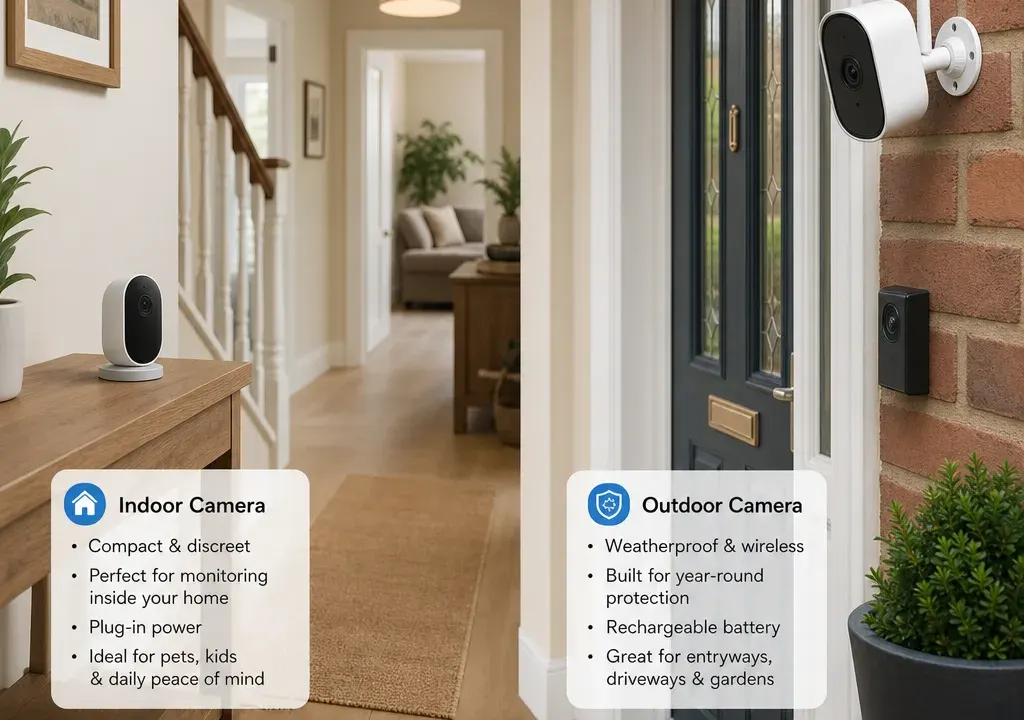
Blink and Tapo are two of the most commonly compared names for budget-friendly Surveillance Cameras. Both can make sense for a first home security setup, but they do not always compete in the same way. The best choice depends on where you want the camera, whether you prefer battery or mains power, and how you want recordings stored.
For shoppers comparing products and offers, Tapo often stands out in catalogue data for very low entry prices on indoor models, with examples such as the TP-Link Tapo C100 and TP-Link Tapo C200 appearing among the cheaper camera options when discounted. Blink, meanwhile, is usually considered by buyers who want simple wireless cameras, compact designs and an app-led experience that fits neatly into an Amazon household.
Choose Tapo first if your priority is the lowest upfront spend, especially for indoor monitoring, plug-in cameras or pan-and-tilt coverage. In the available comparison data, Tapo models such as the C100 and C200 sit in the low-cost end of Surveillance Cameras, and Tapo’s wider range also includes more advanced options such as the Tapo C460 KIT 4K 8MP Solar Panel Security Camera.
Choose Blink first if you prefer a simpler wire-free approach and you are happy to compare the total cost of the camera, any required accessories and the storage route before buying. Blink’s appeal is often convenience: battery-powered placement, a streamlined app and an ecosystem that many shoppers already understand.
For pure bargain hunting, Tapo is usually the brand to inspect first. For low-fuss placement where you do not want to run a cable, Blink should stay on your shortlist.
Budget buyers naturally start with the price, but the cheapest security camera is not always the best value. A very low-cost indoor camera may be ideal for a hallway, pet room or small office, but less useful if you need weather resistance, long battery life, wider outdoor coverage or higher resolution.
Recent catalogue examples show Tapo models carrying strong discount signals, including entry-level indoor cameras and a higher-spec solar kit. That makes Tapo a useful brand to compare when scanning current Surveillance Cameras offers. However, discounts change, and a big percentage reduction only matters if the final product suits your room, mounting position and storage preference.
When comparing Blink and Tapo deals, check the final basket cost rather than the camera price alone. You may need a mounting accessory, memory card, hub, subscription or additional camera. If you are planning more than one camera, compare the cost of a two-camera or four-camera setup rather than judging a single unit in isolation.
Tapo has a particularly broad budget feel because it includes simple indoor cameras, pan-and-tilt models and more advanced outdoor or solar-assisted options. The TP-Link Tapo C100 is the kind of model budget shoppers often consider for fixed indoor coverage, while the Tapo C200 1-pack is better suited to buyers who want a camera that can adjust its view remotely. Always confirm the current specification, as model names can be similar but features can differ.
Blink is often compared for compact indoor and outdoor cameras, plus doorbell-style options in some ranges. It tends to suit buyers who want a cleaner, wire-free installation rather than a camera permanently plugged into a socket.
A simple rule helps: for a single room, compare low-cost Tapo indoor models first; for a front door, garden gate or shed where cables are inconvenient, compare Blink’s battery options with Tapo’s outdoor or solar-assisted alternatives.
Power source is one of the biggest practical differences. Mains-powered cameras are usually better for places where you can plug in discreetly and leave the camera running. They can be good value because you are not paying extra for battery hardware, but they limit placement and may leave a visible cable.
Battery-powered cameras are easier to position and can work well for doors, garages and outbuildings, provided the Wi-Fi signal reaches and you are comfortable with recharging or replacing batteries when needed. Blink is a natural comparison point here because many shoppers associate it with wire-free installation.
Tapo should not be dismissed for outdoor buyers, though. The catalogue includes the TP-Link Tapo C460 KIT 4K 8MP Solar Panel Security Camera, which shows how Tapo also competes beyond basic indoor plug-in models. If you like Tapo pricing but need outdoor flexibility, compare its battery or solar-assisted models against Blink rather than only looking at the cheapest indoor cameras.
Storage is where a budget camera can become less budget-friendly over time. Some shoppers prefer cloud recording because it is convenient and accessible from the app. Others prefer local storage because they want to avoid ongoing subscription costs where possible.
Tapo models commonly appeal to buyers looking for flexible storage choices, including models that may support local storage depending on the exact camera. Blink buyers should compare how recordings are stored, whether a Sync Module is involved, and what features require a subscription or extra hardware. Do not assume that every feature shown in an app screenshot is included forever without an ongoing cost.
Before buying either brand, ask three questions: can the camera record clips without a subscription, how much history do you actually need, and what happens if the camera is stolen or loses connection? The cheapest upfront deal may not be the best if it pushes you into storage costs you did not plan for.
Resolution matters, but it should be judged alongside lens angle, lighting, night vision, motion detection and where the camera will be mounted. A higher-resolution camera can help if you need more detail across a driveway or garden, while a basic indoor camera may be perfectly adequate for checking whether a delivery arrived inside a porch or whether a pet is in the room.
In the current product context, Tapo ranges from simple indoor models to higher-resolution options such as the Tapo C460 KIT 4K 8MP Solar Panel Security Camera. Blink shoppers should compare the stated resolution and field of view on the exact model they are considering rather than assuming every camera performs the same.
For budget buyers, it is sensible to prioritise the right camera position first. A well-placed modest camera can be more useful than a higher-spec model pointing at the wrong area or struggling with glare from a window.
The app experience can be just as important as the hardware. Look for clear motion alerts, easy live view, simple camera sharing, privacy settings and controls that let you reduce unnecessary notifications. If a camera constantly alerts you to passing cars, pets or shadows, it quickly becomes annoying.
Blink is likely to appeal if your household already uses Amazon smart home devices and you want a camera system that fits that routine. Tapo may appeal if you want a wider selection of low-cost TP-Link cameras and straightforward control from one app across different camera types.
Whichever brand you choose, compare the features that are included with the camera against those that depend on subscriptions, hubs or additional accessories. App convenience is valuable, but it should not hide the real total cost.
When browsing Surveillance Cameras, compare Blink and Tapo alongside the wider market rather than treating the decision as only a two-brand contest. The supplied catalogue context also includes other security products and accessories from brands such as TP-Link, IMOU, Synology, Eufy, Ring and Hikvision. Some are full cameras, while others are recorders, housings or mounts, so read product titles carefully.
This matters because a bargain-looking item may be an accessory rather than a camera. For example, mounts and housings can appear at very low prices, but they will not monitor your home on their own. If you are replacing parts or expanding an existing system, Accessories for Surveillance Cameras can be useful; if you are starting from scratch, make sure your basket contains the actual camera and any required storage or hub components.
A good comparison shortlist should include one low-cost indoor option, one outdoor or battery option, and one higher-resolution model if you need more detail. That makes it easier to see whether Blink or Tapo offers the better value for your specific setup.
For the lowest indoor spend, start with Tapo. Models such as the Tapo C100 and C200 are useful reference points when comparing affordable plug-in cameras and discounted offers.
For easy wire-free placement, compare Blink carefully. It is often the more obvious shortlist brand if you want to avoid cables and prefer a compact battery camera.
For avoiding surprise costs, compare storage first. Check whether your preferred Blink or Tapo model needs cloud storage, local storage hardware, a hub, a memory card or a subscription to unlock the features you expect.
For outdoor coverage, do not assume the cheapest camera will work. Check weather suitability, mounting options, Wi-Fi reach and power source. Tapo’s solar-assisted options and Blink’s battery-led approach should both be considered depending on the exact installation point.
For a multi-camera home, calculate the full system price. A brand that is cheaper for one camera may not be cheaper once you add three cameras, storage and accessories.
Tapo is often the stronger starting point for shoppers focused on the lowest upfront price, especially for indoor plug-in cameras. Blink can still be good value if you specifically want wire-free placement, but compare the total cost including storage, hubs, subscriptions and accessories.
Tapo is usually easier to shortlist for low-cost indoor monitoring because it offers simple indoor models and pan-and-tilt options. Blink can still suit indoor use if you prefer its app and ecosystem, but it may not always be the cheapest route.
It depends on the installation. Blink is worth comparing if you want a battery-powered camera with minimal cabling. Tapo is worth comparing if you want outdoor models, higher-resolution options or solar-assisted kits. Always check the exact model’s outdoor suitability before buying.
Some features may depend on cloud plans, hubs or local storage options, depending on the model and setup. Before buying, check how clips are stored, what is included without a subscription and whether you need extra hardware such as a memory card or module.
Not automatically. A large discount is useful only if the camera fits your location, power source, storage preference and resolution needs. Compare the final live offer with the product specification rather than judging by discount percentage alone.
For most budget buyers comparing Blink vs Tapo security cameras, Tapo is the first brand to check for low-cost indoor cameras and strong value signals across the Surveillance Cameras category. Its range gives you plenty of ways to keep the initial spend down, especially if you are happy with mains power or local-storage-friendly models.
Blink remains a sensible choice if convenience and wire-free placement matter more than finding the absolute lowest ticket price. The better buy is the one that matches your camera position, storage preference and long-term running cost, not simply the one with the biggest discount on the day.
