
Loading buyer guide
Hurry, don't miss savings on selected furniture & more.* Shop all offers
A lower sticker price is not always better value. Learn how to divide catalogue price by rated output, spot which Solar Panels can be compared fairly, and understand why brand, panel type and size still matter.
Use our barcode scanner to match products instantly to find the best prices, find products with ease using our voice search and build wish lists and your favourites at the click of a button.
Best solar panels for campervans
Campervan solar works best when the panel, controller, cabling and mounting style all suit the way you travel. Compare wattage, roof space, kit contents and connector compatibility before chasing the biggest discount.
Ecoflow vs Jackery solar panels
EcoFlow and Jackery are often compared by shoppers looking for portable solar charging, but the best choice depends on the listing details: wattage, foldability, connector support, stated efficiency, bundle contents and the real value of any offer.
Best solar panels for small roofs
A small roof does not automatically mean solar is off the table. The key is comparing wattage, footprint, panel type, weight and supporting equipment together, rather than chasing the largest headline output.
Renogy vs Victron Energy solar panels
Renogy and Victron Energy often appeal to different solar shoppers: one is easier to compare around panel bundles, while the other is strongest when you are building a broader power system around charge control and inverter hardware.
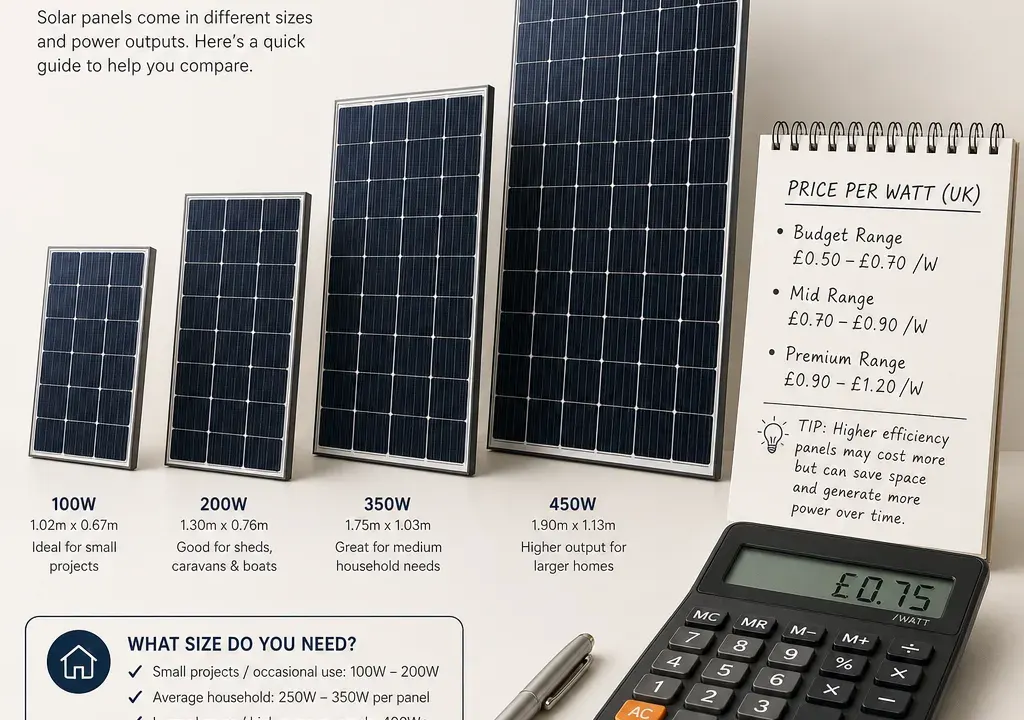
Price per watt is a useful shortcut when comparing Solar Panels because it links what you pay to the rated output you receive. Instead of looking only at the product price, you divide the current catalogue price by the panel’s wattage. The result helps you compare a compact 30W portable panel with a larger 240W module on a more even basis.
The calculation is simple: divide the current catalogue price by the rated watt output. For example, a 100W panel listed at £45.36 works out at about 45p per watt. A 240W panel listed at £99.99 works out at about 42p per watt.
Use the current selling price, not just the original price or discount percentage. Large discounts can be eye-catching, but they do not tell you whether the panel is good value against another panel with a different watt rating. If delivery, installation or essential accessories are not included, remember that your real ownership cost may be higher than the product price alone.
Only calculate price per watt where the product clearly states a watt rating for the panel. Some Solar Panels listings are really brackets, controllers, inverters, stabiliser kits or micro-cell parts. Those may be important in a solar setup, but they should not be compared with generating panels using a simple panel price-per-watt figure.
Using the supplied catalogue data, the Eco-Worthy 240W bifacial monocrystalline module listing at £99.99 works out at roughly 42p per watt. The Excel Compact 100W Solar Charger Adventurer at £45.36 works out at roughly 45p per watt. The Sodial 12V 30W portable panel at £15.40 works out at roughly 51p per watt.
The Renogy ShadowFlux Anti-Shading Solar Panel listing shows 200W and a catalogue price of £194.99, which works out at about 97p per watt if the 200W figure is the rated output being compared. Because the title also mentions four pieces, shoppers should check the product listing carefully to confirm whether the wattage shown is total output or per panel before making a like-for-like comparison.
These examples show why a lower product price is not always the lowest-cost output. A small 30W panel may be cheaper to buy than a 240W panel, yet cost more per watt. That does not make it a poor choice if you only need a compact portable panel, but it does mean you should compare it against other panels in the same use case rather than against larger home or leisure modules.
Several solar-related products in a Solar Panels catalogue will not be panels at all. Mounting brackets, charge controllers, inverters and hybrid inverter-chargers can be vital parts of a complete setup, but they do not generate power in the same way a panel does. A Victron Energy charge controller or a Huawei inverter should be assessed on compatibility, system rating and features, not on panel price per watt.
The same applies to small DIY kits and micro solar cells where the listing gives volts and amps rather than a clear panel watt rating. You may be able to estimate output from electrical specifications, but that is not as clean as comparing products with a published watt rating. If the listing does not clearly state watts, treat it as a separate type of purchase rather than forcing it into the same comparison.
A good comparison habit is to make two shortlists: one for generating Solar Panels and another for supporting equipment. Compare panels by price per watt, size, voltage and intended use. Compare accessories by whether they fit the panel, battery and installation you are planning.
Brand can influence price per watt because different listings may target different uses. A compact portable panel from one brand may cost more per watt than a larger fixed module from another, simply because small, portable products often prioritise convenience and packability over maximum output per pound. That can still be sensible if the panel is for camping, charging small devices or temporary use.
Panel type matters too. The catalogue examples include terms such as bifacial, monocrystalline, portable and anti-shading. These labels may point to different designs and intended applications, but you should still check the actual specification rather than assuming one type is automatically better value. A bifacial or anti-shading product may be attractive for a particular setup, but the right choice depends on where it will be used and what other equipment it must work with.
Size is also a practical constraint. A larger panel may achieve a lower price per watt, but it needs enough space, suitable mounting and safe positioning. If you are comparing Solar Panels for a shed, campervan, garden building or small off-grid setup, a slightly higher price per watt may be acceptable if the panel physically fits and suits the system voltage.
Discount percentages are useful as a signal that an offer may be worth checking, but they should not be the basis of your decision. A product with a high advertised discount can still have a higher price per watt than another panel with a smaller discount. It may also be an accessory rather than a panel, which makes the comparison invalid.
Look at the current catalogue price first, then rated wattage, then the product type. If two panels are similar in wattage and intended use, the lower price per watt may be the better value starting point. If they differ in size, portability, voltage or included components, the cheaper watt may not translate into the better purchase.
It is also worth comparing offers across retailers where available. Current prices can change, and availability may vary, so use price per watt as a snapshot for narrowing your shortlist rather than as a permanent ranking.
First, decide what the panel must power or support. A small portable charger, a leisure battery top-up and a larger fixed installation are different shopping problems. Once you know the intended use, compare only Solar Panels that are broadly suitable for that job.
Second, calculate price per watt for products with a clear watt rating. Write down the current catalogue price and the stated output, then divide price by watts. This quickly highlights whether you are paying more because the panel is compact, specialised or bundled with other features.
Third, check compatibility and completeness. A panel may still need a suitable charge controller, cabling, mounting hardware, inverter or battery depending on the system. If these are not included, factor them into your total cost before choosing between offers.
It depends on the panel size, type and intended use. In the supplied catalogue examples with clear watt ratings, figures range from around 42p per watt to around 97p per watt. Treat this as a comparison snapshot rather than a fixed benchmark, because current prices and product availability can change.
No. The lowest price per watt is useful, but it is not the whole decision. Check whether the panel fits your space, suits your voltage and setup, and needs extra equipment. Portable and specialist panels can cost more per watt while still being the right choice for a specific job.
Not in the same way. Inverters, charge controllers and mounting brackets do not generate power like a solar panel, so comparing them by panel price per watt is misleading. Assess them on compatibility, ratings and whether they suit the rest of your solar setup.
Check whether the wattage shown is the total output for the whole bundle or the output of each individual panel. If the listing is unclear, confirm the specification before calculating. Using the wrong wattage can make a bundle look much cheaper or more expensive per watt than it really is.
Price per watt is a strong first filter when comparing Solar Panels, especially when products have clear watt ratings and are aimed at a similar use. It helps you see past headline prices and focus on how much generating capacity your money buys.
Use it carefully: exclude accessories, confirm ambiguous wattage, and compare like with like. The best shortlist usually balances price per watt with panel type, physical size, system compatibility and the total cost of any extras needed to make the setup work.
