
Loading buyer guide
Hurry, don't miss savings on selected furniture & more.* Shop all offers
Brand names help narrow the search, but solar panel listings need a closer look. Compare EcoFlow and Jackery options against wattage, portability, compatibility and bundle contents before deciding.
Use our barcode scanner to match products instantly to find the best prices, find products with ease using our voice search and build wish lists and your favourites at the click of a button.
Best solar panels for campervans
Campervan solar works best when the panel, controller, cabling and mounting style all suit the way you travel. Compare wattage, roof space, kit contents and connector compatibility before chasing the biggest discount.
Best solar panels for small roofs
A small roof does not automatically mean solar is off the table. The key is comparing wattage, footprint, panel type, weight and supporting equipment together, rather than chasing the largest headline output.
Renogy vs Victron Energy solar panels
Renogy and Victron Energy often appeal to different solar shoppers: one is easier to compare around panel bundles, while the other is strongest when you are building a broader power system around charge control and inverter hardware.
JA Solar vs Renogy solar panels
JA Solar and Renogy often suit different solar shoppers: one is usually considered for fixed roof or commercial-style arrays, while the other is commonly browsed for off-grid, vehicle, camping and smaller DIY set-ups. The right choice depends less on the logo and more on wattage, panel format, installation plans, warranty terms and live retailer availability.
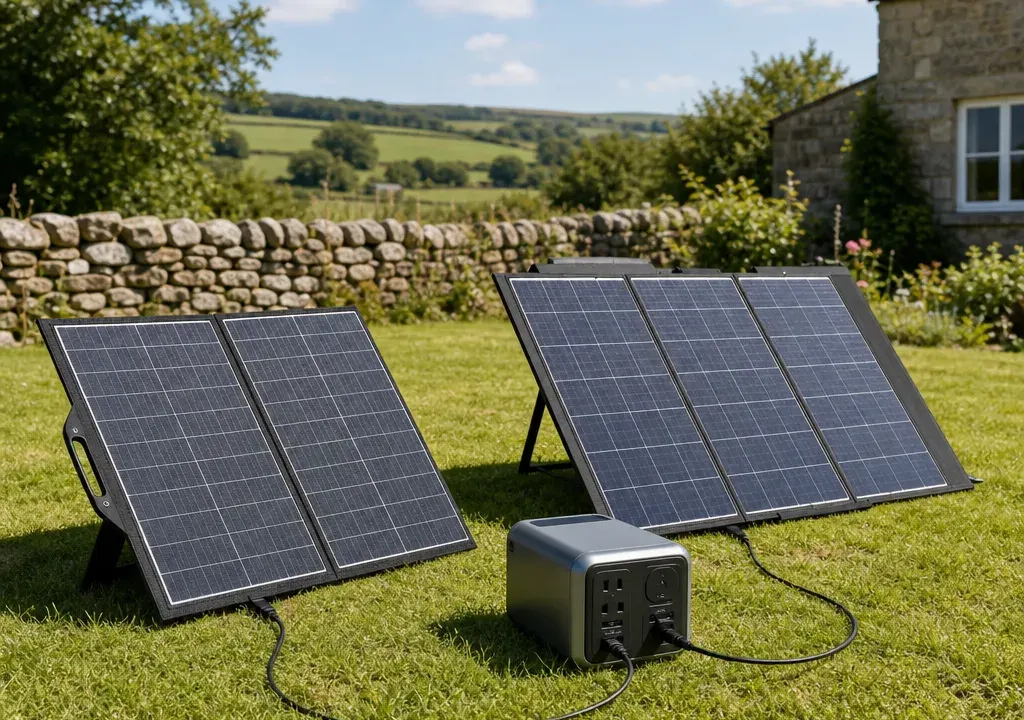
EcoFlow vs Jackery solar panels is a comparison many shoppers make when they want portable solar charging for camping, garden use, touring, backup power or off-grid top-ups. The brand matters, but it should not be the first or only filter. A better decision comes from comparing the exact panel listing in front of you.
Use EcoFlow and Jackery as your shortlist, then judge each offer by output, design, compatibility and what is actually included. The cheapest listing is not always the best value, and the highest wattage is not always the easiest to live with.
Before comparing EcoFlow and Jackery, decide whether you need a portable charging panel or part of a more permanent solar set-up. A foldable panel for a power station is a different purchase from a roof-mounted module, a DIY micro panel or a charge controller.
For occasional camping, festival use or garden charging, portability, folded size, handle design and connector compatibility may matter more than maximum output. For longer trips or larger power stations, wattage and bundle contents become more important.
Catalogue examples show how varied Solar Panels listings can be. A 30W portable panel, a compact 100W charger and a 240W two-panel kit are not solving the same problem. Accessories such as mounting brackets, inverters and MPPT charge controllers may appear alongside panels, but they are supporting components rather than direct alternatives to a foldable EcoFlow or Jackery panel.
Wattage is usually the first specification to compare, but it only helps when the listings are genuinely similar. A 100W portable charger should be compared with another portable panel around the same output, not with a small DIY cell kit or a multi-panel home-style bundle.
In the supplied Solar Panels catalogue context, there are examples such as a compact 100W solar charger, a 12V 30W portable panel and a 240W bifacial two-panel kit. Those figures show why it is worth filtering carefully: the right wattage range depends on whether you are topping up small devices, charging a portable power station, or contributing to a larger off-grid system.
When comparing EcoFlow and Jackery listings, check the stated rated power, whether the figure applies to one panel or a pair, and whether the listing is for a single item or a bundle. If one option looks unusually good value, confirm that the wattage and included contents match what you expect.
For portable use, the design is often as important as the headline wattage. A rigid panel may offer strong output for its size category, but a foldable panel can be easier to pack, carry and position. If you are comparing EcoFlow vs Jackery solar panels for a power station, look closely at folded format, stand design, cable storage and how easily the panel can be angled towards the sun.
Do not assume every Solar Panels listing is built for the same lifestyle. Some listings are clearly portable chargers, while others are solar modules, brackets or electrical system components. The product title can give useful clues, but it is still worth checking the retailer’s full specification before buying.
A foldable panel may make sense if you need quick setup and storage. A rigid or semi-permanent panel may be more suitable if the panel will stay in one place, such as on a shed, outbuilding or vehicle installation, alongside relevant Floor, Wall & Roofs considerations.
Some solar panel listings include a stated conversion efficiency, while others do not. Where it is available, use it as one comparison point rather than the whole decision. Efficiency can help you understand how effectively a panel is designed to convert sunlight into usable electricity, but real-world output still depends on sunlight, angle, shade, temperature and the device being charged.
When comparing EcoFlow and Jackery, give more weight to efficiency if the panels are similar in wattage, size and design. If one listing states efficiency and another does not, that does not automatically make it better; it simply gives you one more piece of information to assess.
Be cautious with vague claims. A useful listing should make it reasonably clear what the panel is, what output is being claimed, and what devices or systems it is intended to support.
Compatibility can make or break a portable solar purchase. A panel that does not connect cleanly to your power station may need an adaptor, and not every adaptor is included in the box. When comparing EcoFlow vs Jackery solar panels, check connector type, cable length, polarity, input limits and whether any adapter is supplied.
Do not rely on brand names alone. If you already own a power station, its solar input specification should guide your shortlist. Match the panel’s output and connector support to the device, rather than buying a panel first and solving compatibility later.
Bundle listings can be useful here, but only if the bundle includes the parts you actually need. A listing that includes cables or a compatible connector may be better value than a lower-priced panel that needs extra purchases. Equally, a bundle with accessories you will not use may not be the best deal.
Solar Panels listings can show large discounts, but a discount is only useful if the product fits your needs. The supplied catalogue includes examples with strong displayed reductions across panels, accessories and system components, from small DIY solar boards to larger electrical hardware. These are not all comparable products, so a percentage saving should not be treated as a ranking on its own.
When weighing EcoFlow and Jackery offers, compare the current selling price against the wattage, included accessories, portability and compatibility. A lower-priced panel may be better for occasional top-ups, while a higher-output bundle may make sense if it replaces several separate purchases.
Also check whether the offer is for a panel only, a pair of panels, a power-station bundle, a cable kit or a separate component such as an inverter or charge controller. Misreading the listing type is one of the easiest ways to make a poor-value purchase.
Choose the EcoFlow or Jackery option that fits your existing equipment first. If you already own a power station from one brand, a compatible panel from the same ecosystem may be the simplest route, provided the listing confirms the right connectors and input range. If you are starting from scratch, compare the full bundle rather than the panel alone.
Choose by use case next. For easy transport, prioritise foldable construction and manageable wattage. For faster charging in good sunlight, compare higher-wattage options, but check size and setup effort. For mixed home and outdoor use, consider whether you need a portable panel, a more fixed module, or supporting equipment.
Finally, choose by total value. The better buy is the listing that gives you the right output, design and compatibility at a sensible price, not necessarily the one with the biggest discount badge. Use the wider Solar Panels category to compare current products and offers across wattage bands before committing.
Neither brand is automatically the better choice for every shopper. Compare the exact listings by wattage, foldable design, connector support, stated efficiency where available, bundle contents and value. The best option is the one that works with your equipment and intended use.
Start with the power station’s solar input specification, then choose a panel within that supported range. Smaller wattages may suit light top-ups and portability, while higher-wattage panels can be more suitable for larger power needs if they remain compatible.
A bundle can be good value if it includes the cables, adapters or compatible equipment you need. A panel-only listing may be better if you already own the right accessories. Always compare the total cost and the contents rather than the headline price alone.
A foldable panel is useful if you plan to carry, store and reposition it regularly. If the panel will stay in one place, a rigid module or a more permanent solar set-up may be more appropriate.
Solar catalogues often include complete panels, accessories and electrical system components together. Inverters, MPPT charge controllers and mounting brackets can be important parts of a solar set-up, but they are not direct substitutes for a portable panel.
EcoFlow vs Jackery is a useful starting point, but the smarter comparison is listing against listing. Check wattage, foldable design, stated efficiency, connector support, bundle contents and the real usefulness of any offer.
If two options look close, choose the one that is easiest to connect to your existing equipment and most realistic for how you will use it. In Solar Panels, the right product is rarely just the biggest, cheapest or most heavily discounted one; it is the one that fits your power needs without adding avoidable complexity.
