
Loading buyer guide
Hurry, don't miss savings on selected furniture & more.* Shop all offers
Choosing between rigid and flexible solar panels is really a question of where the panel will live, how often it will move, and how much output you expect from the available space.
Use our barcode scanner to match products instantly to find the best prices, find products with ease using our voice search and build wish lists and your favourites at the click of a button.
Best solar panels for campervans
Campervan solar works best when the panel, controller, cabling and mounting style all suit the way you travel. Compare wattage, roof space, kit contents and connector compatibility before chasing the biggest discount.
Ecoflow vs Jackery solar panels
EcoFlow and Jackery are often compared by shoppers looking for portable solar charging, but the best choice depends on the listing details: wattage, foldability, connector support, stated efficiency, bundle contents and the real value of any offer.
Best solar panels for small roofs
A small roof does not automatically mean solar is off the table. The key is comparing wattage, footprint, panel type, weight and supporting equipment together, rather than chasing the largest headline output.
Renogy vs Victron Energy solar panels
Renogy and Victron Energy often appeal to different solar shoppers: one is easier to compare around panel bundles, while the other is strongest when you are building a broader power system around charge control and inverter hardware.
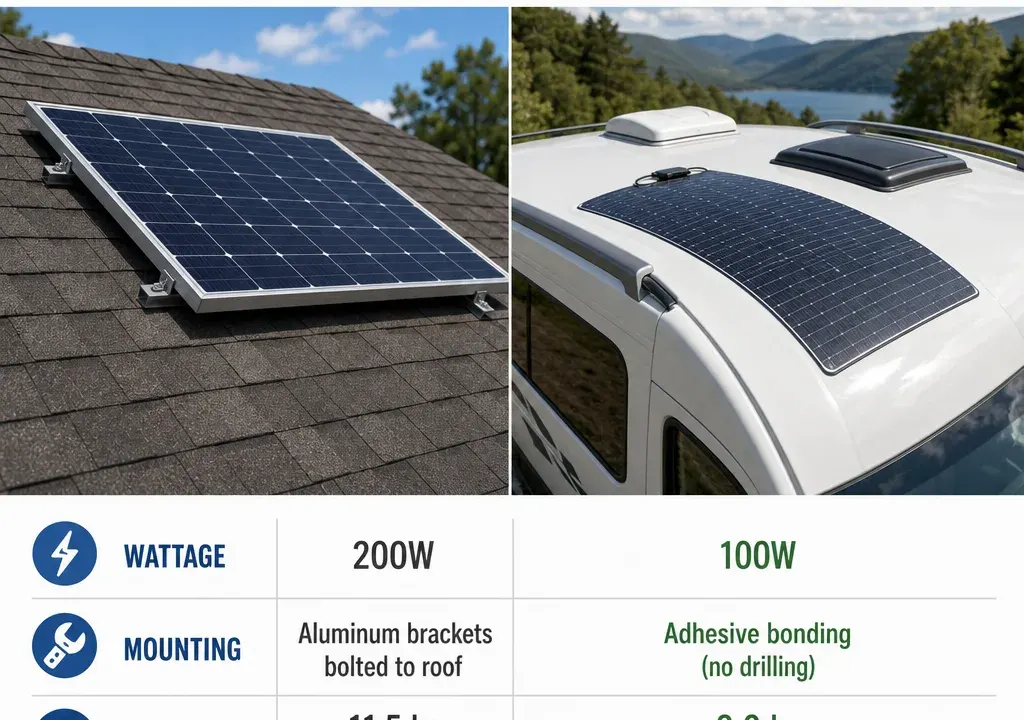
Rigid and flexible solar panels can look similar in product listings, but they are bought for quite different reasons. A rigid panel is typically considered when you want a stable, permanent installation. A flexible panel is often compared for mobile use, curved surfaces or places where a lower profile matters.
The most useful way to choose is not to start with the cheapest offer. Start with the job: a fixed roof, a shed, a campervan, a boat, a portable charging setup or a small DIY electronics project will all point towards different specifications. In Solar Panels, you will also see related kit such as brackets, charge controllers and inverters, so it is worth checking whether the listing is a panel, a full kit or an accessory.
Choose a rigid solar panel if you have a flat or framed mounting area, want a more conventional fixed setup and are comparing higher wattage panels for regular generation. Rigid listings often suit roofs, frames, outbuildings and other installations where the panel can be securely mounted and left in place.
Choose a flexible solar panel if the surface is curved, weight is a major concern or you need something easier to position temporarily. Flexible panels are often considered for campervans, boats, camping setups and low-profile installations, although you should always check the manufacturer’s mounting guidance rather than assuming any panel can bend to any shape.
If you are not sure which type a listing is, look beyond the product title. Product images, stated thickness, weight, mounting holes, frame details and included fixings can tell you whether it behaves more like a rigid module, a portable charger or a flexible sheet-style panel.
Solar Panels listings can include full-size generation panels, compact portable chargers, tiny photovoltaic boards, brackets, stabilisers, charge controllers and inverters. These are not interchangeable purchases, even when they appear in the same category.
For example, a small micro solar board with wires is more relevant to DIY electronics than to powering a shed or campervan. A set of aluminium mounting brackets is useful only if you already have or are buying compatible panels. A charge controller or inverter may be essential in a wider system, but it is not a solar panel by itself.
Before weighing up rigid versus flexible, confirm three basics: whether it is actually a panel, whether it includes the accessories you expect, and whether its voltage and wattage match the rest of your setup. This prevents a cheap-looking offer from becoming poor value because extra components are needed later.
Wattage is one of the clearest ways to compare Solar Panels, but it only helps when matched to use. A 30W portable panel is aimed at much lighter tasks than a 100W compact charger, and both sit in a different buying bracket from multi-panel or higher-output home and off-grid system components.
Listings in the comparison set include examples such as compact 100W solar charger products, 12V 30W portable panel listings, a 240W two-panel bifacial set described as two 120W 12V monocrystalline modules, and a 200W multi-piece panel listing. Those numbers are useful anchors, but they do not replace checking the full specification, connectors and compatible controllers.
If you only need occasional battery topping-up, a lower-wattage portable option may be easier to store and position. If you are building a more permanent system, compare total panel wattage, available mounting area and the other electrical components required. A higher wattage panel can still be the wrong choice if it does not fit, cannot be mounted safely or needs additional kit you have not budgeted for.
Weight matters most when the panel is going on a vehicle, boat, lightweight roof, portable frame or temporary setup. Flexible panels are often considered because they may be easier to handle and can sit closer to the surface, but you should compare the listed weight and thickness rather than relying on the word flexible alone.
Rigid panels may be thicker and heavier because of their frame and protective construction. That can be an advantage for fixed mounting where a stable frame is useful, but it can be less convenient if you need to lift, move or reposition the panel regularly.
When comparing offers, look for stated panel weight, thickness, frame material, fixing points and whether the listing shows the panel as framed or frameless. If these details are missing, treat the listing cautiously, especially for roof, wall or vehicle use where the physical specification affects installation.
For permanent roof or frame mounting, rigid solar panels are usually easier to understand because the listing often shows a framed module with standard-looking fixing points. You may still need separate brackets, rails, cables or a controller, so compare what is included carefully.
For vans, boats and curved surfaces, flexible panels can be appealing because of their lower profile and ability to follow some contours. However, the important detail is the listed bend tolerance and installation method. Do not assume every flexible panel can be sharply curved, walked on or bonded to every surface unless the product specification clearly supports that use.
For portable use, compact solar chargers and folding-style products may be more practical than either a full rigid panel or a permanently installed flexible panel. A compact 100W charger listing, for instance, should be assessed on portability, connectors and storage as much as output.
Durability claims in Solar Panels listings can sound reassuring, but compare the specific wording. Look for stated materials, weather-resistance wording, frame construction, surface protection and any limits on use. Avoid treating broad phrases such as heavy duty or outdoor as proof that a panel suits every installation.
Rigid panels may claim strength through their frame or glass construction, while flexible panels may focus on lightness, bendability or portable use. Neither is automatically more durable for every buyer. A rigid panel can be poor for a curved surface; a flexible panel can be a poor choice if it is repeatedly flexed beyond its intended use.
Also separate panel durability from system durability. Brackets, sealants, wiring, controllers and inverters all affect how reliable a setup is. When a listing is for an inverter, controller or bracket set, judge it as a system component rather than comparing it directly with a panel.
Solar panel prices can vary widely because the listings cover everything from small DIY photovoltaic boards to higher-output panels and specialist electrical components. A low-cost item may be excellent value for a small project but irrelevant for a permanent power setup. A more expensive item may be reasonable if it includes higher wattage, multiple panels or essential system hardware.
Displayed discounts can be useful as a signal to investigate, but they should not drive the decision on their own. Compare the live offer against wattage, panel type, included accessories, retailer availability and whether you will need to buy mounting hardware or charge control separately.
A simple value check is to ask: what usable wattage am I getting, will it physically fit, can I mount it properly, and is it compatible with the rest of my system? If one of those answers is unclear, the cheapest listing may not be the best buy.
Availability matters because Solar Panels purchases often depend on matching parts. If you need panels, brackets and a controller, it is frustrating to find that one key component is out of stock or only available from a different seller with different delivery timings.
When comparing products and offers, check whether the panel itself is available, whether variations such as wattage or pack size are selectable, and whether accessories are separate listings. Multi-piece listings can look attractive, but make sure the quantity, individual panel wattage and total stated wattage are clear.
If your project also involves structural or surface decisions, it may be worth comparing related Floor, Wall & Roofs products separately so the mounting surface, fixings and panel choice work together.
Buy a rigid solar panel if you want a fixed installation, have a suitable flat mounting area, and are comparing panels mainly by output, frame quality, mounting compatibility and long-term placement.
Buy a flexible solar panel if your priority is lower weight, lower profile or use on a surface where a framed panel is impractical. Pay close attention to the stated bend limits, installation instructions, thickness and surface compatibility.
Buy a portable solar charger or compact panel if you want occasional power on the move and value easy storage over permanent installation. Buy small solar boards only for DIY electronics-style projects, not as a substitute for a larger panel system.
For most shoppers, the best choice is the panel type that fits the location first, then meets the wattage requirement, then offers the best value once accessories and availability are included.
Not always. Rigid panels are often better suited to fixed, flat installations, while flexible panels can be better for lighter, lower-profile or curved-surface use. The right choice depends on mounting location, wattage, weight, thickness and the product’s stated installation guidance.
Not automatically. Higher wattage is useful only if the panel fits the space, can be mounted correctly and works with the rest of your system. For portable charging or small projects, a lower-wattage product may be more practical.
Check the stated weight, thickness, bend guidance, mounting method, connectors, wattage and any durability wording. Do not assume a flexible panel can be bent sharply or installed on any surface unless the specification says so.
Solar power setups often need brackets, controllers, inverters and cables, so they can appear in the same shopping journey. Always confirm whether a listing is a panel, a kit or an accessory before comparing value.
Compare the live offer by panel type, wattage, physical size, weight, mounting use, included accessories, compatibility and availability. Discounts can be worth noticing, but they should not outweigh whether the product actually suits your project.
Rigid versus flexible solar panels is not a one-size-fits-all decision. Rigid panels make most sense when the installation is stable, flat and output-led. Flexible panels are more compelling when weight, profile and surface shape are the deciding factors.
Before buying, compare the full listing rather than just the headline price: wattage, thickness, weight, mounting requirements, durability claims, included parts and availability all affect real value. That approach will help you choose a Solar Panels product that fits the project, not just the basket.
