
Loading buyer guide
Hurry, don't miss savings on selected furniture & more.* Shop all offers
Panel technology can influence output and space efficiency, but a smart comparison also checks wattage, stated efficiency, dimensions, accessories and whether the listing is actually a panel, kit, controller or inverter.
Use our barcode scanner to match products instantly to find the best prices, find products with ease using our voice search and build wish lists and your favourites at the click of a button.
Best solar panels for campervans
Campervan solar works best when the panel, controller, cabling and mounting style all suit the way you travel. Compare wattage, roof space, kit contents and connector compatibility before chasing the biggest discount.
Ecoflow vs Jackery solar panels
EcoFlow and Jackery are often compared by shoppers looking for portable solar charging, but the best choice depends on the listing details: wattage, foldability, connector support, stated efficiency, bundle contents and the real value of any offer.
Best solar panels for small roofs
A small roof does not automatically mean solar is off the table. The key is comparing wattage, footprint, panel type, weight and supporting equipment together, rather than chasing the largest headline output.
Renogy vs Victron Energy solar panels
Renogy and Victron Energy often appeal to different solar shoppers: one is easier to compare around panel bundles, while the other is strongest when you are building a broader power system around charge control and inverter hardware.
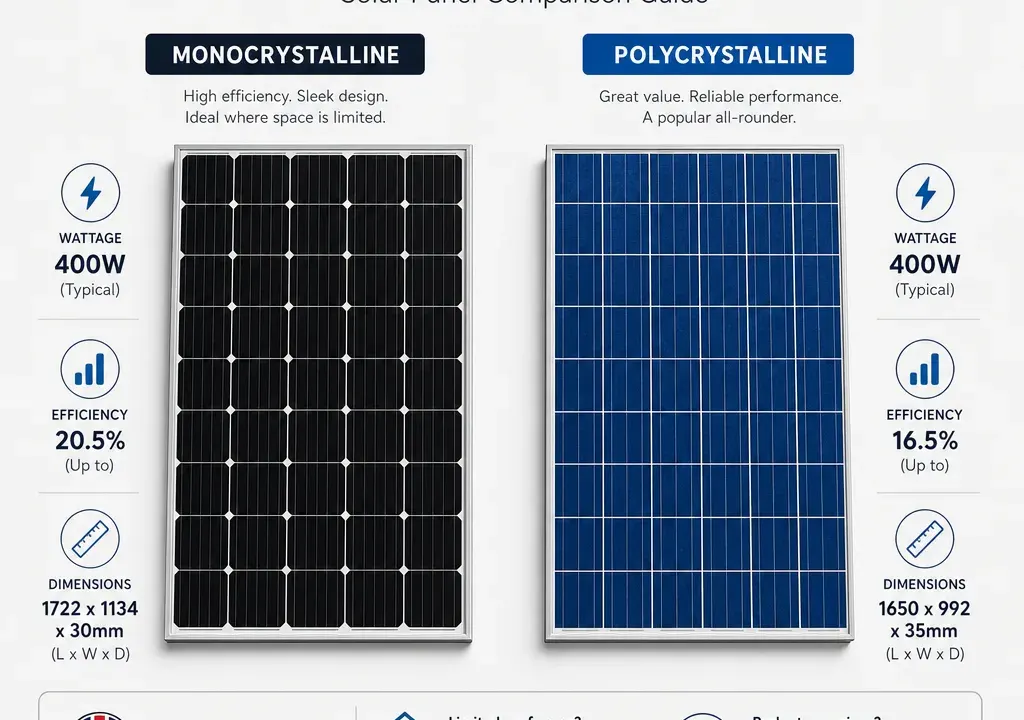
Monocrystalline and polycrystalline solar panels are often compared as if the technology alone decides the best buy. In practice, a good choice comes from reading the product specification carefully and comparing like with like. A 200W panel, a 30W portable panel, a micro solar board and a charge controller are not interchangeable, even if they all appear in Solar Panels search results.
Start with the product title and specification. If a listing says “monocrystalline”, as with the Eco-Worthy 240W Solar Panel Bifacial 2pcs 120 Watt 12 Volt Monocrystalline Generation Module, you can treat that as the stated technology for comparison purposes. If the title does not state the cell type, do not assume it is mono or poly from price, colour or wattage alone.
Polycrystalline panels are usually labelled as such in the product specification or description. If the technology is missing, compare the listing on the information that is stated, then decide whether you are comfortable buying without confirmation. For fitted systems or space-limited setups, an unstated cell type may be enough reason to keep comparing products.
Also separate actual panels from related solar equipment. In the supplied catalogue examples, items such as the Victron Energy Smart Solar MPPT charge controller, Huawei inverter and Victron MultiPlus-II units are part of a solar power setup, but they are not solar panels. Mounting brackets and stabiliser kits are accessories. They can be essential, but they should not be compared against panels on wattage or efficiency.
Monocrystalline panels are commonly chosen when shoppers want strong output from limited space, but the individual product specification still matters more than the category label. A compact mono panel with lower wattage may not suit the same job as a larger panel with a higher stated output.
Polycrystalline panels can be worth considering where there is more mounting space and the total system value looks favourable. However, a poly panel with incomplete specifications is harder to judge than a mono panel with clear wattage, dimensions, voltage and stated efficiency.
The safest comparison is not “mono is better” or “poly is cheaper”. It is “which product gives the required output, fits the available space, works with the rest of the system and is available from a suitable retailer?” That approach avoids overpaying for a label or underbuying for the job.
Wattage is the headline figure most shoppers notice first. In the catalogue sample, panel-related examples include small micro solar boards, a 12V 30W portable solar panel, a compact 100W solar charger, 200W panel products and a 240W bifacial monocrystalline pair made up of two 120W modules. Those products are intended for very different uses.
For trickle charging, hobby projects or lightweight portable use, lower-wattage products may be relevant. For more demanding off-grid power, caravan, shed or home energy projects, you will normally be comparing higher-wattage panels and the controller, inverter and battery compatibility around them.
When comparing Solar Panels, check whether the wattage is per panel or for the whole kit. A listing may describe two panels together, four pieces, or a complete bundle. Divide the stated output by the number of panels if you need to compare panel-for-panel value.
Efficiency is useful only when it is clearly stated and measured in a comparable way. If a listing does not provide a stated efficiency figure, do not fill in the gap yourself. Instead, use the available data: wattage, dimensions, panel type, voltage and included components.
Efficiency matters most when space is tight. If two panels have similar wattage but one is much smaller, the smaller panel may be the more space-efficient option, assuming the specification is accurate and complete. If you are fitting panels to a roof, van, boat, shed or balcony frame, size and mounting constraints can be just as important as the cell type.
For larger installations, overall system design may matter more than a small difference in panel efficiency. Inverters, charge controllers, shading, orientation and batteries can all affect whether the setup meets your needs, so avoid choosing a panel in isolation if it will be part of a broader solar system.
A product can look good on wattage and price, but still be wrong if it does not fit. Always check length, width, thickness and mounting requirements before deciding. This is especially important for portable kits, campervans, narrow roof spaces and garden buildings.
The supplied examples include panels, chargers and accessories with very different intended uses. A compact 100W solar charger should not be judged in the same way as a set of rigid panels, and micro solar boards are not a substitute for household-scale panels. Compare dimensions only within the same type of product.
Mounting hardware should also be checked separately. For example, solar panel mounting brackets may be listed in the wider Solar Panels category, but they do not add generation capacity. Make sure bracket sizes, panel frame thickness and installation method match the panel you choose.
Discounts can be useful signals, but they should not be the main reason to buy. A heavily reduced accessory, controller or inverter is not automatically a better solar panel deal than a modestly discounted panel. First confirm what the product actually is, then compare it with similar products.
For panels, look at the cost in relation to stated wattage, technology, size, included cables, number of panels and compatibility with the system you are building. A lower-priced low-wattage panel may be good value for a small task and poor value for a larger energy requirement.
Catalogue prices and offers can change, so use them as comparison signals rather than fixed facts. If two products are close on wattage and type, the stronger offer may be the one with clearer specifications, suitable availability and the accessories you actually need, not simply the largest percentage discount.
Availability is not just whether an item appears in stock. It also includes whether the product type you need is easy to compare. In the supplied product sample, monocrystalline technology is explicitly stated on at least one panel listing, while many other listings do not declare the cell type in the title. That means shoppers may need to open the full specification before deciding whether they are comparing mono, poly or another type of product.
If you specifically want monocrystalline or polycrystalline Solar Panels, filter and compare listings where the technology is stated. If there are fewer clearly labelled options in your preferred type, widen the comparison to include wattage, dimensions and compatibility rather than buying the first listing that uses the right term.
Retailer availability can also vary between single panels, multipacks, portable chargers, controllers and accessories. A panel that is available as a pair or four-piece kit may suit one project but be awkward for another if you only need one module or have limited mounting space.
Choose monocrystalline if the listing clearly states the technology, the wattage suits your energy needs, the dimensions fit your available space and the value looks sensible against comparable panels. It is particularly worth considering when panel area is limited and the product specification is complete.
Consider polycrystalline if the product is clearly labelled, the panel size is acceptable, the wattage meets your requirement and the overall offer compares well against similar panels. Do not assume it is the budget choice unless the actual product data supports that conclusion.
Keep comparing if the listing is unclear. Missing cell type, missing dimensions, uncertain kit contents or confusing product titles make it harder to judge value. In Solar Panels, the best buy is usually the one with the clearest match to your installation, not the one with the most eye-catching headline.
Not always. Monocrystalline panels are often chosen for space-conscious setups, but the right choice depends on the stated wattage, efficiency, dimensions, compatibility, availability and price of the actual products you are comparing.
Check the product title and specification for terms such as monocrystalline or polycrystalline. If the listing does not state the technology, do not assume it from the appearance or price alone.
Price per watt can be a useful starting point, but it is not enough on its own. Also compare dimensions, voltage, included accessories, panel count, stated efficiency and whether the item is a panel, kit, controller or accessory.
It depends on the setup. Portable chargers, small panels and larger off-grid systems can have different requirements. Check the panel specification and make sure any controller, inverter or battery equipment is compatible before buying.
No. Higher wattage may help if you need more output, but the panel still needs to fit the available space, work with your system and suit your intended use. For small portable jobs, a lower-wattage option may be more practical.
Monocrystalline vs polycrystalline is a useful comparison, but it should be the start of your decision rather than the whole decision. Identify the technology from the specification, then compare wattage, stated efficiency, dimensions, kit contents and availability across products that genuinely do the same job.
When browsing Solar Panels, separate panels from accessories and system components, treat discounts as value signals rather than proof of quality, and favour listings with clear, comparable specifications. That is the most reliable way to choose a panel that suits your space, setup and budget.
