
Loading buyer guide
Hurry, don't miss savings on selected furniture & more.* Shop all offers
A 100W panel can be easier to carry, store and position, while a 200W panel may suit shoppers who want more charging capacity from fewer panels. Here’s how to compare the options using catalogue clues such as wattage, format, accessories and offer availability.
Use our barcode scanner to match products instantly to find the best prices, find products with ease using our voice search and build wish lists and your favourites at the click of a button.
Best solar panels for campervans
Campervan solar works best when the panel, controller, cabling and mounting style all suit the way you travel. Compare wattage, roof space, kit contents and connector compatibility before chasing the biggest discount.
Ecoflow vs Jackery solar panels
EcoFlow and Jackery are often compared by shoppers looking for portable solar charging, but the best choice depends on the listing details: wattage, foldability, connector support, stated efficiency, bundle contents and the real value of any offer.
Best solar panels for small roofs
A small roof does not automatically mean solar is off the table. The key is comparing wattage, footprint, panel type, weight and supporting equipment together, rather than chasing the largest headline output.
Renogy vs Victron Energy solar panels
Renogy and Victron Energy often appeal to different solar shoppers: one is easier to compare around panel bundles, while the other is strongest when you are building a broader power system around charge control and inverter hardware.
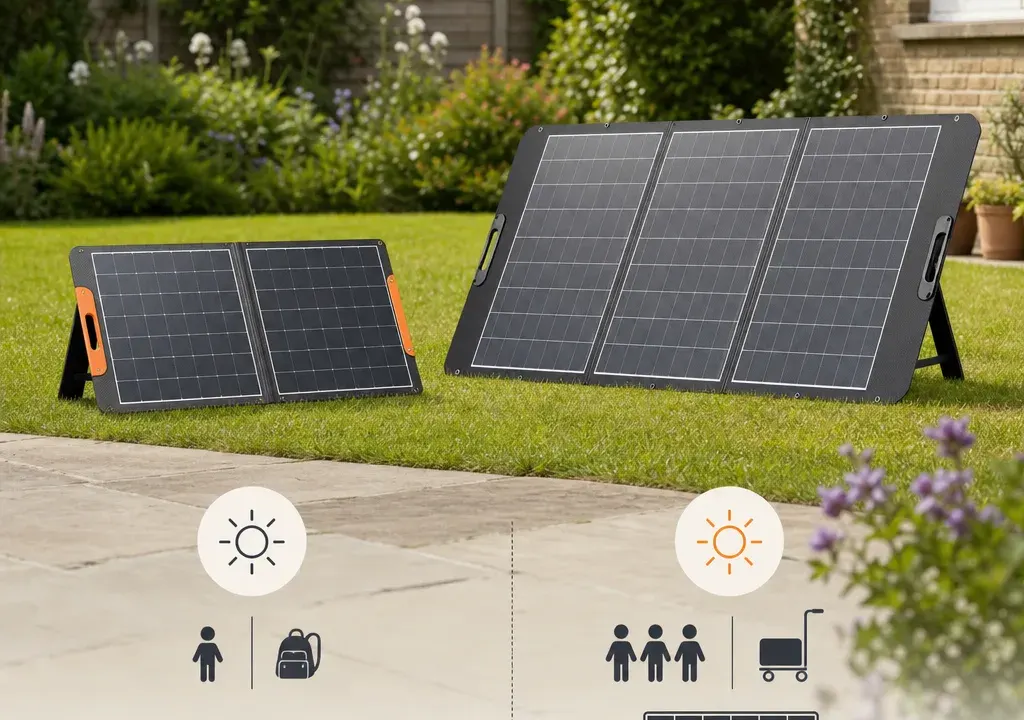
If you are comparing Solar Panels, the jump from 100W to 200W is one of the most common decision points. A 100W panel can look appealing because it is usually easier to store, carry and place. A 200W panel, or a kit made up of panels that reach around 200W, may be more suitable if you want higher potential output and have enough space to use it properly.
The important word is potential. A wattage rating helps you compare panels, but it is not a promise of what you will get in every setting. Shade, angle, weather, cable length, charge controller choice and the device or battery you are charging can all affect real-world results. That means the best choice is not always the highest wattage; it is the panel that fits your space, setup and expectations.
Choose a 100W solar panel if portability, simple storage and lower upfront spend are your main priorities. In the supplied catalogue data, an Excel Compact 100W Solar Charger Adventurer appears as a lower-cost example than the larger 200W and multi-panel kits. That does not automatically make it better value for every buyer, but it shows why 100W panels often attract shoppers who want a more manageable entry point.
Choose a 200W solar panel if you have more space, want more potential charging capacity and are comfortable with a larger or multi-panel arrangement. The catalogue includes a Renogy ShadowFlux Anti-Shading Solar Panel 200W 4 Pieces listing and an Eco-Worthy 240W bifacial listing made up of two 120W panels. These examples show that higher-output options are not always a single physical panel; they may be kits or paired modules.
If you are buying for occasional device charging, camping, a shed battery or light seasonal use, a 100W option may be enough to consider. If you are comparing panels for a more demanding battery setup, longer off-grid stays or faster charging potential, 200W is usually the more relevant shortlist. Always check compatibility with your battery, charge controller, inverter and cables before buying.
The wattage rating is a useful comparison shorthand. A 200W panel is rated for twice the power of a 100W panel under standard test conditions, so it has higher output potential. However, catalogue wattage is not the same as guaranteed everyday output. In UK use, light levels and panel positioning can vary significantly throughout the year.
For shoppers, the wattage decision should start with the job the panel needs to do. If you are topping up a portable power station, maintaining a small 12V battery or charging modest devices, 100W may be a sensible size to compare. If you are trying to recover battery capacity more quickly or support several loads through a suitable system, 200W gives more headroom.
Be careful when comparing full panels with accessories or components. The supplied catalogue includes items such as a solar panel stabiliser DIY kit, mounting brackets, a charge controller and inverters. These may be important parts of a solar setup, but they are not directly comparable with a 100W or 200W panel. When browsing Solar Panels, filter or read titles carefully so you are comparing panel output against panel output.
The supplied catalogue data shows a wide spread of prices because the category includes compact panels, larger panel kits and separate electrical components. At the lower end, small DIY solar boards and stabiliser kits appear, but these are not alternatives to a proper 100W or 200W panel. Among more relevant examples, the Excel Compact 100W Solar Charger Adventurer is listed in the catalogue snapshot at £45.36, while the Renogy 200W four-piece listing appears at £194.99. The Eco-Worthy 240W two-piece listing appears at £99.99 in the same supplied data.
Those figures are useful as catalogue context, not as a guarantee of what you will see when you shop. Offers can change, and a lower price may reflect a different format, included accessories, brand positioning or stock status. Before choosing, compare the live product page, what is included in the box, the wattage, panel type, connector details and whether you need extra mounting or control equipment.
A simple way to compare value is to divide the offer price by the rated watts, but do not stop there. A cheaper panel that needs extra cables, brackets or a controller may not be cheaper once your full setup is complete. Similarly, a higher-output kit may look expensive until you consider that it could reduce the number of separate panels you need.
Dimensions and weight are often where the 100W versus 200W decision becomes practical. The supplied catalogue examples do not provide verified dimensions or weights, so it would be unhelpful to guess. Instead, treat size and weight as must-check specifications before adding any panel to your basket.
As a general buying principle, if two panels use similar construction and technology, the higher-output panel usually needs more surface area. That means a 200W option may be longer, wider, heavier or supplied as multiple panels compared with a 100W alternative. Foldable designs, framed rigid panels and multi-piece kits can all feel very different in use, even when the wattage looks similar on paper.
Measure where the panel will be used, not just where it will be stored. For a garden, shed roof, campervan, balcony-style area or temporary outdoor pitch, you need enough clear space to position the panel effectively. If you are carrying it regularly, also check packed size, handle design if shown, and whether the product is a rigid panel or a portable charger format.
Portability is one of the strongest reasons to stay around 100W. A compact 100W panel or solar charger can be easier to move around a garden, pack for a trip or reposition during the day. If your use is occasional and you value convenience, a smaller panel may be used more often simply because it is less effort to set up.
A 200W setup can still be portable, especially if it is split into smaller sections or designed as a folding kit. The Renogy 200W listing in the supplied data is described as four pieces, which suggests shoppers should look closely at how the kit is configured rather than assuming it behaves like one large panel. Multi-piece kits can be flexible to arrange, but they may involve more connections and more setup time.
For any portable Solar Panels, check whether the listing clearly shows the output ports or connectors, whether a controller is included, and whether your power station or battery system accepts the panel’s voltage and connector type. If those details are missing, compare another listing with clearer specifications rather than relying on the headline wattage alone.
The supplied data includes products from several retailers and a mix of panel types, kits and related components. That variety is useful because it reflects how Solar Panels are often merchandised: a shopper searching for panels may also see brackets, charge controllers, inverters and small hobby solar boards. Availability across multiple retailers can give you more comparison points, but it also increases the risk of comparing unlike-for-like products.
Use the product title as a first filter. Words such as 100W, 200W, 240W, 12V, monocrystalline, portable, bifacial, charger, controller or inverter all point to different buying considerations. A charge controller from Victron Energy or an inverter from Huawei or Victron Energy may be relevant to a wider setup, but it should not be weighed against a panel as though it produces solar power itself.
Discount labels and merchandising signals can help you spot offers worth checking, but they should not decide the purchase on their own. A large percentage discount is only meaningful if the product is the right type, includes what you need and has the specifications to suit your setup. For comparison-led shopping, shortlist by wattage and format first, then compare offers.
A 100W panel is usually the more sensible starting point if you are new to solar charging and want to keep the setup straightforward. It can suit shoppers who are comparing options for small-scale use, occasional outdoor charging or topping up a compatible battery without committing to a larger installation.
It may also be the better choice where space is limited. If the only available position is a small shed roof, a narrow outdoor area or a temporary pitch where you must move the panel frequently, a lower-output but more manageable option can be more practical than a larger panel that is awkward to place.
The trade-off is patience and capacity. If your battery is larger, your daily energy use is higher, or you want more charging headroom in weaker light, you may quickly find yourself comparing 200W options instead.
A 200W panel or kit is worth considering when you already know your solar use will be more demanding. It gives you more rated output to work with and may reduce the need to buy multiple smaller panels. For shoppers building around a leisure battery, power station or broader off-grid arrangement, 200W is often a more realistic comparison point than 100W.
It can also make sense if you have good placement space. Higher output is only useful if the panel can be positioned well and connected safely to compatible equipment. If the panel will be shaded, poorly angled or inconvenient to set up, the theoretical advantage over 100W may be less useful in practice.
Check whether the 200W product is a single panel, a folding design or a multi-panel bundle. The setup experience, storage needs and extra accessories can differ significantly between those formats.
Start with your use case: small top-ups, portable charging, shed power, campervan use or a more involved battery system. Then estimate whether convenience or charging headroom matters more to you. If convenience wins, compare 100W panels first. If headroom wins, compare 200W panels and kits.
Next, check the complete specification. Look for rated wattage, voltage, connectors, whether a charge controller is required or included, panel dimensions, weight, panel type and any mounting requirements. If the listing does not make these clear, compare another product rather than filling in the gaps yourself.
Finally, compare the whole offer. Consider the panel price, included accessories, retailer availability, format, and whether you will need brackets, cables, controllers or inverters from related categories such as Floor, Wall & Roofs or other solar equipment ranges. The cheapest product on the page is not always the cheapest working setup.
No. A 200W panel has higher rated output potential, but it may be larger, heavier or more involved to set up. A 100W panel can be the better buy if you need portability, simpler storage or only modest charging capacity.
Yes, but compare the full setup rather than wattage alone. Check combined output, dimensions, weight, connectors, controller requirements and how easy the panels are to position. Two smaller panels may be more flexible, while one kit may be simpler depending on what is included.
Some low-priced listings may be small DIY solar boards, accessories, brackets or electronic components rather than full-size 100W or 200W panels. Read the title and specification carefully so you are comparing like with like.
It depends on the panel and what you are connecting it to. Many battery-based setups need a suitable controller, while some portable power stations have solar input handling built in. Always check the requirements of both the panel and the device or battery system.
Do not guess. Look for another listing with clearer specifications or confirm the details before buying. Dimensions and weight are especially important if the panel must fit a roof, vehicle, balcony-style space, shed, storage area or portable kit bag.
For most shoppers, the 100W versus 200W choice comes down to portability versus headroom. A 100W solar panel is attractive when you want something easier to carry, store and position. A 200W option is more compelling when you have the space, compatible equipment and a real need for higher rated output.
Use wattage as your starting point, then compare dimensions, weight, format, included accessories and live offers. The best Solar Panels purchase is the one that fits your actual setup, not just the one with the biggest number or the largest discount.
