
Loading buyer guide
Hurry, don't miss savings on selected furniture & more.* Shop all offers
Weekend away, seven nights or a full fortnight? Compare typical suitcase sizes, litre capacity and packing extras so you can choose luggage that fits the trip, not just the cupboard.
Use our barcode scanner to match products instantly to find the best prices, find products with ease using our voice search and build wish lists and your favourites at the click of a button.
Antler vs Eastpak luggage: which is right for your trip?
Choosing between Antler and Eastpak is less about picking a famous luggage name and more about matching the case to your route, packing habits and budget. Here’s how to compare sizes, features, offers and availability without being distracted by a big discount alone.
Best luggage sets for families
Family luggage works best when the pieces solve different jobs: a large hold case for shared clothing, cabin bags for essentials, and smaller children’s options or accessories for organisation. The best value is not always the biggest discount, so compare included sizes, usable capacity, colour, retailer availability and the cost per case before you buy.
Best lightweight luggage for easier travel
Lightweight luggage is not just about picking the smallest case. The right choice depends on listed weight, capacity, dimensions, trip length and how much structure you need for clothes, tech and extras.
Best value luggage from Salter, Rock and IT Luggage
Good-value luggage is not simply the cheapest case in the list. Size, capacity, travel style, retailer availability and the usefulness of included features all affect whether a suitcase is genuinely worth buying.
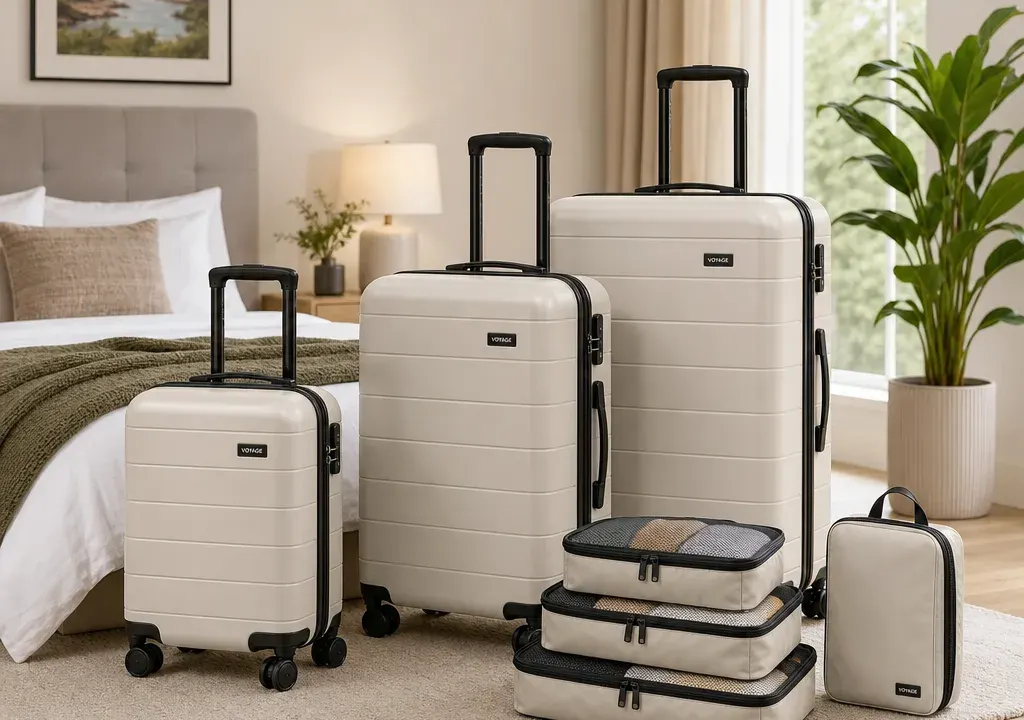
Choosing the right suitcase size is one of the easiest ways to make travel less awkward. Too small, and you end up sitting on the zip or carrying extra bags. Too large, and you pay for space you do not need, drag more weight than necessary and leave your belongings sliding around inside.
The useful comparison is not only height in centimetres. Litre capacity, shape, wheel design, soft-shell flexibility and how you pack all affect what will realistically fit. A 55cm carry-on can be perfect for a disciplined weekend packer, while a 79cm case can suit a fortnight away, family overflow or bulky winter clothing.
As a rough rule, a compact 45cm to 55cm bag suits an overnight stay, business trip or short weekend if you pack lightly. A medium checked suitcase around 65cm to 70cm is often a sensible choice for a week away. A large suitcase around 75cm to 80cm, especially one with a stated capacity above 100 litres, is better suited to a fortnight, long-haul travel or trips where shoes, coats and family items take up space.
The big caveat is that two people taking the same length of trip may need very different luggage. A summer city break with trainers, light layers and hotel toiletries can fit into far less space than a winter break with knitwear, boots and a hairdryer. If you tend to bring outfit options, sports kit or children’s extras, size up. If you use Packing Cubes and repeat outfits, you may be able to stay with a smaller case.
Also think about whether your luggage will be carried, wheeled or lifted frequently. A larger suitcase may be convenient at the packing stage, but awkward on stairs, trains and car boots. For a trip with multiple stops, a slightly smaller, better-organised case can be easier to live with than maximum capacity.
For one or two nights, the most useful comparison is usually between a small wheeled case, a Cabin Bag and a hybrid backpack. In the supplied catalogue examples, the Monolith 2-in-1 Wheeled Laptop Backpack is listed as 45cm, putting it in the compact travel category. That sort of size can suit a work trip or overnight stay where you want laptop space and mobility rather than a full holiday wardrobe.
A 51cm or 55cm case gives you more classic suitcase space. The Eastpak Tranverz 51cm and the 5 cities 21 inch/55cm Carry On are both examples of smaller wheeled luggage aimed at short trips. The 55cm height is a common carry-on style, but airline limits vary, so always check the allowance for your specific ticket before treating any case as cabin-safe.
For a weekend, prioritise easy access and usable compartments over raw litres. If you are taking a laptop, documents or chargers, a wheeled backpack format may be more practical than a standard hard-shell case. If you are packing clothes only, a simple small suitcase can be neater. Soft-sided luggage may also offer a little more flexibility when packing around awkward items, though it can be less structured than a hard case.
For a typical seven-night trip, many shoppers find that medium checked Suitcases are the most balanced option. They offer more room than a cabin case without the bulk of a large family-sized suitcase. In the product examples, the Samsonite Intuo Spinner 69cm sits in this medium checked-luggage bracket. At this sort of height, you are generally shopping for a case that can hold a week’s worth of clothing for one person, with space depending on packing style and the item’s internal layout.
A medium case is a good choice if you want one main suitcase rather than a small cabin bag plus overflow tote. It is also a sensible compromise for couples who prefer individual cases: two medium suitcases can be easier to manage than one very large shared case, and they reduce the risk of one person’s items taking over the whole space.
When comparing medium luggage, look beyond the outer height. Check whether the case is expandable, whether the inside has compression straps or dividers, and whether the handle or wheel housings eat into the packing area. A spinner wheel design can be easier through airports, while two-wheel designs may leave a little more internal room depending on construction. Product listings vary in how much detail they provide, so compare the specification rather than relying on the size label alone.
For two weeks, especially with beach towels, extra shoes, formalwear or colder-weather clothing, large checked luggage is usually more realistic. The clearest example in the supplied data is the Eastpak Tranverz L Suitcase, listed at 79 x 40 x 33cm with a 121 litre capacity. That stated capacity puts it firmly in the large-case category and gives a useful benchmark for shoppers comparing fortnight luggage.
Another listed large example is the Eastpak Tranverz 79cm, which signals the same broad height class, although the supplied data here does not include a litre capacity. The lesson is important: two suitcases can share a similar height but differ in depth, width, shape and internal usable space. Whenever available, litres are a better comparison point than height alone.
A 79cm case can be very useful for longer trips, but it is not automatically the best buy for everyone. Larger luggage can be harder to store at home, heavier when full and more awkward on public transport. If you are travelling as a family, compare one large suitcase against two medium cases or a Suitcase Set. Separate cases can make packing more organised and may be easier to distribute between travellers.
Litres tell you the approximate internal volume, making them one of the most helpful specifications in Luggage comparisons. A small cabin-style case may be enough for minimalist packing, but without a litre figure you are estimating from height. A listed 121 litre case, by contrast, gives a much clearer sense that it is built for substantial packing loads.
If a listing gives both dimensions and litres, use them together. Dimensions affect handling, storage and whether a case fits within travel restrictions. Litres affect how much you can pack. The Eastpak Tranverz L example, at 79 x 40 x 33cm and 121 litres, shows how a relatively tall and deep case can provide significant capacity. A 69cm case may be easier to handle but will generally be chosen for a different trip length or packing style.
Be cautious when comparing expandable and non-expandable cases. An expandable suitcase may offer extra room on the return journey, but once expanded it may be bulkier and easier to overfill. If you regularly come home with shopping, gifts or laundry that takes up more space, expansion can be useful. If you often struggle with baggage weight, it may tempt you to pack too much.
Before buying a larger case, check whether your problem is actually organisation rather than capacity. Packing Cubes, compression cubes and sensible compartment use can make a familiar suitcase feel more usable. The Thule Compression Packing Cube Small is one catalogue example of an accessory that may help separate items and reduce clutter, although it will not turn a small case into a fortnight-sized suitcase.
Luggage Scales are another practical add-on if you often travel with checked bags. They do not increase space, but they help you manage packed weight before you leave home. Luggage Tags and Luggage Straps can also make sense for checked Suitcases, particularly when several bags look similar on a carousel.
Suitcase Sets are worth comparing if you travel in different ways throughout the year. The Groundlevel Regency Hard Shell Luggage Set of 4 is one example from the supplied products. A set can cover cabin, medium and larger trips, but only makes sense if you will use the different sizes. If you mostly take weekend breaks, a set may be unnecessary. If you alternate between work travel, family holidays and longer breaks, a set can be more flexible than buying one oversized case.
Children’s Luggage is not simply a smaller version of adult luggage. It often needs to be easy for a child to recognise, light enough for an adult to manage alongside other bags, and sized for short-trip essentials rather than a full independent wardrobe. The Trunki Dougie Dog Ride-On Suitcase is one example in the supplied catalogue data, positioned around child-friendly travel rather than adult capacity.
For family holidays, it can be tempting to give every child a separate case, but that may create more items to supervise. A small children’s case can be useful for toys, spare clothes and in-journey essentials, while larger family clothing goes into a medium or large checked suitcase. Compare whether the children’s case is genuinely adding convenience or just another piece to carry.
If you are buying for a child, focus on practicality: recognisable design, manageable format and how it fits with the rest of your family luggage. For a fortnight, children’s luggage is usually best treated as supplementary, not the main packing solution.
First, decide your trip category: weekend, week or fortnight. For weekends, compare compact 45cm to 55cm options and check airline rules if you want cabin use. For one week, start with medium checked luggage around the high-60cm range and refine by compartments, wheels and expandability. For a fortnight, compare large cases around 75cm to 80cm and prioritise litre capacity where shown.
Second, compare the real product specifications side by side. A 45cm wheeled laptop backpack, a 55cm carry-on, a 69cm spinner and a 79cm 121 litre suitcase are not competing for exactly the same job. They suit different journeys. Buying well means matching the product to the journey you take most often, not the biggest discount or the largest case on the page.
Finally, compare offers with flexibility in mind. Prices, reductions and retailer availability can change, so look at the total value: size, capacity, brand, materials stated in the listing, accessories included and whether the luggage solves your usual travel problem. The best suitcase is the one you will fill comfortably, move easily and use repeatedly.
For a weekend, a compact 45cm to 55cm bag is often enough if you pack lightly. A 45cm wheeled backpack can suit an overnight work trip, while a 51cm or 55cm carry-on style suitcase gives more room for clothes. Always check airline cabin limits if you plan to take it on board.
A 69cm suitcase is commonly in the medium checked-luggage category and can be a good starting point for a one-week trip. Whether it is enough depends on clothing bulk, shoes, toiletries and how efficiently you pack.
For a fortnight, many travellers move up to a large checked suitcase around 75cm to 80cm. A listed example such as a 79 x 40 x 33cm case with 121 litres shows the sort of capacity that suits longer trips, although weight and handling should still be considered.
Litres are often more useful for judging packing capacity, while height and dimensions are important for handling, storage and travel restrictions. If both are listed, compare both rather than relying on a simple small, medium or large label.
A suitcase set can make sense if you take a mix of short breaks, week-long holidays and longer trips. If you usually travel in the same way each time, one well-chosen suitcase may be better value and easier to store.
The right suitcase size starts with the trip you take most often. Choose 45cm to 55cm luggage for weekends and short work travel, look at medium cases around 69cm for a week away, and compare large 75cm to 80cm suitcases with clear litre capacities for a fortnight.
Use dimensions, litres and layout together, then compare current Luggage offers across Cabin Bags, Suitcases, Suitcase Sets and useful accessories. A carefully chosen case should make packing easier before you leave and simpler to manage once the journey begins.
