
Loading buyer guide
Hurry, don't miss savings on selected furniture & more.* Shop all offers
Trying to choose between a rigid suitcase and a fabric case? Compare shell type, capacity, weight, pockets, expandability and live offers before deciding which luggage is best for your next trip.
Use our barcode scanner to match products instantly to find the best prices, find products with ease using our voice search and build wish lists and your favourites at the click of a button.
What size suitcase do you need for a weekend, week or fortnight?
Suitcase sizing is less about buying the biggest case and more about matching litres, height and packing style to the length of your trip. Here’s how to compare cabin bags, medium cases and large suitcases using real catalogue examples.
Antler vs Eastpak luggage: which is right for your trip?
Choosing between Antler and Eastpak is less about picking a famous luggage name and more about matching the case to your route, packing habits and budget. Here’s how to compare sizes, features, offers and availability without being distracted by a big discount alone.
Best luggage sets for families
Family luggage works best when the pieces solve different jobs: a large hold case for shared clothing, cabin bags for essentials, and smaller children’s options or accessories for organisation. The best value is not always the biggest discount, so compare included sizes, usable capacity, colour, retailer availability and the cost per case before you buy.
Best lightweight luggage for easier travel
Lightweight luggage is not just about picking the smallest case. The right choice depends on listed weight, capacity, dimensions, trip length and how much structure you need for clothes, tech and extras.
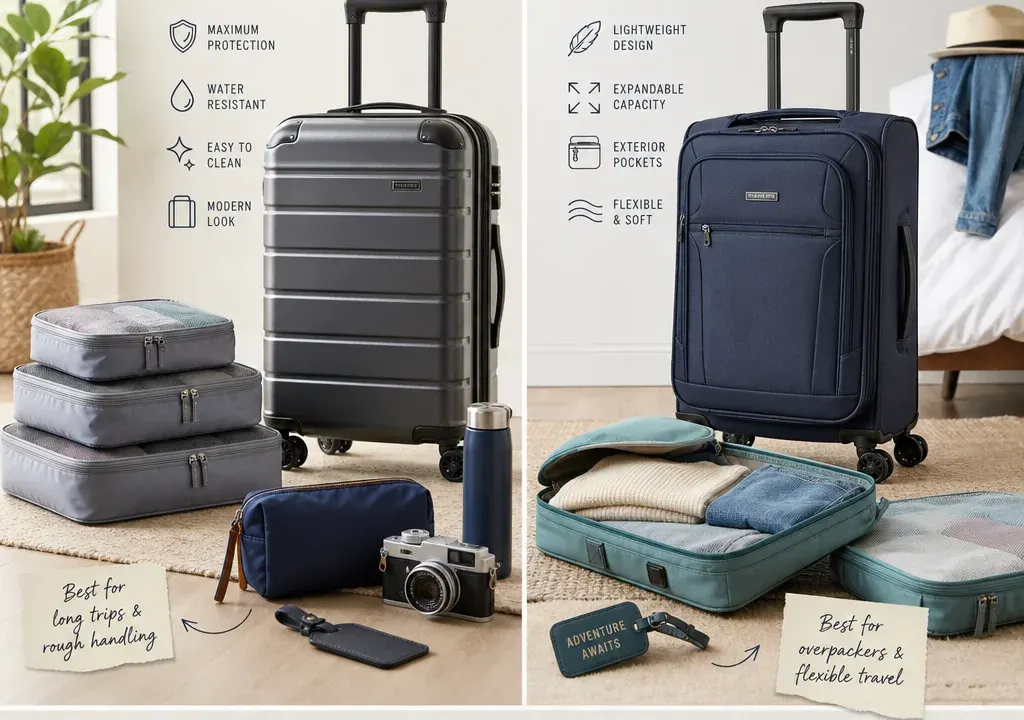
Choosing between hard shell and soft shell luggage is one of the most important decisions before you compare specific suitcases. Both can be good buys, but they solve different problems. A rigid case may feel neater and more protective, while a fabric case can be easier to squeeze into car boots, overhead lockers and crowded storage areas.
The smartest way to decide is to compare the details that affect day-to-day travel: shell material, empty weight, usable capacity, pockets, expandability, wheels, handles and price. Catalogue examples in Luggage range from compact 45cm wheeled laptop backpacks and 55cm carry-on cases to large 79cm cases with listed capacities over 100 litres, so the practical differences can be bigger than the shell type alone.
A hard shell suitcase is usually the better fit if you want a case that keeps its shape, stacks neatly and separates your packing into two structured halves. This can be useful for flights, longer trips and travellers who prefer a tidy, compartment-led layout.
A soft shell case is usually the better fit if you value outside pockets, a little give when packing, and easier access to documents, chargers or an extra layer. Soft designs can be especially convenient for train travel, car travel and short breaks where you may need to open the bag on the move.
Neither type automatically gives you better value. In the current Luggage selection, shoppers can find discounted options across different formats, including carry-on cases, large suitcases, wheeled backpacks, suitcase sets and accessories. The better buy is the one with the right size, weight and features at the offer available when you shop.
Capacity is often more important than shell type. A compact cabin case, a 45cm wheeled laptop backpack and a 79cm large suitcase are built for very different journeys. For example, the catalogue includes large luggage such as the Eastpak Tranverz L listed at 79 x 40 x 33 cm with a 121 litre capacity, which is aimed at far more packing space than a 54cm or 55cm carry-on style option.
For weekend trips, city breaks and hand-luggage-only travel, start with Cabin Bags and compare the listed dimensions carefully against your airline or operator’s own allowance. A hard cabin case may offer a tidy shape, but a soft case with external pockets may be easier if you often need passports, headphones or liquids quickly.
For longer holidays or family packing, larger Suitcases and Suitcase Sets may offer better practicality. Hard shell sets can be appealing if you want matching structured cases in different sizes, while soft large cases may suit overpackers because fabric designs often have more give. Always check stated capacity rather than relying on the visual size of the product image.
A suitcase’s empty weight affects how much you can pack before reaching a travel allowance or simply making the case awkward to lift. Hard shell luggage can sometimes feel more substantial because of its rigid body, but soft shell luggage can vary widely too, especially when extra pockets, frames, handles and wheel systems are added.
When comparing products and offers, look for the listed weight next to the dimensions and capacity. A large case with impressive litre capacity is only useful if you can still lift it comfortably when full. For train platforms, stairs and older accommodation without lifts, a lighter case may be more valuable than a tougher-looking shell.
If you carry work items, a wheeled laptop backpack such as a 45cm 2-in-1 style may be worth comparing with a small suitcase. It may not replace a full holiday case, but it can suit commuters and overnight travellers who need laptop organisation more than maximum clothing space.
Choose hard shell luggage if you prefer structure. The fixed shape can help stop the case bulging, and many hard cases open like a book with packing space on both sides. That layout suits packing cubes, folded clothing and travellers who like to separate clean and worn items.
Hard shell options also make sense if you are buying a set. A hard shell luggage set, such as the catalogue’s Groundlevel Regency Hard Shell Luggage Set of 4, can be useful for households that want multiple sizes for different trip lengths. When comparing sets, check whether you will genuinely use every size, as a cheaper-looking set is not always the best value if two cases sit unused.
The trade-off is access. Many hard cases do not have front pockets, so you may need to open the whole case to reach small items. If you regularly travel with paperwork, medicine, a tablet or children’s items that need to be close at hand, factor that into your decision before choosing a rigid design.
Soft shell luggage is often the better option for flexible packing. Fabric designs may include front pockets, compression straps, expandable sections or layouts that make them easier to use in tight spaces. This can be useful for road trips, coach travel, rail travel and shared accommodation where fully opening a suitcase is inconvenient.
Soft cases are also worth considering if you tend to bring back more than you packed. Expandability is not universal, so do not assume every fabric case expands, but when a product lists an expandable section it can add useful overflow space for souvenirs, extra clothing or last-minute packing.
The trade-off is shape. A soft case can look less neat when overfilled, and the contents may depend more on how well you pack. Packing Cubes can help by adding structure inside a softer bag, while Luggage Straps can add reassurance and make the case easier to identify.
The biggest practical difference is often not durability or looks, but access. If you want a quick-access pocket for boarding documents, a book, travel adaptors or a waterproof jacket, soft shell luggage and wheeled backpacks usually have the advantage. Hard shell cases may suit travellers who pack once and do not need to open the case until arrival.
Expandability deserves a separate check. It can be valuable, but it can also make a case deeper than expected when full. If you are buying for cabin use, compare the dimensions in both normal and expanded modes where available. An expanded cabin case may no longer suit every travel allowance.
For families, access can matter even more. Children’s Luggage, ride-on cases and smaller soft bags may be easier for short trips than a single large suitcase. If a child needs snacks, toys or spare clothing en route, external pockets and easy openings can be more important than a rigid shell.
A good shell type will not compensate for an awkward case. Compare whether the luggage uses two wheels or spinner-style wheels, and check handle positions. Four-wheel spinners can be easier to manoeuvre on smooth floors, while two-wheel designs may feel more controlled over uneven pavements. The right choice depends on where you travel most.
Large cases need comfortable top and side handles because they will be lifted into car boots, onto luggage racks and up steps. Cabin cases need a telescopic handle that suits your height. If you often move between transport types, do not choose purely on hard versus soft shell; compare the whole carrying system.
For heavier packing, accessories can also help. Luggage Scales are useful if you want to avoid guesswork, while Luggage Tags make identification easier. These are small purchases compared with a suitcase, but they can improve the experience of whichever shell type you choose.
Discounts can be useful, but they should not decide the purchase on their own. The supplied catalogue includes examples with strong discount signals across very different products, from large cases and hard shell sets to carry-on luggage, packing cubes and luggage tags. Because these items serve different needs, the headline saving is only meaningful after you confirm the specification fits your trip.
Use a simple order of priority: first choose the luggage type, then the size, then the shell style, then the practical features, and only then compare live offers. That stops a low price on a large case tempting you when you really need a compliant cabin bag, or a compact case tempting you when you need a family-sized option.
Also compare value by expected use. A frequent traveller may justify paying more for a suitcase with the right capacity, layout and manoeuvrability, while an occasional traveller may prefer a straightforward case at a lower offer. For families, a suitcase set may offer better overall value than buying separate cases, but only if the sizes match real trips.
Buy hard shell luggage if you want a structured suitcase, a clean look, a split packing layout and a case that keeps its shape. It is a strong candidate for longer holidays, organised packers, matching suitcase sets and travellers who mainly open their luggage at the destination.
Buy soft shell luggage if you want flexibility, external pockets, easier access and potential expandability. It is a strong candidate for short breaks, car and train travel, work trips and anyone who likes to keep travel essentials close without opening the full case.
If you are still unsure, compare one hard option and one soft option in the same size bracket. Look at capacity, empty weight, pocket layout, wheel type and current offer side by side. Once those details are visible, the better choice usually becomes obvious.
Not always. Hard shell luggage is better for structure and a tidy split-packing layout, while soft shell luggage is better for flexibility, pockets and quick access. The better choice depends on your trip length, transport type and packing habits.
Both can work, but dimensions matter most. A hard cabin case can be neat and easy to stack, while a soft cabin bag may give you external pockets and a bit more flexibility. Always compare the listed size against the allowance you need to meet.
Expandable luggage is useful if you often return with more than you packed, but check the expanded dimensions. Extra depth may be convenient for car or train travel, but it can be a problem if you need the case to stay within strict cabin limits.
A suitcase set can be good value for households that will use several sizes. If you usually take the same type of trip, one well-chosen suitcase may be more practical than a set with sizes you rarely need.
Packing Cubes can add structure, especially in soft cases. Luggage Scales help you check weight before travelling, while Luggage Tags and Luggage Straps can make identification easier. Choose accessories based on how you travel rather than buying everything at once.
Hard shell versus soft shell luggage is not a question of one being universally better. Hard cases suit travellers who want structure and a neat packing layout; soft cases suit those who want flexibility, pockets and easier access on the move.
Before you buy, compare products in Luggage by size, capacity, weight, expandability, pockets, wheels and live offers. Once those details match your travel style, the shell choice becomes far simpler.
