
Loading buyer guide
Hurry, don't miss savings on selected furniture & more.* Shop all offers
Choosing a cabin case is less about finding the biggest bag and more about matching dimensions, usable space and retailer value to the way you fly. Here’s how to compare cabin-friendly luggage before you buy.
Use our barcode scanner to match products instantly to find the best prices, find products with ease using our voice search and build wish lists and your favourites at the click of a button.
What size suitcase do you need for a weekend, week or fortnight?
Suitcase sizing is less about buying the biggest case and more about matching litres, height and packing style to the length of your trip. Here’s how to compare cabin bags, medium cases and large suitcases using real catalogue examples.
Antler vs Eastpak luggage: which is right for your trip?
Choosing between Antler and Eastpak is less about picking a famous luggage name and more about matching the case to your route, packing habits and budget. Here’s how to compare sizes, features, offers and availability without being distracted by a big discount alone.
Best luggage sets for families
Family luggage works best when the pieces solve different jobs: a large hold case for shared clothing, cabin bags for essentials, and smaller children’s options or accessories for organisation. The best value is not always the biggest discount, so compare included sizes, usable capacity, colour, retailer availability and the cost per case before you buy.
Best lightweight luggage for easier travel
Lightweight luggage is not just about picking the smallest case. The right choice depends on listed weight, capacity, dimensions, trip length and how much structure you need for clothes, tech and extras.
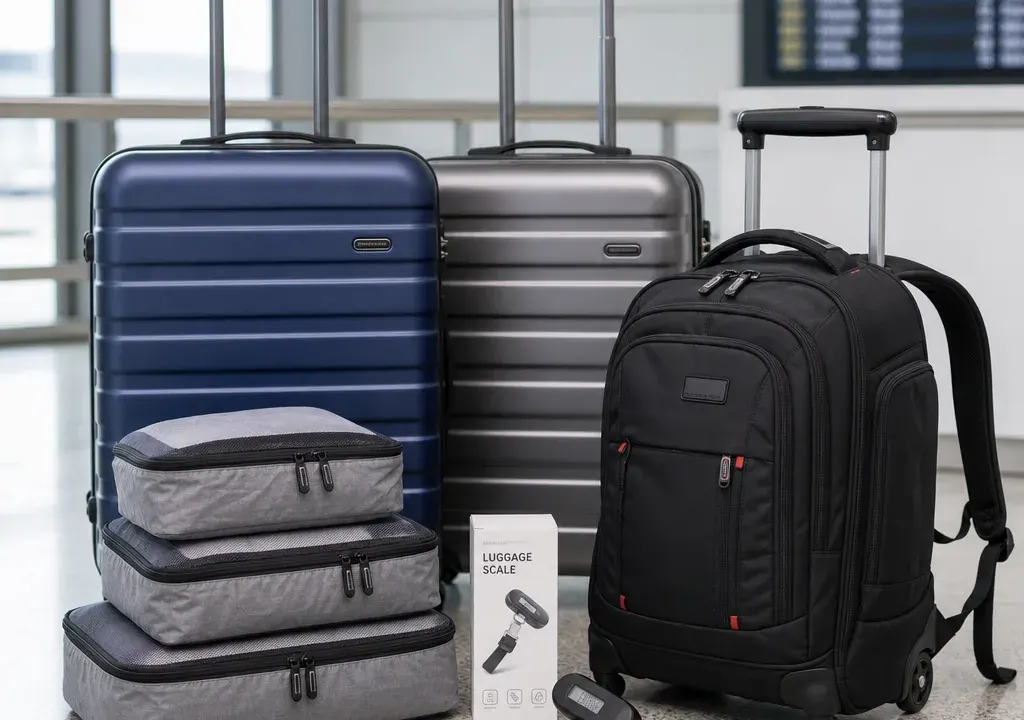
Finding the best cabin luggage for UK airline hand luggage rules starts with one awkward truth: there is no single universal cabin size. A case that works for one fare type or carrier may be too deep, too wide or too heavy for another, especially once the wheels, handles and front pockets are included.
That makes comparison more useful than chasing one headline size. A 55cm carry-on may be a sensible starting point for many travellers, but you still need to look at the full measurements, the litre capacity, the empty weight where available, and whether the retailer’s listing gives enough information to buy with confidence.
Using the current Luggage catalogue as comparison context, several products stand out as worth checking for different needs: the 5 cities 21"/55Cm Carry On, Eastpak Tranzshell 54cm, Eastpak Tranverz 51cm, and Monolith 2-in-1 Wheeled Laptop Backpack 45cm. Larger Suitcases and Suitcase Sets can offer better value for checked baggage, but they are not automatically suitable as Cabin Bags.
Product titles often use phrases such as carry on, cabin, 21 inch or 55cm, but those words are not a guarantee that the bag will meet your airline’s rules. For UK departures, many full-size cabin allowances sit around the familiar 55cm height range, while under-seat bags are usually smaller. Depth is often the problem measurement, because wheels, handles and packed front pockets can push a bag beyond the stated allowance.
When comparing options, look for three numbers: height, width and depth. If only the height is visible, treat it as a shortlist item rather than a final decision. The Eastpak Tranzshell 54cm and the 5 cities 21"/55Cm Carry On both appear relevant to shoppers looking for cabin-sized Luggage, but you would still want to confirm the complete external dimensions before booking them for a strict airline allowance.
The Eastpak Tranverz 51cm is a slightly shorter option in the current catalogue, which may appeal if you prefer leaving more margin for the size gauge. However, soft-sided wheeled bags can change shape when overpacked, so do not rely on height alone.
Some deals in Luggage look tempting because the discount or litre capacity is strong, but that does not mean they are suitable for hand luggage. The Eastpak Tranverz L Suitcase is listed at 79 x 40 x 33 cm with a 121 L capacity. Those figures make it a large travel bag rather than a cabin case for typical UK airline hand luggage rules.
The same caution applies to mid and large Suitcases such as a 69cm spinner. A 69cm case may suit a week away or checked baggage allowance, but it is not the right comparison set if your aim is to avoid checking in a bag. Keep your cabin shortlist separate from larger Suitcases, otherwise an attractive offer can pull you towards the wrong purchase.
Suitcase Sets can be good value for households, especially when one purchase covers different trip lengths. But if your immediate priority is cabin compliance, check which case in the set is actually small enough, and whether the individual dimensions are clearly provided.
Litre capacity tells you how much the bag may hold, but it should come second to external dimensions. A larger capacity can be helpful for longer trips, but if the case is too deep for your airline’s size limit, the extra space becomes a liability.
For cabin luggage, the best practical balance is usually a case that uses its allowed dimensions efficiently without encouraging you to overpack. Boxier hard-shell cases can be easier to measure and stack, while soft-sided bags may offer more forgiving pockets but can bulge when full. Wheeled duffel-style designs can feel flexible, but again, the packed depth matters.
If the retailer listing does not show litre capacity, compare visible dimensions, internal layout images and product type instead. A wheeled laptop backpack such as the Monolith 2-in-1 Wheeled Laptop Backpack 45cm is a different proposition from a 55cm cabin suitcase: it may suit work trips and tech organisation better, but may not offer the same clothing capacity.
Empty case weight is easy to overlook, yet it can decide how much you can actually pack. Some airlines focus on dimensions, while others also apply a weight allowance. Even when no weight limit is prominent, a lighter bag is usually easier to lift into an overhead locker, carry upstairs or manage on public transport.
The challenge is that not every catalogue listing clearly shows weight. If weight is not visible, do not assume a compact case is automatically light. Hard shells, spinner wheels, telescopic handles and laptop compartments can all add weight. Before buying, check the retailer’s specification panel or manufacturer details where available.
A Luggage Scale can be a sensible add-on if you regularly fly with strict allowances. It is not a substitute for choosing the right bag, but it helps you avoid last-minute repacking at the airport.
Among the supplied product candidates, the most relevant cabin-luggage comparisons are the 5 cities 21"/55Cm Carry On, the Eastpak Tranzshell 54cm, the Eastpak Tranverz 51cm, and the Monolith 2-in-1 Wheeled Laptop Backpack 45cm. Each points to a different buying priority: low-cost carry-on, branded compact case, slightly smaller soft travel bag, or work-friendly wheeled backpack.
The 5 cities 21"/55Cm Carry On is the most explicitly carry-on-focused title in the selection and appears competitively priced in the catalogue data. It is the kind of option to compare if your priority is keeping spend low, but you should still confirm the full measurements and airline fit before relying on it.
The Eastpak Tranzshell 54cm and Eastpak Tranverz 51cm sit in a more brand-led part of the shortlist. Their catalogue prices and discounts may look appealing compared with original prices, but value depends on whether the size, weight, wheel design and storage layout suit your journey. The Monolith 45cm wheeled laptop backpack is worth considering if laptop access and office organisation matter more than maximum clothing space.
Retailer availability can influence the best choice, particularly when you need luggage before a specific trip. In the current catalogue, relevant cabin and compact options are listed across retailers including Amazon, Absolute Snow and Euroffice, while larger or accessory items appear through other retailers. Availability can change, so use the live product listing to confirm whether the item is still in stock before you decide.
Price comparisons should also be like for like. A discounted large 79cm suitcase is not a better cabin purchase than a compliant 54cm case simply because the percentage saving looks bigger. Likewise, Luggage Accessories such as Packing Cubes, Luggage Tags and Luggage Straps serve a different purpose and should not be compared directly with a suitcase.
When two cabin-sized options are similarly priced, give extra weight to clearer specifications. A listing that clearly states dimensions, weight, capacity and product images reduces the risk of buying the wrong size.
For short city breaks, a compact 51cm to 55cm case may be enough if you pack lightly and use Packing Cubes to compress clothing. Prioritise external size, wheel stability and internal organisation over maximum capacity.
For business travel, consider whether a laptop needs to come out quickly at security or during the journey. A wheeled laptop backpack can be more practical than a traditional case, even if it carries less clothing. Check laptop compartment size separately rather than assuming all work bags fit every device.
For family travel, Children’s Luggage such as ride-on cases can be useful for younger travellers, but it should be compared against the child’s ticket allowance and the adult’s ability to carry it when needed. For longer family holidays, a mix of Cabin Bags and checked Suitcases may be more realistic than trying to make every item cabin-only.
Before you buy, check the airline’s latest hand luggage allowance for your fare type, then compare the suitcase’s external height, width and depth, including wheels and handles. If any dimension is missing, look for the full specification before purchasing.
Next, compare the litre capacity and empty weight where available. Choose the largest useful capacity that still leaves a margin within the airline limit, rather than pushing right to the edge.
Finally, compare price, retailer availability and accessories. A cheaper case may be ideal for occasional use, while a better-specified option may be worth considering if you travel often. Add Packing Cubes or a Luggage Scale only if they solve a real packing problem, not just because they are on offer.
There is no single size that works for every UK airline and fare type. Many travellers start by comparing cases around the 55cm height range, but width, depth, wheels and handles matter too. Always check your airline’s latest allowance before buying.
Not always. A 55cm case may still be too wide or too deep for some allowances, especially if it bulges when packed. Confirm the full external dimensions rather than relying on the height or the words carry on.
Hard-shell cases can be easier to measure and may protect contents from knocks, while soft-sided luggage can offer flexible pockets and easier packing. For strict size limits, make sure a soft bag does not bulge beyond the permitted depth.
Only if you need checked luggage. A large case with a strong discount can be good value for longer trips, but it will not replace a cabin bag if it exceeds airline hand luggage dimensions.
Packing Cubes can help organise clothing and make better use of limited space. They do not change the airline size limit, so avoid overfilling the case until it bulges beyond the allowed dimensions.
The best cabin luggage for UK airline hand luggage rules is the option that fits your actual airline allowance, not simply the bag with the biggest discount or the most generous headline capacity.
For most shoppers, the smartest approach is to shortlist true Cabin Bags first, compare full external dimensions, then weigh up capacity, empty weight, price and retailer availability. Larger Suitcases, Suitcase Sets and Luggage Accessories may still be useful, but they belong in a separate comparison unless they genuinely solve your travel need.
