
Loading buyer guide
Hurry, don't miss savings on selected furniture & more.* Shop all offers
Choosing between ABS, polypropylene and polycarbonate luggage is less about picking the “best” plastic and more about matching shell material, size, weight, wheels and budget to how you travel.
Use our barcode scanner to match products instantly to find the best prices, find products with ease using our voice search and build wish lists and your favourites at the click of a button.
What size suitcase do you need for a weekend, week or fortnight?
Suitcase sizing is less about buying the biggest case and more about matching litres, height and packing style to the length of your trip. Here’s how to compare cabin bags, medium cases and large suitcases using real catalogue examples.
Antler vs Eastpak luggage: which is right for your trip?
Choosing between Antler and Eastpak is less about picking a famous luggage name and more about matching the case to your route, packing habits and budget. Here’s how to compare sizes, features, offers and availability without being distracted by a big discount alone.
Best luggage sets for families
Family luggage works best when the pieces solve different jobs: a large hold case for shared clothing, cabin bags for essentials, and smaller children’s options or accessories for organisation. The best value is not always the biggest discount, so compare included sizes, usable capacity, colour, retailer availability and the cost per case before you buy.
Best lightweight luggage for easier travel
Lightweight luggage is not just about picking the smallest case. The right choice depends on listed weight, capacity, dimensions, trip length and how much structure you need for clothes, tech and extras.
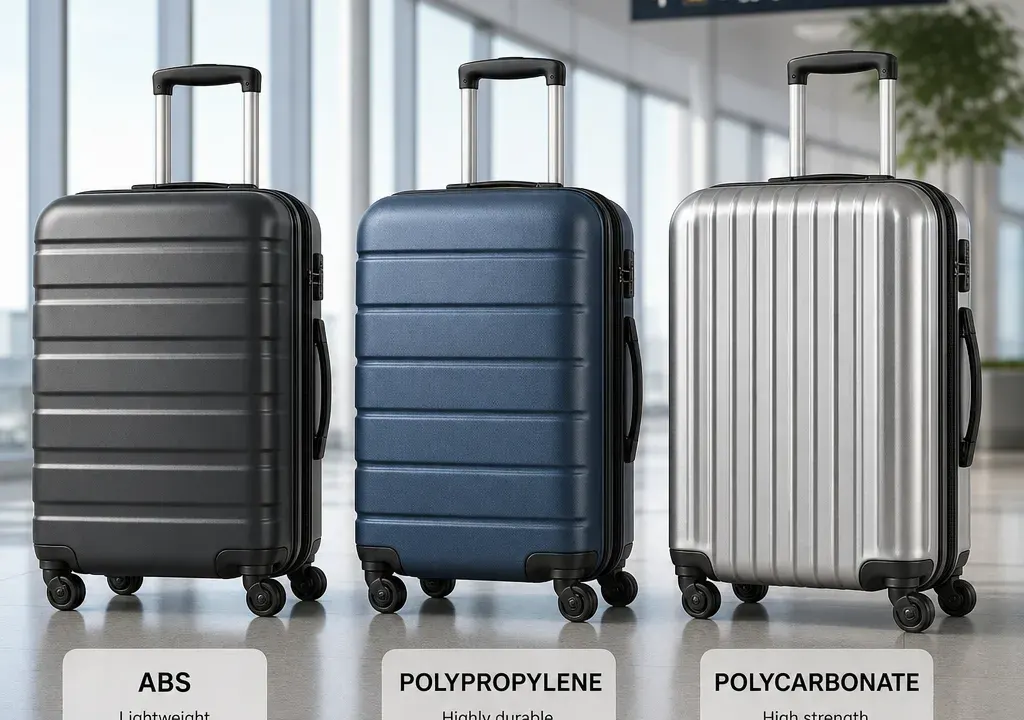
Hard-shell luggage is often sold on looks first: a glossy shell, a smart colour and a neat set of spinner wheels. But if you are comparing Suitcases or Suitcase Sets, the material listing can tell you a lot about where a case sits for value, weight and everyday resilience.
The three common materials you will see are ABS, polypropylene and polycarbonate. None is automatically the right choice for everyone. A cheap ABS Cabin Bag may be sensible for occasional short trips, while a frequent traveller may prefer a polypropylene or polycarbonate case with stronger feature details. The best buy is usually the one where the shell material, size, weight, capacity and price all make sense together.
Start with how often you travel and how the case will be used. If you need an affordable case for a few UK breaks or a once-a-year holiday, ABS can be a cost-conscious place to start. If you want something that feels more forgiving against knocks and pressure, polypropylene is worth comparing. If you want a more premium hard case and are prepared to pay for a stronger material specification, polycarbonate is often the material to look at first.
That said, the material name is only one part of the decision. A well-specified ABS case with smooth wheels, a sensible handle and a useful internal layout may be more appealing than a poorly equipped case made from a theoretically better material. Likewise, a polycarbonate suitcase is not automatically good value if it is too heavy, too small for your packing style or lacks the features you expect at its price point.
When comparing offers in Luggage, use the material as a filter, then check the size, stated weight, wheel type, handle arrangement, lock style, internal dividers and whether the deal is for one suitcase or a multi-case set.
ABS is commonly used for lower-cost hard-shell luggage. It gives a rigid shell and allows brands to produce colourful, lightweight-looking designs at accessible prices. In catalogue comparisons, ABS cases often appear among the cheapest hard-shell options, especially in smaller cabin sizes and value-focused sets.
The trade-off is that ABS is generally less flexible than polypropylene or polycarbonate. A very rigid shell can be fine for light use, but it may be less forgiving when heavily loaded, dropped or compressed among other bags. That does not mean every ABS suitcase is poor; it means you should be more careful about checking the full specification before buying.
ABS makes most sense if price is your main concern, you travel occasionally, or you need a spare case for guests, school trips or infrequent holidays. It is also worth considering when the listing has other reassuring details, such as a practical wheel layout, a telescopic handle, secure zips and a usable interior.
Be careful when a very low price is paired with a large size. A 75cm or 79cm suitcase can carry a lot, and a budget shell may be put under more strain when packed heavily. If you often fill a large case to the limit, it may be worth comparing polypropylene or polycarbonate alternatives rather than choosing only on headline price.
Polypropylene is a popular hard-shell material because it can offer more flex than ABS. In simple terms, that flexibility can help the shell absorb everyday knocks rather than simply feeling hard and brittle. Many shoppers see polypropylene as a practical middle ground between budget ABS and premium polycarbonate.
In price terms, polypropylene luggage often sits in the middle of the market, although brand, size and features can move it up or down. A polypropylene cabin case with basic features may compete with better ABS models, while a larger polypropylene spinner from a recognised luggage range may cost closer to entry-level polycarbonate options.
Polypropylene is worth comparing if you want a hard case for regular holidays, family travel or checked baggage, but you do not necessarily want to stretch to a premium shell. It can also be a good material to look for in Suitcase Sets, where the overall saving of buying multiple cases can be attractive, but you still want a shell that feels suited to repeated use.
Do not judge polypropylene by the material alone. Look for the stated weight because shell thickness and frame design vary. Also check whether the case expands, how the compartments are divided, and whether the wheels look suitable for the places you travel through most often, such as train platforms, hotel corridors and airport terminals.
Polycarbonate is commonly used in more premium hard-shell suitcases. It is valued because it can combine strength with flex, helping the shell move under pressure rather than simply resisting it rigidly. For frequent travellers, that material reputation is one reason polycarbonate cases often command higher prices.
The important word is “often”. Not every polycarbonate suitcase is light, and not every expensive suitcase is the best choice for your trip. Handles, wheels, zips, locks, lining and the way the shell is constructed all influence how good the final product is. Some listings may also refer to blends or layered shells, so read the material description carefully rather than assuming the whole case is made from one material.
Polycarbonate is most worth considering if you travel frequently, check luggage into the hold, want a case that looks more refined, or are comparing established Luggage ranges where spare sizes and matching pieces may be available. It may also be sensible for a main suitcase that you expect to use for several years, provided the rest of the specification suits you.
If you are choosing a polycarbonate case, compare the price against similar sizes, not against every suitcase on the page. A 55cm Cabin Bag and a 69cm medium spinner do different jobs, and a 79cm large case needs to be judged on capacity, weight and handling as well as shell material.
Luggage prices vary sharply because shoppers are often comparing very different products at once. A 55cm carry-on case, a 69cm spinner, a 79cm large suitcase and a four-piece hard-shell set are not direct equivalents. The catalogue examples in this category show everything from compact carry-on options to large 121-litre cases and multi-case sets, so the cheapest item is not always the best-value item for your journey.
When comparing offers, ask what you are actually getting for the money. Is it a single cabin case, a checked suitcase, a large family-sized case or a full set? Does the listing include a capacity in litres, a stated weight and dimensions, or only a general size label? A discounted large suitcase may be good value if you need the capacity, but it may be inconvenient if you usually travel by train or need to lift it into a car boot.
Brand range also matters. Some brands offer coordinated lines with different sizes, colours and matching accessories. Others focus on budget travel basics. Neither approach is wrong, but it changes how you should compare the offer. A lower-priced case may win for occasional use, while a more expensive case may be more appealing if it fits into a broader range with matching Cabin Bags or replacement-friendly sizing.
Shoppers often ask which material is lightest, but suitcase weight is not decided by shell material alone. The thickness of the shell, wheel housings, handles, internal structure, zips and expansion panels can all affect the final weight. Two cases made from the same material can feel quite different once packed.
For Cabin Bags, weight matters because airline allowances and lifting into overhead lockers can be restrictive. For checked luggage, weight matters because a heavier empty case leaves less allowance for clothes, shoes and toiletries. A large 79cm case with generous capacity may be useful for long trips, but only if the empty weight and packed handling are manageable.
When a listing provides weight, compare it alongside capacity. A very light case with limited capacity may not solve your packing problem, while a slightly heavier case with better wheels and a stronger handle may be easier to live with. For longer trips, Packing Cubes can also help organise the interior so you use the space more efficiently without overfilling one side.
Once you have narrowed the material, compare the practical features. Spinner wheels are convenient in airports and hotels, while two-wheel designs can be steady on rougher pavements. A telescopic handle should suit your height and feel appropriate for the size of the case. Expandable sections add flexibility, but they can also encourage overpacking.
Inside the suitcase, look for zipped dividers, compression straps and pockets that match your packing style. A clamshell hard case usually opens into two halves, which can be excellent for organised packing but may need more floor space in a small hotel room. A soft-sided or hybrid design may offer external pockets, which many hard shells do not.
Security features are also worth comparing, but avoid paying for a feature you will not use. Some travellers prioritise integrated locks, while others prefer separate Luggage Accessories such as locks, Luggage Tags, Luggage Straps and Luggage Scales. If you are buying for children, Children’s Luggage may place more emphasis on fun design and manageable size than shell material.
For occasional city breaks, an ABS cabin case can be perfectly sensible if the price is attractive and the features are adequate. Prioritise dimensions, empty weight and easy handling over premium shell claims.
For family holidays, polypropylene is often a strong material to compare because it can balance cost, flexibility and practicality. Look closely at medium and large sizes, and consider whether a Suitcase Set offers better overall value than buying individual cases.
For frequent work travel, polycarbonate may be worth the extra spend if the rest of the specification is strong. A smart 55cm case with smooth wheels, a comfortable handle and a well-organised interior may be more useful than a larger case that is awkward on public transport.
For long-haul trips or heavy packers, focus on checked Suitcases with a shell and wheel system that look suited to repeated handling. Polypropylene and polycarbonate are both worth comparing here, but do not ignore the stated weight, capacity and internal layout.
First, confirm the material rather than relying on the phrase “hard shell”. If the listing does not clearly say ABS, polypropylene or polycarbonate, compare it more cautiously.
Second, check dimensions and capacity. A 55cm case is usually a different purchase from a 69cm or 79cm case, and capacity in litres can be more useful than height alone.
Third, compare the empty weight if it is listed. This is especially important for cabin travel and for anyone who tends to pack heavily.
Fourth, look at the feature set: wheels, handle, lock, expansion, internal divider and straps. These details often decide whether the suitcase is pleasant to use.
Finally, compare current offers across similar products rather than chasing the largest apparent discount. A good deal is one that fits your route, trip length, packing habits and budget.
Polycarbonate is generally considered the more premium hard-shell material because it can offer good strength and flexibility. ABS is usually more budget-focused. However, a suitcase should still be judged by its size, weight, wheels, handle and interior features, not by material alone.
Polypropylene can be a very sensible middle-ground choice for hard-shell luggage. It is often compared for its flexibility and practical value, particularly in checked suitcases and family luggage. Always check the full product specification before deciding.
There is no guaranteed lightest option based only on material. ABS, polypropylene and polycarbonate cases can all vary in weight depending on shell thickness, wheels, handles and internal construction. Use the stated product weight where available.
ABS can be a reasonable choice for an affordable cabin bag, especially for occasional travel. Check the dimensions, weight and wheel quality carefully, and compare it with polypropylene or polycarbonate options if you travel frequently.
Suitcase sets can be good value if you will use several sizes, but they are not automatically the best option. Compare the material, size mix, storage space at home and whether every case in the set is genuinely useful for your trips.
ABS, polypropylene and polycarbonate luggage each has a clear place. ABS is usually the budget route, polypropylene often offers a practical balance, and polycarbonate is commonly the premium hard-shell option. The right choice depends on how often you travel, how much you pack and how much you want to spend.
Before buying, compare products and offers like for like: same size, similar capacity, stated weight and comparable features. That approach will tell you far more than the material name on its own and should lead you to luggage that suits your journeys, not just the search filter.
