
Loading buyer guide
Hurry, don't miss savings on selected furniture & more.* Shop all offers
Big discounts can make Smartwatches look tempting, but the best budget choice is rarely just the cheapest one. Compare brand, size, connectivity, use case and retailer availability before you commit.
Use our barcode scanner to match products instantly to find the best prices, find products with ease using our voice search and build wish lists and your favourites at the click of a button.
Which smartwatch should i buy?
Choosing a smartwatch is less about finding the most impressive spec sheet and more about matching the watch to your phone, routine, wrist size and budget. Here’s how to compare Smartwatches without getting distracted by features you may never use.
Best smartwatches for sleep tracking
Sleep tracking is only useful if the watch is comfortable enough to wear, has the right companion app, and does not need charging just as you go to bed. Here’s how to compare smartwatch offers with overnight wear in mind.
Best smartwatches for gym workouts
Gym-focused smartwatch shopping is less about picking the most expensive model and more about matching the watch to your training style. Compare workout modes, sensor details, water resistance, music controls, strap comfort and battery claims before being swayed by a headline discount.
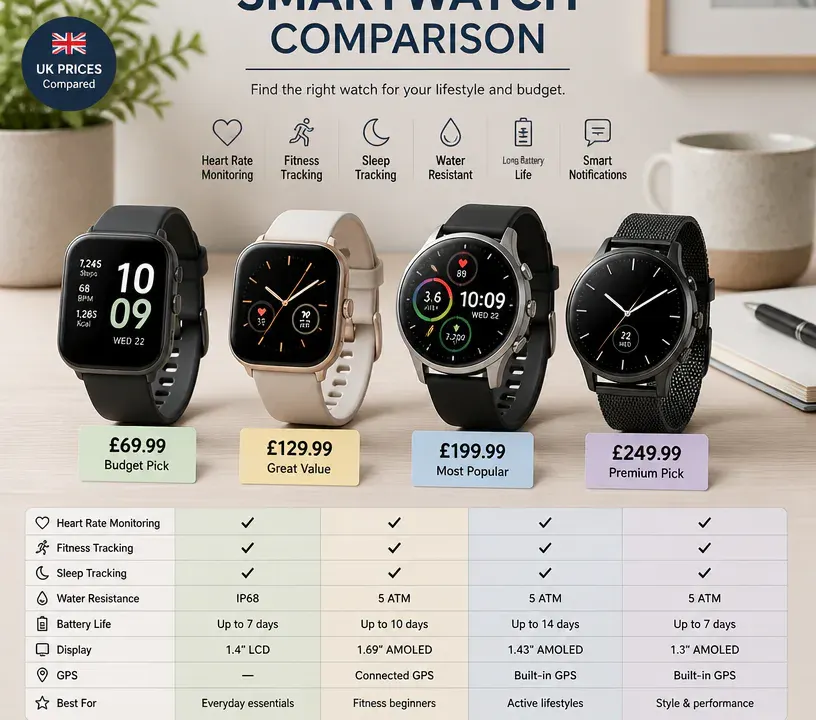
Finding the best budget Smartwatches is not just about sorting by the lowest price. A very cheap model can be a good everyday option, but only if it fits your phone, wrist, preferred style and the way you plan to use it. Equally, a higher-priced smartwatch with a large discount may offer better value if it comes from a brand or range you already trust.
For this comparison-led guide, we looked at current product catalogue data across Wearables, including price and discount signals, retailer availability and merchandising indicators such as whether a listing has an image. This is a shopping comparison guide, not a physical product test, so the aim is to help you shortlist sensibly rather than declare one universal winner.
The budget end of Smartwatches is broad. In the current candidate set, it ranges from very low-cost kids and fashion-led options to discounted models from Apple, Samsung, Fitbit, Garmin, Amazfit and Radley. That means the right choice depends heavily on what “budget” means for you: the lowest possible spend, the largest saving, or the best-known brand within a capped budget.
Start with your real budget, then compare what sits just below and just above it. If you only want a simple, low-cost wearable, the cheapest suitable option may be enough. If you want a more recognised smartwatch brand, it can be worth looking at discounted mid-range models rather than only the lowest ticket price.
Look at the saving, but do not let the percentage discount make the decision for you. A product showing a large reduction from its original price may be a strong deal, but only if the current price still makes sense for the type of watch, the retailer listing is complete and the model suits your needs. A 60% discount on a watch you will not use is still poor value.
Pay attention to what the product title tells you. Size indicators such as 40mm, 44mm, 46mm or 47mm can affect how the watch looks and feels on the wrist. Connectivity terms such as GPS, Bluetooth or LTE can also matter, although you should always check the full product listing before buying because compatibility and service requirements vary by model and retailer.
Finally, check the basics that comparison shoppers often overlook: whether the product image is clear, whether the retailer listing gives enough information, whether the colour and strap style suit you, and whether the watch is intended for adults, children, sport, fashion or everyday use.
If your priority is simply spending as little as possible, the Biggerfive Kids Smart Watch 1.8 Inch Fitness stands out in the supplied comparison set because it is listed at a very low catalogue price with a large discount signal. The title also makes clear that it is a kids’ smartwatch, so it should not be compared directly with adult-focused Apple, Samsung or Fitbit models.
For adult shoppers looking at low prices rather than flagship specifications, Radley models are prominent in the current shortlist. The Radley London Series 8 Blue and Radley Series 32 Ladies' Strap Smart both appear with substantial discount percentages and relatively low catalogue prices compared with many technology-brand alternatives. They may suit shoppers who want a watch-style wearable at a modest spend, particularly where appearance and everyday wear are important.
Another Radley Series 32 Strap Smart option is also present with a sizeable discount. When comparing similar Radley listings, do not just choose by price. Check whether the colour, strap description and any retailer details differ, because small style differences can be the reason one listing suits you better than another.
If you are willing to pay more for a well-known technology brand, the current comparison set includes discounted Fitbit, Samsung, Apple, Garmin and Amazfit options. These are not automatically better for every shopper, but they are the models many buyers will compare when looking for a budget route into a bigger brand ecosystem.
The Fitbit Versa 4 Graphite appears with a strong discount signal and sits in the middle of the current budget comparison rather than at the very cheapest end. It may be worth shortlisting if you are specifically comparing fitness-focused Wearables and want a familiar brand name, but you should still check phone compatibility, included features and retailer details before purchasing.
Samsung options in the supplied data span different sizes and connectivity descriptions, including Galaxy Watch7 44mm BT Green, Galaxy Watch7 40mm LTE, Galaxy Watch9 LTE 44 mm Silver and Galaxy Watch Ultra 2025 Bluetooth 47mm. The key budget decision is whether you need a particular size or connectivity type, because a lower price on the wrong version is not a saving. LTE-labelled watches may also require closer checking of network and plan requirements before you buy.
The Apple Watch Series 10, Aluminium, 46mm, GPS, Sport Band Rose Gold is a higher-ticket option within this budget-led shortlist, but the discount signal makes it relevant for shoppers who specifically want an Apple Watch rather than a cheaper generic smartwatch. For many buyers, the value question will be simple: if you do not need Apple compatibility or that particular size and finish, a lower-priced alternative may make more sense.
For the lowest possible outlay, start with kids or fashion-led listings such as the Biggerfive and Radley options, then check whether the product is suitable for the intended wearer. A children’s smartwatch and an adult smartwatch are not interchangeable purchases, even if they appear in the same Smartwatches category.
For fitness-led value, compare Fitbit and Amazfit alongside Sport Watches and Activity Trackers. The Amazfit W2435EU1N Smartwatch is another discounted option in the candidate set, and it may suit shoppers who want an affordable alternative to the best-known premium smartwatch brands. However, the final decision should come from the full product listing rather than the discount alone.
For golf or sport-specific shopping, the Garmin Approach S12 Black is worth a closer look because Garmin’s Approach naming is associated with that shopping intent, and the supplied listing shows a notable discount signal. That said, a specialist model is only good value if its specific focus matches what you actually want from a wearable.
For Android-oriented shoppers, Samsung Galaxy Watch listings will naturally be compared closely, but size and connectivity labels matter. A 40mm LTE listing and a 44mm Bluetooth listing may appeal to different buyers. Before choosing, compare the watch size, colour, network needs and retailer information rather than treating all Samsung deals as equivalent.
For iPhone-focused shoppers, the Apple Watch listing may be the obvious shortlist candidate, but it is not the cheapest route into Smartwatches. If budget is the main priority and you only need basic wearable functions, compare it against lower-priced options before deciding whether the brand ecosystem is worth the extra spend.
Avoid buying purely because the discount percentage is high. A large saving can be useful, but it can also distract from practical issues such as whether the watch is the right size, whether the colour is what you want, or whether the product is aimed at a different type of user.
Be cautious when product titles are brief. If a listing does not clearly explain what you are getting, use the retailer’s product details to confirm compatibility, battery information, included accessories, warranty terms and any subscription or connectivity requirements. Do not assume these details from the brand name alone.
If you mainly want step counting or simple activity tracking, Activity Trackers or Smart Rings may be better value than a full smartwatch. If accurate workout heart-rate tracking is your priority, Chest Strap Heart Rate Monitors may be more relevant. If you already own a watch and only want to refresh the look, a Smartwatch Strap could be the cheapest upgrade of all.
A good shortlist should include one lowest-price option, one familiar-brand option and one model that best matches your main use case. For example, you might compare a low-cost Radley or Biggerfive listing, a Fitbit or Samsung model, and a Garmin, Amazfit or Apple option depending on your phone and activity needs.
From the current product candidates, the Radley London Series 8 Blue is a notable low-cost adult-style option, the Biggerfive Kids Smart Watch 1.8 Inch Fitness is the clearest children’s choice, the Fitbit Versa 4 Graphite is a recognisable fitness-brand option, and the Samsung Galaxy Watch7 listings are useful comparisons for buyers weighing size and connectivity.
If your budget stretches further, the Apple Watch Series 10 and Samsung Galaxy Watch Ultra listing may be relevant, but only if you specifically want those brands or formats. In a value-led comparison, paying more can be justified, but only when the product genuinely fits your phone, preferences and intended use.
Prioritise suitability first: phone compatibility, wearer age, size, connectivity, style and intended use. Then compare price, discount and retailer listing quality. The cheapest smartwatch is not always the best value if it does not match how you will use it.
Not always. A large discount can be a useful value signal, but it should be checked against the current price, the brand, the exact model, the retailer information and whether the watch is right for you. Do not buy solely because the saving looks impressive.
Choose a smartwatch if you want a watch-style device with broader everyday use. Consider Activity Trackers if your needs are simpler and fitness-focused. For some shoppers, a cheaper tracker may be better value than a budget smartwatch.
It can be, especially if you already use that brand’s ecosystem or want a specific model type. However, budget shoppers should compare those brands against lower-priced options and only pay extra when the compatibility, size and intended use justify it.
Smartwatch offers can change frequently, so it is worth comparing products and retailers close to the time you plan to buy. Check the latest product listing rather than relying only on a previous discount or catalogue snapshot.
The best budget smartwatch is the one that balances price with suitability. A very low-cost model can be ideal for simple needs, while a discounted Apple, Samsung, Fitbit, Garmin or Amazfit watch may be better value for shoppers who want a specific brand or format.
Use the Smartwatches selection to compare current offers side by side, then widen your search across Wearables if you are not sure a smartwatch is the right product type. In many cases, the smartest budget decision is not the biggest discount, but the watch you will actually wear and use.
