
Loading buyer guide
Hurry, don't miss savings on selected furniture & more.* Shop all offers
Before choosing a Smart Ring, look past the headline hardware price. Recent UK-facing comparisons show why two-year cost, app access, battery expectations and sleep-tracking evidence all deserve a closer look.
Use our barcode scanner to match products instantly to find the best prices, find products with ease using our voice search and build wish lists and your favourites at the click of a button.
Smart glasses in the UK: buy now or wait for 2027 models?
Smart glasses are moving quickly, but UK availability is uneven. Some products are talked about as imminent, others appear to be focused on the US or Korea first, and UK policy discussions could affect how camera-equipped models are used.
Is an AI flip phone for an older relative a sensible buy?
AI companion phones promise reassurance, but families should look beyond the comforting pitch. The HMD 2660 Flip Senior Edition with Mary raises useful questions about simplicity, subscriptions, privacy and what support an older relative actually needs.
Are Samsung black friday phone offers worth buying now?
Samsung’s UK Black Friday phone offers include headline savings, payment extras and trade-in potential, but the real value depends on what you qualify for and whether the terms suit how you buy.
Update 2026 new phones guide: which handsets are actually available on UK networks now?
November contract shoppers need a sharper shortlist than launch rumours and headline announcements. The useful question is which 2026 Mobile Phones are appearing through UK network channels, whether they are buy-now or pre-order, and which type of handset they belong to.
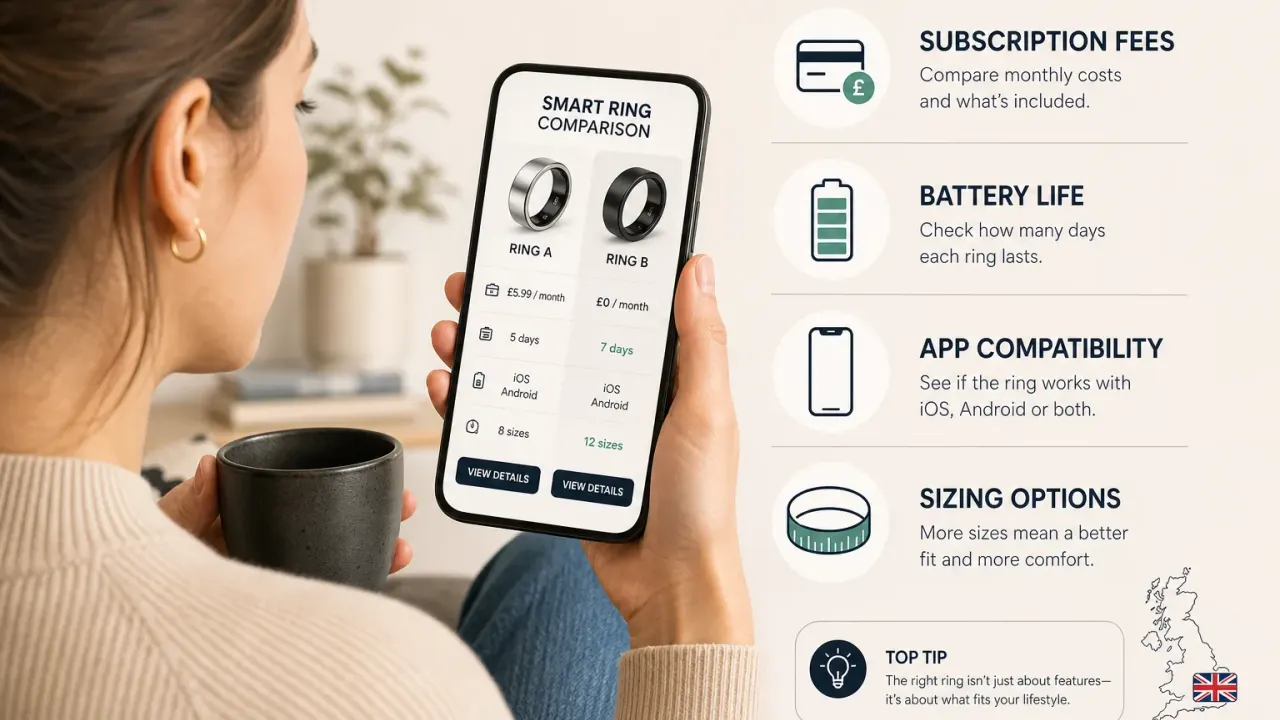
A Smart Ring can seem like a simple Phones & Wearables purchase: pick the size, choose a finish and check the upfront price. In practice, the ring is only half the product. The app, subscription model, charger, sizing process and phone support can decide whether it still feels good value after a few months.
Two UK-facing smart-ring comparisons published on 16 October 2026 and 29 October 2026 put recurring app fees, compatibility and evidence behind sleep data into focus for shoppers comparing wearables and activity trackers in late 2026.[1][2] They do not remove the need to check live product listings, but they do show why the cheapest-looking option is not always the simplest buy.
The most important calculation is not just “How much is the ring?” but “How much will I pay to use the features I actually want?” One October 2026 comparison calculated costs over two and three years because some smart rings separate the hardware price from an ongoing app membership.[1]
For example, that article stated that, at its September 2026 price check, an Oura Ring 5 Silver was listed at £399 and UK membership was £69.99 a year, giving a two-year total of £538.98 when annual membership was included.[1] That figure should not be treated as a live price, but it is a useful reminder that a membership can materially change the total cost of ownership.
By contrast, the same comparison said some rings were sold without a recurring fee for core ring data, while also noting that some optional software add-ons may still cost extra depending on the brand.[1] The buying point is simple: compare products and offers using a like-for-like ownership period, then use live product modules or retailer listings for the latest price and availability.
A subscription is not automatically bad value. It may fund app development, new insights or coaching features. The practical question is whether the data you care about remains available without it.
The 16 October 2026 comparison said Oura’s ring and app would still work without membership, but the insights and personal health data available would be much more limited.[1] That distinction matters if you are buying a Smart Ring mainly for sleep trends, recovery scores or longer-term health-style dashboards rather than basic activity tracking.
Before buying, write down the three features you would be disappointed to lose. If those sit behind a membership, include the subscription in your comparison. If a no-subscription ring covers those needs, the lower ongoing cost may be more relevant than a flashier app.
Smart Rings are small, but they depend heavily on the phone app. If the app does not support your phone well, or if certain features are limited to one mobile ecosystem, the ring may not deliver what you expected.
The 29 October 2026 comparison noted that Samsung’s Galaxy Ring works with Android phones running Android 11 or later, but not with iPhones, and that some features need a Samsung phone.[2] That does not make it a poor choice for everyone; it means iPhone users and non-Samsung Android users need to check feature availability carefully before comparing it with other Mobile Phone Accessories or Wearables.
Also check how the app presents data. A ring can collect heart-rate, movement and temperature-related signals, but the usefulness depends on how clearly the app turns them into trends, alerts or scores. If the app experience is central to the product, compare screenshots, feature lists and subscription terms with the same care as the ring itself.
Battery life is another area where headline numbers can hide real-world trade-offs. A longer rated battery life may be attractive if you travel often or dislike frequent charging, but it should be weighed against ring size, charger type, charging case availability and whether key features reduce runtime.
The 29 October 2026 comparison listed examples of manufacturer-rated battery claims, including RingConn Gen 3 at up to 14 days per charge and Ultrahuman Ring Pro at up to 15 days per charge, with the Ultrahuman charging case described as extending time between wall sockets.[2] Those are useful comparison points, but shoppers should still check the conditions behind any “up to” claim.
Think about your routine. If you shower, sleep and exercise with the ring, when will you charge it? Is the charger included, or is a travel charger or charging case extra? One comparison specifically flagged sizing kits, size exchanges, charging accessories, warranty length and delivery as smaller costs that can change the real price.[1]
Smart Rings are often bought for sleep and recovery insights, but shoppers should separate helpful trend tracking from medical certainty. The evidence base is uneven, and not every comparison is based on hands-on lab testing.
The 29 October 2026 article stated that it had not run the rings through its own lab and instead built its ranking from official product pages, UK retailer listings, independent reviews, owner feedback and published validation studies.[2] That is useful context: it can inform a shortlist, but it is not the same as identical controlled testing across every ring.
The same article cited a 2024 study of 96 adults in Sleep Medicine in which the Oura Gen3 detected sleep correctly 94.4% of the time but identified wakefulness at about 73%.[2] For shoppers, the takeaway is not that every ring is equally accurate, but that sleep scores should be treated as estimates and trends rather than perfect measurements.
Be especially careful with features related to conditions such as sleep apnoea or blood pressure. The 29 October comparison described one ring’s apnoea-related function as a risk indicator rather than a diagnostic tool, and said its vascular insights relied on blood pressure readings entered from a separate cuff rather than the ring measuring blood pressure itself.[2]
Before choosing between Smart Rings, activity trackers or other Wearables, compare each option on the same practical basis.
First, calculate the total cost over two years, including any mandatory app membership. Second, check what features remain if you cancel or never start a subscription. Third, confirm phone compatibility, especially if you use an iPhone or need features tied to a particular Android brand.
Fourth, check sizing and exchange rules before ordering. A ring that is too tight, too loose or awkward overnight can become an expensive drawer item. Fifth, look for charger details, warranty terms and whether travel accessories cost extra. Finally, treat sleep and recovery claims as decision-support tools, not definitive health assessments.
Not always. A no-subscription Smart Ring may be better value if it includes the features you will actually use, but a subscription model can still make sense if the paid app insights are important to you. Compare the two-year cost and the feature list rather than judging by the headline claim alone.
Battery life matters, but it should not be the only deciding factor. Check how the claim is worded, whether the charger is convenient, whether accessories cost extra and whether the app and phone support suit your needs.
The supplied evidence supports caution. One comparison cited sleep-validation research and described an apnoea-related feature on one ring as a risk indicator rather than a diagnostic tool.[2] If you have health concerns, use ring data as background information and seek appropriate medical advice.
Check whether the ring has an iOS app, whether all advertised features work on iPhone and whether any functions require an Android or Samsung phone. One October 2026 comparison specifically noted that Samsung’s Galaxy Ring does not support iPhones.[2]
The best smart-ring purchase is not necessarily the one with the lowest upfront price or the boldest “no subscription” message. It is the one where the total cost, app access, phone compatibility, charger setup and evidence behind the insights all line up with how you plan to use it.
For UK shoppers comparing Smart Rings, the safest approach is to shortlist by features first, calculate the realistic two-year cost second, and only then compare live offers. That keeps the focus on long-term usefulness rather than a tempting checkout price.
