
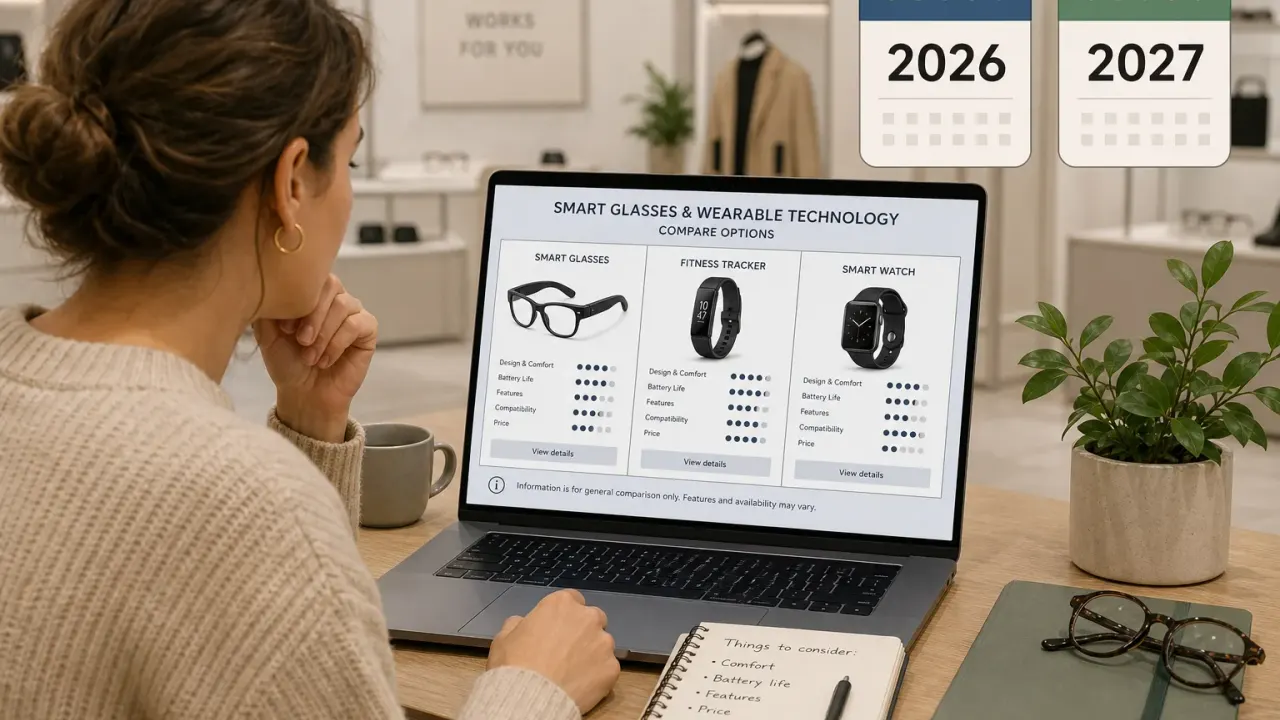
Smart glasses are no longer a distant concept, but they are still a messy category for UK buyers. Some models are presented as available, some are being previewed for overseas launches, and some are wrapped in reports of future release windows rather than confirmed UK retail plans.
The short answer: buy now only if the specific pair you want is officially sold for the UK, has clear support routes and does something you genuinely need. If you are waiting for lighter display glasses, Android XR models or VR-style eyewear, 2027 may be the more sensible comparison point.
What has actually changed?
Recent reporting points to a busier smart-glasses launch cycle rather than a simple wave of UK stock. Samsung’s Intelligent Eyewear was reported on 6 November 2026 as having pre-orders due to start on 12 November 2026, but that report said the launch focus was the US market, with Korea also mentioned through another partner, and only potential wider availability through 2027 [1].
A separate 5 November 2026 report also described pre-orders for Samsung’s Android XR glasses as starting on 12 November 2026, while noting reports that release may be limited to South Korea and the US at first [2]. For a UK shopper, that distinction matters: a product can be real, imminent and heavily covered without being a straightforward UK purchase.
Meta’s VR Glasses are also being discussed around a spring 2027 arrival window. A 5 November 2026 hands-on report described them as expected to arrive in the following spring, specifying April to early June, but that is not the same thing as a confirmed UK retail date [5].
Are smart glasses available to UK shoppers now?
The evidence supplied does not give a complete, verified list of every smart-glasses model currently on sale in the UK. That is important because smart glasses sit across several product types: camera glasses, audio glasses, display glasses, AR glasses and VR-style eyewear can all be described in similar language.
If a retailer or aggregator marks a product as landed, due, slipped or undated, treat that as a research lead rather than proof that you should buy. Before comparing offers, check whether the seller is a UK retailer, whether the product page clearly states UK availability, whether returns and warranty support are local, and whether the companion app or account features are supported in the UK.
For changing prices and availability, use live Wearables product modules rather than relying on launch articles. Early wearable tech often moves between pre-order, reservation, limited release and general sale, and those stages are not equally useful for ordinary buyers.
Why 2027 matters for buying decisions
The 2027 question is not just about waiting for something newer. It is about avoiding a purchase that could be outdated, unsupported or awkward to use in the UK by the time wider releases arrive.
Samsung’s reported Android XR glasses are a good example. The available evidence suggests pre-orders were due to begin in November 2026, but with the initial market focus outside the UK and possible expansion through 2027 [1]. If you buy early through an import route, you may be taking on extra uncertainty around support, returns, prescriptions, accessories and software features.
Meta’s VR Glasses are another example of why waiting could make sense. A hands-on report described a spring 2027 arrival window and positioned the device more like lightweight VR eyewear than simple camera glasses [5]. If your main interest is immersive screens, virtual desktops or entertainment, buying a simpler pair of camera or audio glasses now may not satisfy that need.
The UK privacy and policy question
Camera-equipped glasses have another complication: social acceptance and restrictions. On 5 November 2026, reports said the UK government was looking at options to restrict smart glasses in certain settings and restrict sales to certain users, with concerns focused on secret filming and consent [3].
Another report published the same day cited the UK safeguarding minister saying the benefits of smart glasses must be weighed against harms, and that options were being explored around restrictions in certain settings and sales to certain users [4]. That does not mean a blanket UK ban has happened, but it does mean buyers should consider where and how they expect to wear camera-equipped models.
There is already evidence of restrictions in specific places. England and Wales courtrooms were reported to have banned Meta glasses, with confiscation promised if they were worn into courtrooms and return after leaving [3]. For most shoppers this will not affect everyday use, but it shows why the category may face location-specific rules.
Buy now if your needs are simple and confirmed
Buying now can make sense if you have a clearly defined use case and the model is genuinely available through normal UK retail channels. Examples might include hands-free audio, calls, basic camera capture where permitted, or accessibility-related features, provided the product you choose supports what you need.
Do not buy just because a launch is attracting attention. Compare products by practical criteria: whether you need a camera at all, whether you need prescription lens options, battery and charging approach, compatibility with your phone, app support, returns, and how obvious the recording indicators are.
If you already own a strong smartphone and smartwatch, ask whether smart glasses add a new function or merely duplicate features in a less discreet way. In Phones & Wearables, the best choice is often the device that fits your daily routine rather than the newest form factor.
Wait if you want display glasses, Android XR or less risk
Waiting is the safer route if your interest is in Android XR glasses, richer displays, VR-style eyewear or products that have not been confirmed for UK sale. The supplied evidence points to several important products being discussed around overseas launches or 2027 windows rather than clear UK availability.
Waiting also gives the market time to settle. Early models can be expensive to access, accessories may be limited, and software features can change after launch. More importantly, UK policy discussions around camera-equipped smart glasses are not fully resolved, so buyers who plan to wear them in public spaces should be cautious.
A useful compromise is to shortlist features now, then compare offers again when UK retailers list confirmed stock. Put models into three groups: available in the UK, available overseas only, and announced or expected but not yet confirmed for UK buyers.
Early-adopter checklist for UK shoppers
Before you pay, check five things. First, is the product officially sold to UK customers, not merely reported or imported? Second, does the retailer make returns and after-sales support clear? Third, does the device work with your phone and the apps you actually use?
Fourth, consider the camera. If you do not need one, camera-free or display-focused options may avoid some social friction. Fifth, check timing: if a model you really want is expected in 2027, a stop-gap purchase now may be poor value unless it solves an immediate problem.
When comparing products and offers, avoid treating pre-order dates, overseas release windows and UK availability as the same thing. They are separate buying signals, and confusing them is where early wearable-tech purchases can go wrong.
Frequently asked questions
Should I buy smart glasses in the UK now?
Only if the exact model is clearly available from a UK seller and meets a real need. If the model is listed as due, overseas-focused or without a UK date, it is safer to wait or compare confirmed alternatives.
Are Samsung Android XR smart glasses confirmed for the UK?
The supplied evidence reports pre-orders beginning on 12 November 2026, but describes the initial focus as the US and Korea, with possible wider availability through 2027 [1]. That is not the same as confirmed UK retail availability.
Could UK restrictions affect smart glasses?
Possibly. Reports published on 5 November 2026 said the UK government was looking at options to restrict smart glasses in certain settings and restrict sales to certain users [3]. The evidence does not show that a broad UK ban has already been introduced.
What is the biggest risk of buying early?
The biggest risk is paying for a device before UK support, availability, app features and social rules are clear. Imports and limited launches can also make returns and accessories more complicated.
Conclusion
For most UK shoppers, smart glasses are worth watching rather than rushing. Buy now only where availability, support and use case are clear. If you are tempted by Android XR, display glasses or VR-style eyewear, the evidence points to 2027 as an important moment to reassess.
Use Wearables comparisons to track confirmed products and live offers, but treat launch rumours and overseas pre-orders with caution. In this category, waiting for clarity can be as valuable as getting the newest frame first.
Sources
- [1] T3 — Samsung's "Intelligent Eyewear" smart glasses get a pre-order date – and you only have to wait one more week until you can book your Android XR pair. Published 6 Nov 2026; Accessed 8 Nov 2026.
- [2] Android Central — Mark your calendar: Intelligent Eyewear pre-orders reportedly begin soon. Published 5 Nov 2026; Accessed 8 Nov 2026.
- [3] Tom's Guide — UK weighs ban on Meta Ray-Bans and other smart glasses, citing 'secret filming'. Published 5 Nov 2026; Accessed 8 Nov 2026.
- [4] TechRadar — Smart glasses 'not only have the potential to erode safety and privacy... but raise really important questions about consent': the UK is the latest country to consider restricting or controlling the sale of smart glasses — here's what you need to know. Published 5 Nov 2026; Accessed 8 Nov 2026.
- [5] TechRadar — Meta's VR glasses gave me something Vision Pro and Galaxy XR haven't: a reason to stay immersed. Published 5 Nov 2026; Accessed 8 Nov 2026.
