Loading buyer guide
Hurry, don't miss savings on selected furniture & more.* Shop all offers
Queues, games, scans and samples can make Beauty shopping feel more confident. The safer move is to use the experience as a first test, then compare full-size products, ingredients, usage claims and offers before buying.
Use our barcode scanner to match products instantly to find the best prices, find products with ease using our voice search and build wish lists and your favourites at the click of a button.
Tesco black friday 2026 preview: should you wait before buying an Oral-B electric toothbrush or kitchenaid stand mixer?
Tesco’s planned Black Friday timing may be a reason to pause, but not a reason to assume a bargain. For Oral-B electric toothbrushes and KitchenAid stand mixers, the smarter move is to compare live prices, bundle contents and retailer conditions before deciding.
How can you avoid buying counterfeit beauty products online?
Official warnings about fake cosmetics are a reminder to look beyond a tempting listing. Seller identity, product presentation and the buying channel all matter when you compare make-up, skincare and fragrance online.
Should you buy wellness supplements from boots and waitrose instead of specialist retailers?
Wellness supplements are moving further into everyday retail, with Boots adding K-Wellness and Waitrose creating dedicated Wellbeing Bays. The bigger question for shoppers is not simply where to buy, but how to compare formats, servings, pack sizes and claims before choosing between a high-street shelf, a supermarket aisle or a specialist subscription.
Currys is trialling tiktok shop — what to check before buying health and beauty tech in-app
Currys’ move into TikTok Shop could make some health and beauty tech easier to discover in social videos, but shoppers should still pause, verify the seller and compare the offer before paying in-app.
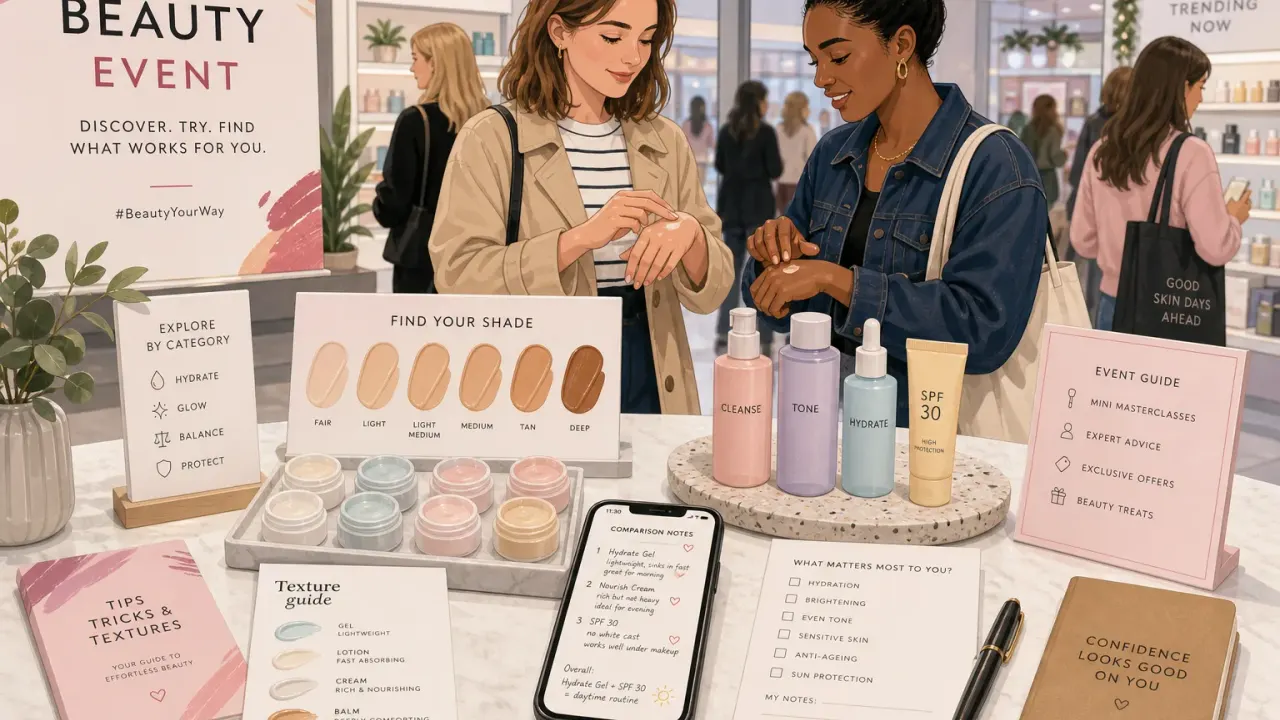
Beauty pop-ups and sample-led events can be genuinely helpful. They let you feel a texture, smell a fragrance, see a shade in real life and ask questions before committing to a full-size Beauty purchase.
But they are also designed to be memorable. Queues, games, prizes, limited experiences and polished displays can make a product feel more exciting than it may seem once it is sitting in your bathroom cabinet. The smart approach is not to ignore these events, but to treat them as one part of your buying process rather than the final verdict.
Recent UK examples show how beauty discovery is being turned into an in-person experience. SEPHORiA London was reported on 16 October 2026 as an event where shoppers queued at 180 Studios, with more than 40 brands offering product trials, workshops and interactive activations across themed areas.[1]
The same report said visitors could try Beauty Scan technology that measures oil and hydration levels and supports more precise foundation shade matching, alongside founder-led workshops and make-up demonstrations.[1] That matters for shoppers because some Beauty and cosmetics choices are difficult to judge from a product page alone, especially base makeup shades, finishes and textures.
Another example was Palmer’s Vanilla Dreams Diner at Manchester’s Trafford Centre. A report published on 27 October 2026 said the second edition was scheduled to run from 11am to 9pm on Saturday 31 October 2026 and to mark the launch of an extended Tahitian Vanilla Body and Hair line.[2] The evidence available here describes the event as scheduled and explains its planned product trials and sample-led activities, but it does not independently confirm post-event turnout, shopper satisfaction or product performance.
These examples show experiential beauty retail activity. They do not, by themselves, prove market-wide demand, long-term product quality, or that any product featured at an event is better value than alternatives.
A pop-up or demo can answer questions that are hard to settle online. Does a body lotion feel too rich or too light? Does a hair product’s scent linger longer than you want? Does a foundation shade look different under indoor lighting than it did on your phone?
The Palmer’s pop-up report said visitors would be offered the opportunity to try products served on a tray, with a menu explaining each formula and its benefits.[2] That type of format can help you notice texture, scent and immediate feel. It should not be treated as proof that the formula will suit you after repeated use, because the supplied evidence does not provide long-term testing data.
For Beauty shoppers, the most useful notes to make at an event are simple: how the product felt on your skin or hair, whether the scent was pleasant after a few minutes, whether the colour still looked right away from the stand, and whether the product would replace something you already use.
Games, freebies and limited experiences can make a product feel more desirable. At the Palmer’s activation, the report said attendees would be able to answer a quiz question, receive treat tokens, get samples through a gum ball machine and use a Plinko-style game with prizes including full-size products.[2]
There is nothing wrong with enjoying that. The buying risk is assuming that a free sample, queue or prize mechanic tells you anything about the full-size product’s value. It does not tell you how much you will use, whether the pack size is competitive, or whether another retailer has a better live offer.
Before buying, compare the full-size product against similar body care, hair products or cosmetics. Look at size, format, how often you expect to use it, whether it duplicates something you own, and whether the offer is attached to extras you do not need. Use live product modules for changing prices and availability rather than relying on an event impression.
Beauty scanning and shade-matching tools can be useful, particularly if you struggle to choose base makeup online. The SEPHORiA report said visitors could try Beauty Scan technology that measures oil and hydration levels and supports more precise foundation shade matching.[1]
Even so, a scan should be treated as guidance, not a guaranteed perfect match. Lighting, skin preparation, recent skincare, undertone preferences and your preferred finish can all affect whether you like the result. If a match is suggested, check it in natural light where possible, see whether it oxidises or changes after wear, and compare it with shades you already know suit you.
If you are buying foundation, concealer, BB creams or CC creams after a scan, avoid rushing straight to the largest or most expensive format. A smaller size, sample or retailer return policy information may be worth checking first, where available, but only rely on clearly stated retailer terms.
A sample is most useful when you test it in normal conditions, not just on the back of your hand at a busy stand. For body care and hair products, try to notice whether the fragrance suits your day-to-day routine, whether the texture works with your skin or hair type, and whether it layers comfortably with products you already use.
For cosmetics, test the product with your usual moisturiser, SPF, primer or base makeup where relevant. A product that looks excellent during a demo may behave differently with your existing routine.
If you know you are sensitive to fragrance or certain ingredients, do not let the excitement of a pop-up override your usual checks. Read the ingredient list, compare it with products you have reacted to before, and avoid buying immediately if you are unsure. This is practical shopping caution, not medical advice.
Wait before you buy if the product is not essential. Even a short pause can separate genuine interest from event excitement.
Check the full-size size, format and usage instructions. A generous-feeling sample does not always tell you how quickly you will use the full product.
Compare products and offers across the relevant Beauty category. Look beyond the featured product and compare similar body care, hair products, cosmetics or gift sets by size, ingredients, format and retailer availability.
Question event-only urgency. If the evidence you have is a queue, a demo or a freebie, that is not enough to prove best value.
Keep your routine in mind. The best purchase is the one you will actually use, not the one attached to the most memorable activation.
They can be a good starting point because you can often check texture, scent, shade and packaging in person. They should not be your only buying evidence, especially for products that need repeated use to judge properly.
Not unless you already know the product suits your needs and you have compared the full-size option. If possible, test the sample in your normal routine first, then compare products and live offers before buying.
The supplied evidence says Beauty Scan technology at SEPHORiA London was used to measure oil and hydration levels and support more precise foundation shade matching.[1] That is useful guidance, but it should still be checked against your preferred finish, lighting and wear time.
No. Queues can show interest in an experience, but they do not prove that a specific product is the best value, best performing or right for your routine.
Compare full-size quantity, ingredients, scent, format, how it fits your routine, retailer availability and any live offers. For changing prices and stock, use live product information rather than relying on what you saw at the event.
Beauty events, pop-ups, scans and samples can make shopping more informed when you use them carefully. They are especially helpful for sensory checks that online listings cannot fully answer.
The safer buying decision comes afterwards: test the sample properly, read the product details, compare similar offers and avoid treating entertainment as evidence. If the product still makes sense once the event excitement has faded, you are in a much stronger position to buy with confidence.