
Loading buyer guide
Hurry, don't miss savings on selected furniture & more.* Shop all offers
Boots and Waitrose are giving collagen, electrolytes, protein and gut-health products more space. Here’s how to judge convenience, value and clarity without assuming mainstream availability means a product is right for you.
Use our barcode scanner to match products instantly to find the best prices, find products with ease using our voice search and build wish lists and your favourites at the click of a button.
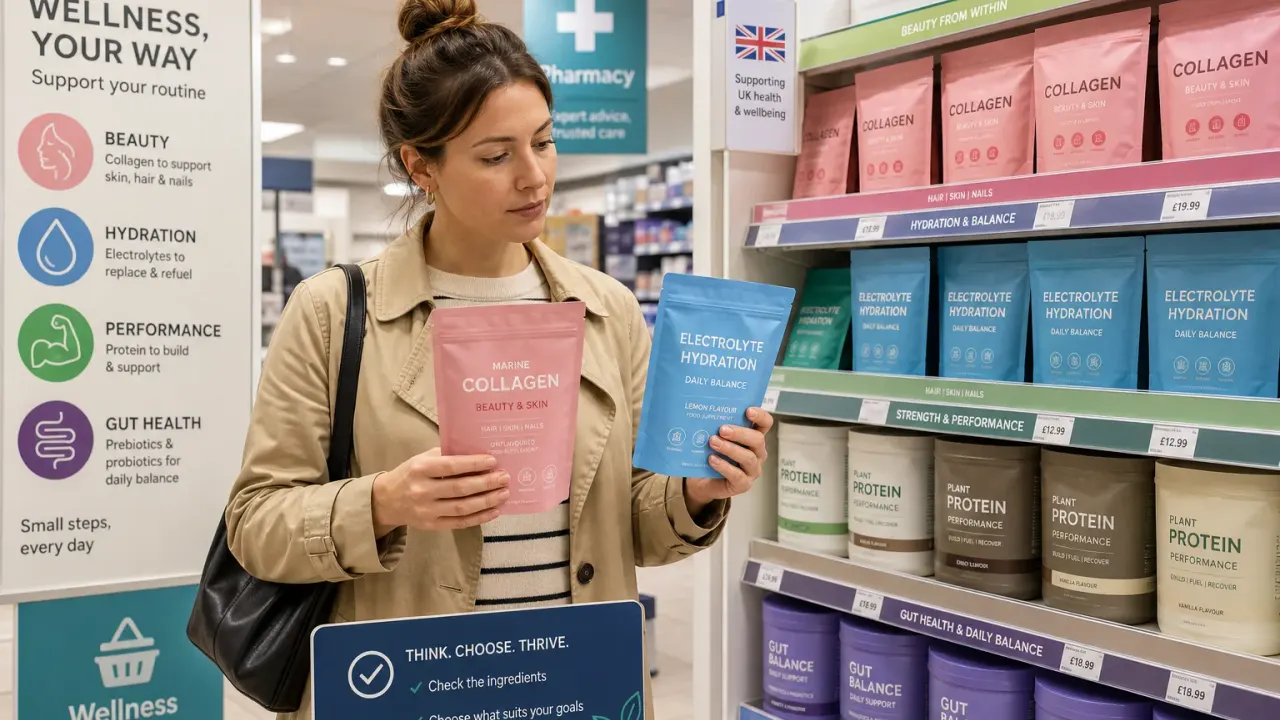
Boots and Waitrose are both giving wellness supplements more prominent space, which could make collagen, electrolytes, protein and gut-health products easier to find during an ordinary shopping trip. That does not automatically make them better value, more suitable or more effective than products from specialist retailers.
The useful buying question is narrower: when does a mainstream retailer make sense, and when should you still compare specialist health shops, brand websites or subscription options? For Health & Beauty shoppers looking at Vitamins & Supplements, the answer comes down to format, pack size, price per serving and how clearly the product explains what it is for.
Boots announced on 2 November 2026 that it was launching a dedicated K-Wellness category, rolling out from November with Korean wellness products across ingestible beauty, functional formats and traditional Korean ingredients.[1] The reported range includes external Korean brands as well as Boots-sourced ranges, with examples mentioned in the source including collagen jelly sticks, dissolving films, pear-juice-based drinks, marine collagen peptides and gut-health jellies.[1]
Boots also said it had created dedicated Wellness Zones in more than 30 stores, supported by more than 500 Health and Wellness Specialists across the UK.[1] That may help shoppers who prefer to browse in person, although the evidence supplied does not tell us exactly which stores carry each product, what stock levels are like or how advice is delivered in practice.
Waitrose said on 3 September 2026 that it had launched dedicated Wellbeing Bays across 52 shops, online and through on-demand grocery, with more than 40 premium wellness products across collagen, creatine, hydration, protein and gut health.[2] It also said smaller pack sizes would allow shoppers to try premium wellness products without committing to larger packs or online subscriptions.[2]
Both developments suggest wellness products are becoming more visible in everyday retail. However, the sales and search figures in the supplied evidence are retailer-reported signals, not independent proof of wider market demand or product effectiveness.
The biggest advantage is convenience. If you already shop at a supermarket or pharmacy, adding electrolytes, protein powder or a gut-health product to the same basket can reduce the friction of ordering from several places. That is especially useful when you are still working out which format fits your routine.
Mainstream retailers can also make trial easier. Waitrose specifically highlighted smaller pack sizes as a way for customers to try premium wellness products without committing to larger packs or online subscriptions.[2] For shoppers who are unsure whether they will use a powder every day, or whether a drink, stick, sachet or capsule is easier, a smaller format can be a sensible test before buying more.
In-store shopping may also make label comparison easier. You can hold two packs side by side, compare serving sizes, check whether the product is a powder, ready-to-drink option, sachet, jelly or capsule, and see whether the front-of-pack claim is explained clearly on the back.
Specialist retailers and brand subscriptions can still be worth comparing, particularly if you already know the exact supplement type, format and serving routine you want. A subscription may be convenient if you use the same product consistently, but it is less attractive if you are still experimenting or if the pack size is larger than you realistically finish.
Specialist ranges may also offer more depth within one category. For example, a mainstream shelf might carry a compact edit of collagen, electrolytes, protein and gut-health products, while a specialist retailer may offer more variations by flavour, format or serving style. The supplied evidence does not give enough detail to compare full range depth, so shoppers should compare live product listings rather than assume one channel has the better choice.
The key is not to treat supermarket or high-street availability as a shortcut for suitability. A product becoming easier to buy does not tell you whether the dose, format, ingredients or claims match your needs.
Format affects whether you will actually use the product. Collagen may appear as powders, drinks, jelly sticks or other ingestible beauty formats; Boots’ K-Wellness examples include collagen jelly sticks and marine collagen peptide products.[1] Electrolytes may be positioned around hydration and can appear in formats such as drinks, powders or sachets, depending on the product range available to you.
Protein products can vary between powders, ready-to-drink options, bars or other foods. Gut-health products may be sold as drinks, jellies, fibres or other supplement formats. Waitrose said its Wellbeing Bays cover collagen, creatine, hydration, protein and gut health, but the supplied evidence does not list every product format or serving size.[2]
Before comparing offers, decide what you will realistically take. A powder may be good value per serving but less useful if you dislike mixing it. A ready-to-drink option may be convenient but could cost more per serving. A small trial pack may be sensible if flavour, texture or routine are uncertain.
A larger tub or multipack can look cheaper at first glance, but the fair comparison is usually price per serving. Use the live product information available at the time you shop, because supplement prices, offers and availability can change.
To compare fairly, check the number of servings in the pack, the recommended serving size and the total pack price shown by the retailer. Divide the current price by the number of servings. Then compare that figure with similar formats from other retailers, including any subscription option you are considering.
Also look for hidden practical costs. If a powder needs a shaker, if a product is sold in a short trial size, or if a subscription requires buying more than you need, the headline offer may not reflect your real cost. For product modules and comparison tables, use live prices and stock rather than relying on fixed article copy.
The supplied evidence shows that retailers are using wellness language around areas such as ingestible beauty, hydration, protein and gut health.[1][2] Those category labels can help you find products, but they should not replace careful label reading.
For each product, look for the active ingredient, amount per serving, suggested use, allergen information, warnings and whether the claim is explained in plain English. If a product uses trend-led language, check whether the label makes clear what the product contains and how it is intended to be used.
Be especially cautious with vague promises. A clear product page or pack should make it easy to understand the format, number of servings and ingredient amounts. If you cannot work out what you are buying without decoding marketing language, compare alternatives before purchasing.
Choose Boots or Waitrose if you value convenience, want to browse in person, are trying a smaller pack, or want to compare wellness supplements alongside your normal Health & Beauty or grocery shop.
Compare specialist retailers if you want a wider set of formats, are buying a repeat product in bulk, or are considering a subscription and need to check whether the saving is worthwhile per serving.
Pause before buying if the serving size is unclear, the pack does not state how many servings it contains, the claim is not easy to understand, or the product format does not fit your daily routine. The best deal is the one you will use correctly and consistently, not simply the one with the biggest-looking pack.
The supplied evidence does not show that they are better. Boots and Waitrose are making wellness products more visible and convenient, but shoppers should still compare format, serving size, ingredients, price per serving and claim clarity against specialist retailers or subscriptions.
It can be useful if you are trying a new format, flavour or routine. Waitrose said smaller pack sizes would help shoppers try premium wellness products without committing to larger packs or online subscriptions, but value still depends on the live price per serving.
A subscription can make sense if you already use the same product regularly and the price per serving is competitive. If you are still testing a product, a supermarket or high-street pack may be less committal.
No. Retailer-reported search or sales figures can indicate interest on that retailer’s own channels, but they do not prove a product is effective or suitable for an individual shopper.
Boots and Waitrose moving further into wellness supplements is useful for shoppers because it makes products such as collagen, electrolytes, protein and gut-health supplements easier to compare during everyday trips. It is not, by itself, a reason to switch away from specialist retailers.
The smartest approach is to compare the product, not just the retailer. Check the format, pack size, number of servings, live price per serving and clarity of claims. If a mainstream shelf helps you trial a product without overcommitting, it may be the better route. If you already know exactly what you need, specialist retailers and subscriptions still deserve a place in the comparison.
