Loading buyer guide
Hurry, don't miss savings on selected furniture & more.* Shop all offers
A talking air fryer is most interesting for shoppers who find small screens, silent presets or unclear end alerts frustrating. The key is to compare the accessibility feature with the basics that make an air fryer useful day to day.
Use our barcode scanner to match products instantly to find the best prices, find products with ease using our voice search and build wish lists and your favourites at the click of a button.

A talking air fryer is worth considering if the usual air fryer experience feels fiddly: small displays, touch-only buttons, quiet beeps, hard-to-read presets or uncertainty about when to shake food. The point is not that speech automatically makes an appliance better, but that clearer prompts may remove a common barrier for some users.
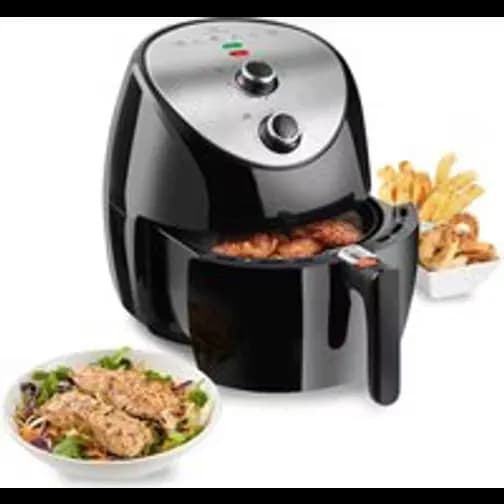
The verified development is that the Cobolt talking air fryer is described as telling users when to shake chips and when dinner is ready . That is a useful accessibility idea, but it is not enough on its own to prove cooking performance, ease of cleaning, value for money or suitability for every household.
For UK shoppers comparing Airfryers in the wider Home & Lifestyle category, the best approach is to treat talking prompts as one feature in a broader shortlist, not as a shortcut to the right model.
A talking air fryer may be useful for someone who struggles to read a small digital display, remember where they are in a cooking programme, hear a subtle end beep or interpret icon-led presets. It could also help if the appliance is being bought for a relative who wants more reassurance during cooking but does not want to keep checking the basket.
It may be less important for confident air fryer users who already rely on manual time and temperature settings, kitchen timers or visual reminders. If you usually cook the same foods and know when to shake or check them, spoken prompts may be convenient rather than essential.
Think about the person who will use it most. If they need clearer feedback, the talking function could be a meaningful feature. If they need simpler controls overall, a standard air fryer with large physical dials, clear labels and fewer menus may be just as suitable.
Spoken prompts can help with timing and reassurance. A prompt to shake food, for example, may reduce the need to watch the timer closely. A spoken ready alert may also be easier to notice than a quiet beep in a busy kitchen.
However, speech does not automatically make an appliance fully accessible. You still need to consider how easy it is to load the basket, set a programme, change time or temperature, clean the drawer and understand any warning lights. If the main controls are still hard to use, a talking alert at the end will only solve part of the problem.
Also consider the kitchen environment. Spoken prompts may be helpful in a quiet room, but less useful if there is background noise, an extractor fan running or other appliances beeping. If possible, compare how the control layout works as a whole rather than judging the product only by the presence of speech.
For an accessible air fryer, the control panel matters as much as the cooking basket. Look for controls that are easy to distinguish, with clear start and stop functions, legible markings and settings that do not require too many steps. Touchscreens can look tidy, but they are not always the easiest option for everyone.
Physical buttons or dials may suit users who prefer tactile feedback. A bright display may suit some shoppers, while others may prefer audible confirmation. Presets can be helpful if they are clearly labelled, but confusing if they use small icons or require the user to remember what each symbol means.
When comparing products and offers, do not assume the more feature-packed air fryer is the easier one to live with. A simpler standard model with clearer controls may be a better buy than a talking model if the spoken prompts are paired with awkward menus.
Accessibility features should not distract from size. A compact air fryer may be easier to lift, store and clean, but it may not suit a household cooking larger portions. A bigger model may reduce batch cooking, but it can take up more worktop space and may be harder to move around.
Before buying, think about the meals you actually cook: single portions, chips and snacks, two-person dinners, or family sides. If the basket is too small, the user may need to cook in several rounds. If it is too large, it may become awkward for daily use.
Where possible, compare the internal cooking space and the external footprint rather than relying on broad labels such as compact or family size. Availability and current offers can change, so use live product modules to check what is on sale before deciding.
A talking reminder is useful during cooking, but cleaning is what determines whether an appliance stays in regular use. Compare how easy the drawer is to remove, whether the basket feels manageable, and whether the surfaces look simple to wipe after everyday meals.
For shoppers with reduced grip strength or limited mobility, a heavy drawer or awkward handle can be a bigger drawback than a missing preset. If buying for someone else, try to think beyond the first week: will they be comfortable pulling the basket out, shaking food safely and returning it to the appliance?
Also compare where the air fryer will live. If it needs to be stored in a cupboard and lifted out every time, weight and shape become more important. A slightly less advanced air fryer that can stay safely on the worktop may be used more often.
It may be worth paying more if the talking function directly solves a real problem for the user: missed alerts, difficulty reading the display, uncertainty about shake reminders or anxiety about whether cooking has finished. In that case, the feature is not a gimmick; it is part of making the appliance usable.
It is harder to justify paying extra if the shopper already uses visual timers comfortably, prefers manual cooking or would be better served by large controls and a straightforward design. The buying decision should come down to practical independence, not novelty.
Compare any talking model against standard Airfryers with similar capacity, control type and cleaning convenience. Then decide whether the speech feature adds enough everyday value to outweigh any trade-offs in price, size, availability or simplicity.
If a talking air fryer does not feel right, there are other routes to a more usable setup. A standard air fryer with large dials may be easier for some people than a digital model. A separate loud kitchen timer can help with shake reminders. A model with clear presets may reduce guesswork without adding spoken prompts.
For households already comparing air treatment or other Home & Lifestyle appliances, the same principle applies: the most useful product is the one that fits the user’s routine, not necessarily the one with the newest feature. Accessibility is about removing friction in daily use.
If buying as a gift, involve the intended user if you can. Air fryers are hands-on appliances, and preferences around sound, touch controls, basket size and cleaning can be very personal.
No. A talking air fryer may be better for someone who benefits from spoken prompts, but a standard air fryer with clearer controls, suitable capacity and easier cleaning may be the better choice for another user.
Start with control layout, display readability, basket size, cleaning, handling and where it will sit in the kitchen. Then compare the talking feature as an accessibility benefit, not as the only reason to buy.
Shoppers who struggle with small displays, quiet beeps, icon-led presets or remembering when to shake food may find spoken prompts helpful. The benefit depends on how clear the rest of the appliance is to use.
If the talking function sounds useful but you are unsure about performance, usability or value, it is sensible to compare more product information and current offers before committing. Do not treat the announcement of a feature as proof that the appliance is the right fit.
A talking air fryer is a feature worth taking seriously, especially for shoppers who find standard air fryer controls unclear or easy to miss. Spoken prompts for shaking food and readiness could make cooking feel more manageable for the right user .
The sensible buying decision is to compare the whole appliance: controls, capacity, cleaning, handling, kitchen space and current offers. If the talking feature solves a genuine accessibility need without compromising those basics, it deserves a place on the shortlist. If not, a simpler standard air fryer may be the more practical buy.