
Loading buyer guide
Hurry, don't miss savings on selected furniture & more.* Shop all offers
Before buying another kids’ tablet, it is worth asking what kind of play your child actually returns to. Some screen-free toys offer open-ended play, while others rely on batteries, collections or adult set-up. Here’s how to compare the main categories without being led by hype alone.
Use our barcode scanner to match products instantly to find the best prices, find products with ease using our voice search and build wish lists and your favourites at the click of a button.
How do you check christmas toys for recalls before buying?
Christmas toy shopping is easier when you know where to look for official safety warnings. Here’s how to use GOV.UK and OPSS recall information before buying slime, sensory toys, wooden toys or marketplace kits.
Which john lewis top ten toys 2026 are actually worth shortlisting?
John Lewis’s Christmas 2026 toy prediction is useful inspiration, but it should not become an automatic shopping list. The smarter move is to test each toy against age fit, storage, repeat play, batteries, family involvement and whether a simpler alternative would satisfy the same wish.
Which toys from Amazon’s 2026 christmas list are actually worth shortlisting?
Amazon’s 2026 Toys We Love list can be a useful starting point, but it is still a retailer selection rather than an independent test. Here’s how to turn the named toys into a smarter shortlist by play style, likely use and budget.
Are aldi christmas toy specialbuys worth planning around?
Aldi’s Christmas toy Specialbuys can be handy for early, budget-conscious gift hunting, but the middle aisle should not replace proper comparison. The safest approach is to treat each drop as a shortlisting opportunity, then check age suitability, play value, stock risk and alternative offers before buying.
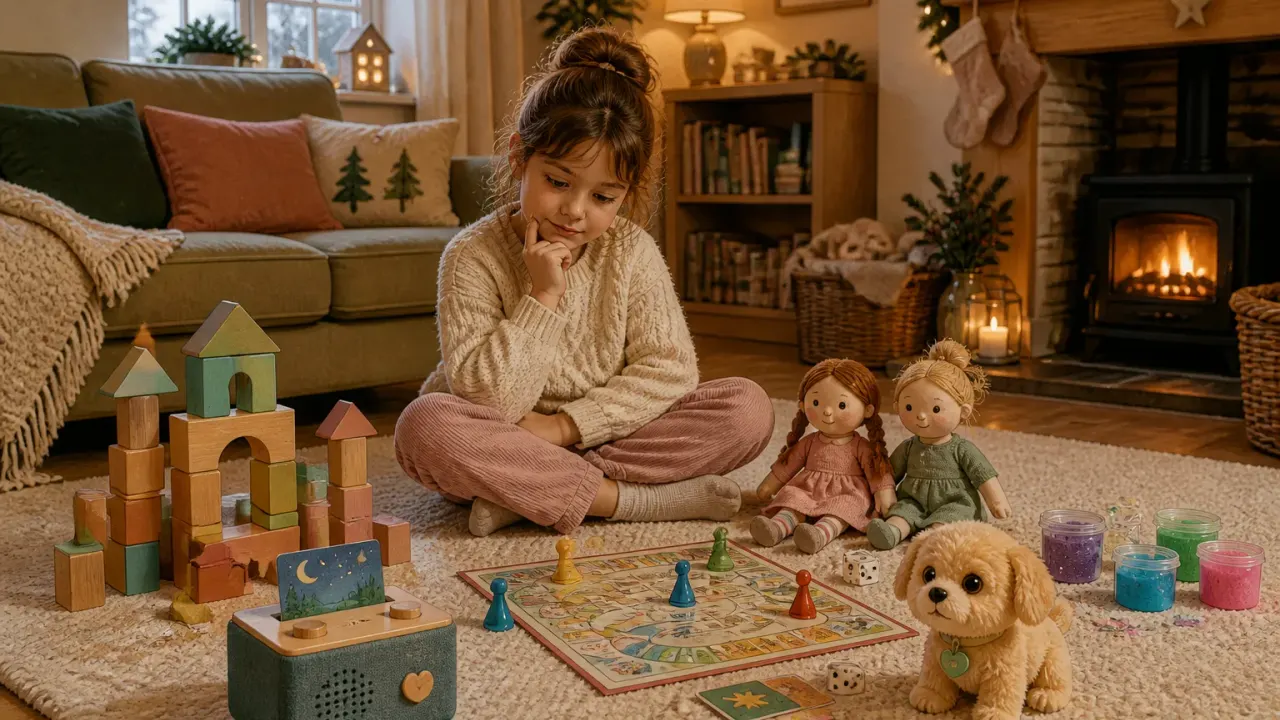
If you want a less screen-led Christmas gift, the question is not simply whether a tablet is “bad” and toys are “good”. It is whether the present fits your child’s age, your home, your tolerance for mess, and the kind of play that will still appeal after Boxing Day.
A retailer release published on 4 November 2026 cited UK Google Trends data from July to October 2026, saying search interest had risen for categories including wooden toys, Little Live Pets, doll sets, slime, squishies and blind-box collectibles, while also highlighting Tonies boxes and board games as screen-free options [1]. That is a useful research prompt, but it is not sales data, independent testing or proof that every named toy category is right for every household.
A separate retailer toy list reported on 2 November 2026 also mixed screen-free options such as card games, building kits, surprise collectables and imaginative playsets with a kids’ tablet, showing that shoppers are still being presented with both digital and hands-on gift ideas in the same Christmas conversation [2]. The practical choice is to compare toys and offers by how they will be used, not by assuming one format wins automatically.
Screen-free can mean several things. For some families, it means quieter bedtime entertainment. For others, it means social play, craft-style sensory play, pretend play, collecting, or toys that keep younger children busy without an app.
Before comparing Toys, decide what problem you are trying to solve. If the child already has plenty of solo entertainment, a board game or cooperative playset may be more useful. If evenings are the challenge, an audio story toy may fit better than slime or construction toys. If storage is tight, a compact card game or small doll accessory set may be easier to live with than a large wooden kitchen or bulky playset.
It also helps to separate “less screen-led” from “no batteries”. Some screen-free toys still use electronics. Interactive pets and audio story toys can avoid screens while still needing power, characters, accessories or replacement parts depending on the product. That is not a reason to avoid them; it is a reason to compare running fuss as well as the initial gift appeal.
The 4 November 2026 retailer release said UK search interest in wooden toys had risen by 194% since July, based on Google Trends data from July to October 2026 [1]. It described wooden toys such as kitchens, blocks and puzzles as tactile, durable and battery-free, with an indicated age focus of 1 to 6 years [1].
For shoppers, the appeal is clear: wooden blocks, puzzles and pretend-play sets can be revisited in different ways as a child grows. They are often good to compare if you want a gift that does not depend on a character licence, a surprise mechanic or a screen.
The trade-off is space. Blocks need a box, puzzles need all their pieces, and larger pretend-play toys can dominate a room. Compare product photos carefully, check the stated age suitability, and think about whether the toy can be packed away by the child or will become another adult tidy-up job.
The same retailer release reported a 166% rise in UK search interest for Little Live Pets since July and described the category as best for ages 5 and up [1]. It also gave an example of an interactive toy responding to touch and sound [1].
Interactive pets can be a strong compromise when a child wants something that feels responsive but you do not want to buy another tablet. They may suit children who enjoy nurturing play, routines and repeated interactions.
However, compare the practical details before buying. Check whether the toy needs batteries, whether any sounds can be switched off, how much space it needs, and whether younger siblings might find small accessories frustrating. If the product’s appeal depends on a specific feature, make sure that feature is clearly stated by the retailer rather than assumed from a video or advert.
Doll sets were another category named in the 4 November 2026 release, which reported UK search interest up 92% since July and described dolls, furniture and accessories as supporting children in building their own stories [1].
Dolls and doll houses are worth comparing when a child enjoys role play, caring games, family scenarios or fashion-style dressing up. They can also be easier to extend gradually than one big-ticket electronic gift, because relatives can choose compatible accessories if they know the range.
The buying risk is compatibility. Before choosing a doll house, furniture pack or accessory bundle, compare scale, age guidance and what is included in the box. A set that looks generous in pictures may rely on separate add-ons, while a simpler doll can still offer plenty of repeat play if it fits the child’s existing toys.
The retailer release said UK search interest in slime sets had risen 91% since July and described them as messy, sensory and customisable, with an indicated age range of 4 to 10 years [1]. It also reported squishies up 75% and described them as satisfying to squeeze [1].
These categories are worth comparing for children who enjoy fidget toys, sensory play or making things. They can feel more hands-on than a screen and can work well as smaller gifts, stocking fillers or part of a bigger present bundle.
The practical questions are mess, materials and lifespan. For slime, look at whether the set is ready-made or requires mixing, what surfaces it can be used on, and whether an adult will need to supervise. For squishies, compare size, age suitability and whether the toy is likely to be a short-lived novelty or something the child genuinely uses to keep their hands busy.
Blind-box collectibles were listed with a 72% rise in UK search interest since July and an indicated age of 6 and up in the 4 November 2026 release [1]. A separate retailer list reported on 2 November 2026 also included surprise collectables among its Christmas toy picks [2].
The appeal is the reveal. For some children, unboxing and swapping are part of the fun. For parents and gift buyers, the downside is duplication and the pressure to “complete” a set.
Compare blind-box toys carefully if you are watching budget or clutter. A single box can be a fun extra, but a collection-led toy can become expensive if the child wants repeated purchases. If you do buy one, it may be wiser to frame it as a one-off surprise rather than the start of a full collection.
Tonies boxes were highlighted in the 4 November 2026 release as audio story toys for ages 3 to 8, pairing stories with physical characters and giving children control without a screen [1].
This kind of gift can make sense if your aim is calmer play, bedtime listening or independent story time. It is not the same purchase decision as a tablet because the child is not watching a display, but it is still a system: you may need to compare the starter set, story character choices and how easily the child can operate it.
The main buying question is whether the content suits the child for more than a few weeks. Compare available stories, familiar characters, volume controls if listed, and how many pieces need storing. For families with more than one child, also consider whether the age range and story choices overlap enough to avoid arguments.
Board games were highlighted in the same 4 November 2026 release as a screen-free way to bring families together, with an indicated age of 6 and up [1]. A separate retailer list reported on 2 November 2026 also featured card and family game options among Christmas toy picks [2].
Board games can be one of the better screen-free categories for repeat play because the value often comes from playing together rather than from a single reveal. They are also easier to store than many playsets, provided the box size is manageable.
The age guidance matters. A game that is too simple may be abandoned quickly, while one with too many rules can turn Christmas afternoon into a negotiation. Compare playing time, number of players, reading requirements and whether adults will genuinely want to join in. A short, replayable game can be more useful than a larger box that rarely leaves the cupboard.
Use the search data as a starting list, not a shopping order. The July to October 2026 Google Trends figures cited in the retailer release show reported interest over a period, but they do not tell you stock levels, product quality, long-term play value or what your child will prefer [1].
A sensible comparison shortlist might include one open-ended option, one social option and one child-specific interest. For example, compare wooden blocks against a board game if you want repeat use, or compare an interactive pet against an audio story toy if you want less screen time but still need independent play.
When browsing Toys offers, use live product modules for changing price and availability rather than relying on any fixed article price. Then check five things: age suitability, what is included, whether batteries or accessories are needed, how much storage it requires, and whether the child can play without constant adult set-up.
The “safer bet” is usually the toy that fits your household friction points. If mess is the issue, slime may be a poor choice even if it is popular. If quiet solo play is the goal, a board game may not solve it. If clutter is already a problem, blind-box collectibles may be less sensible than one compact, reusable game.
Not always. Screen-free toys can encourage hands-on play, social play or listening, but a poor age fit or messy toy can be frustrating. Compare the purpose of the gift, the child’s interests and the practical set-up before deciding.
Based on the supplied evidence, wooden toys, interactive pets, dolls, slime, squishies, blind-box collectibles, audio story toys and board games are all worth comparing. The best choice depends on age suitability, storage, batteries, mess and repeat play.
No. The cited Google Trends data shows reported UK search interest from July to October 2026, not confirmed sales, stock levels or independent product quality. Treat it as an early research signal rather than proof that you must buy quickly.
Board games, card games, compact audio story accessories and smaller wooden puzzles can be easier to store than large playsets. Always compare the actual box contents and dimensions shown by the retailer before buying.
A less screen-led Christmas does not have to mean rejecting every digital product or buying whatever toy category is trending. The useful move is to compare how each toy will work in your home: who it is for, how often it can be replayed, what it needs to function and where it will live after Christmas.
Wooden toys, interactive pets, dolls, slime, squishies, blind-box collectibles, audio story toys and board games all have a case. The best buy is the one that matches the child’s play style and your household limits, not simply the one with the loudest seasonal buzz.
