
Loading buyer guide
Hurry, don't miss savings on selected furniture & more.* Shop all offers
A larger robot vacuum dustbin is not automatically better. Compare bin capacity alongside dock compatibility, water tanks, height, accessory costs and the offer available before deciding which model belongs in your home.
Use our barcode scanner to match products instantly to find the best prices, find products with ease using our voice search and build wish lists and your favourites at the click of a button.
Self-emptying robot vacuums compared
Self-emptying docks can make a robot vacuum cleaner far more convenient, but they also add cost, bulk and ongoing consumables. The smartest buy is not always the most feature-packed model; it is the one whose dock, bags, dimensions and retailer offer fit your home and budget.
Shark vs Eufy robot vacuums
SharkNinja and Eufy appeal to slightly different robot vacuum buyers: Shark is often worth shortlisting when you want a more appliance-like set-up with hands-off emptying, while Eufy is strong for shoppers comparing compact, app-controlled models and value-led offers.
Dreame vs Xiaomi robot vacuums
Dreame and Xiaomi robot vacuums can look similar on paper, but the better buy depends on mapping, mop maintenance, dock automation and the offer available from UK retailers.
Best kettles for hard water areas
Hard water can leave scale around the spout, base and filter of a kettle, so the smartest choice is usually the model that is easiest to fill, descale and inspect rather than simply the one with the lowest ticket price.
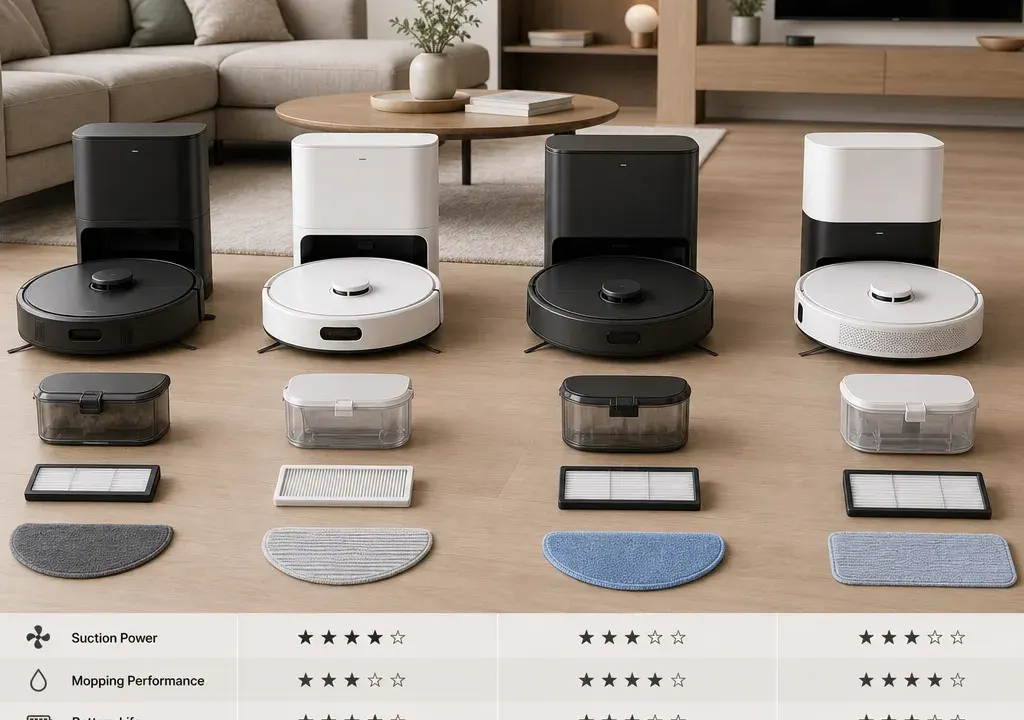
A robot vacuum with a tiny dustbin can still be a good buy for a flat with hard floors. The same model may become annoying in a busy home with pets, rugs and daily crumbs. Dustbin capacity is not just a technical detail; it changes how often you empty the robot and how convenient it feels after the first week.
The tricky part is that robot vacuum cleaner listings do not always present capacity in the same way. Some quote the robot’s internal dustbin, some focus on a self-emptying dock, and mop models may add a water tank that competes for space inside the machine. Use dustbin size as one part of a wider comparison rather than as a single deciding number.
The internal dustbin is the small container inside the robot that collects dust, hair and debris while it cleans. A larger bin usually means fewer interruptions, especially if you run the robot across several rooms or have pets. A smaller bin can still be perfectly reasonable where cleaning runs are short and debris levels are light.
Think about what fills a bin in your home. Fine dust from hard floors may not look like much, while pet hair, cereal, cat litter and fluff from rugs can fill a small bin quickly. If you expect the robot to clean under dining tables, hallways and high-traffic areas every day, capacity becomes more important than it might appear on a spec sheet.
Do not judge dustbin size in isolation from suction claims. Models such as the Vexilar W9 Robot Vacuum Cleaner 8000Pa or the Olsen & Smith Smart Robot Vacuum Cleaner 6500Pa are presented with strong suction figures in their names, but suction does not tell you how much debris the bin can hold or how often it needs emptying. Capacity, filtration access and bin design still matter.
A standard robot vacuum stores everything in its onboard dustbin until you empty it manually. A self-emptying robot can transfer debris into a larger dock or base station, reducing how often you handle dust. These are two different capacities, and it is worth comparing both.
The iRobot Roomba Plus 405 Self-Emptying Robot Vacuum Cleaner is an example from the current comparison set where self-emptying is clearly part of the product proposition. That does not mean it is automatically the best value for every shopper. You still need to compare the robot’s size, the dock footprint, replacement bags or filters, and the live retailer offer.
Premium-looking models such as the Samsung Jet Bot Combo AI, Dreame X50 Ultra Complete Robot Vacuum Cleaner and MOVA Z60 Ultra Roller Robot Vacuum Cleaner may appeal if you want a more automated cleaning set-up, but check the exact dock functions before assuming what is included. Product names can hint at a higher-spec system, yet the important details are in the specification: whether the dock empties dust, washes mop pads, dries them, stores clean water, or simply charges the robot.
For a small flat or a couple of mainly hard-floored rooms, you may be happy with a modest onboard dustbin if the robot is easy to empty and the price is right. Compact models can make sense when storage space is tight or when the cleaner is used as a maintenance tool between deeper cleans.
For a family home, larger internal capacity or a self-emptying dock becomes more appealing. Crumbs, tracked-in dirt and hair can build up quickly, and a small bin may need attention before a full cleaning run is finished. If you want the robot to clean while you are out, bin size matters because a full bin can reduce the usefulness of scheduled cleaning.
For pet owners, capacity is only one part of the decision. Look at brush design, filter availability and how easily hair can be removed from the roller. A large bin is less helpful if the brushroll is hard to clear or replacement parts are difficult to find.
Hybrid robot vacuums and mop models divide the job between collecting debris and carrying water. The Eufy L60 Hybrid Robot Black and the Sodial Robot Vacuum Cleaner Sweep Mop 6000pa are examples where mopping or hybrid cleaning is part of the comparison context. Before choosing, check the dustbin and water tank capacities separately.
A bigger water tank may be useful for larger hard-floor areas, but it can also change how often you refill the robot and how much maintenance is involved. Some shoppers mainly want light damp wiping in the kitchen; others expect a robot to cover open-plan hard floors more regularly. Those are different needs.
If the listing does not state water tank size clearly, treat that as a reason to investigate further rather than guess. It is better to shortlist models where the dustbin, water tank, mop pad type and replacement pad availability are easy to understand.
Robot vacuum dimensions matter because height determines whether the cleaner can reach under sofas, beds and cabinets. Width affects how easily it moves between chair legs and around tight corners. A slimmer robot can be more useful in some homes, even if its bin is not the largest.
The Lefant M210p Robot Vacuum Cleaner is listed with a 7.8 cm height in the product title, making height a key comparison point for shoppers with low furniture. The trade-off to check is whether a compact body still gives you the bin capacity, battery life and navigation features you need.
Also measure where the robot will live. A self-emptying dock or combo station can take up considerably more floor and wall space than a simple charging base. If your chosen spot is a narrow hallway or utility corner, the dock footprint may matter as much as the robot’s own dimensions.
Robot vacuum cleaners in the current comparison set range from budget listings to premium models, with examples such as the Liectroux C30B Black, Eufy RoboVac 15C, Eureka E20 Robotic Vacuum Cleaner Graphite Purple and higher-priced dock-led options. Offers change, so focus on what the price includes rather than treating a discount as the whole story.
A lower-priced robot can be a sensible buy if it covers the basics: suitable bin size, easy emptying, reliable replacement filters and dimensions that suit your rooms. A more expensive model may be worth considering if it reduces manual emptying, handles mopping more conveniently or includes a dock that genuinely fits your routine.
When comparing products and offers, ask whether you are paying for capacity, automation, navigation, mopping, brand ecosystem or simply a temporary deal. The best value is the model whose useful features you will actually use.
Dustbins do not work alone. Filters, side brushes, main rollers, mop pads and, for some self-emptying systems, dust bags all affect the running cost and practicality of a robot vacuum. Before buying, check whether replacements are easy to find from UK retailers and whether they are model-specific.
This is especially important for self-emptying and mop models. If a dock needs disposable bags, the long-term convenience depends partly on the availability of those bags. If a mop system uses specific pads, you will want to know they can be replaced without hassle.
Accessory availability can also influence whether a lesser-known or heavily discounted robot is a sensible purchase. A low upfront price is less attractive if filters or brushes are hard to source later.
Choose a standard onboard-bin robot if you have a smaller home, light debris, limited storage space and do not mind emptying it regularly. Prioritise easy bin removal and washable or replaceable filters where the manufacturer supports them.
Consider a larger-bin or self-emptying model if you have pets, children, multiple rooms or want scheduled cleaning with less intervention. Check both the robot capacity and dock capacity, and make sure the dock fits the space where you plan to keep it.
Choose a hybrid mop model only after checking water tank size, mop pad replacements and whether the mopping feature suits your floor type and expectations. If you mainly need vacuuming, do not let a mop feature distract you from dustbin capacity, navigation and accessory availability.
There is no single best size. Smaller bins can suit flats and light daily cleaning, while larger bins or self-emptying docks are more useful for pets, family homes and multi-room schedules. Compare capacity with your floor area and how often you are willing to empty the robot.
It can be worth paying more if you want less manual emptying, have pets or run the robot frequently. However, you should also compare dock size, replacement bag availability, noise during emptying and the overall offer before deciding.
Some hybrid designs have to accommodate both debris collection and a water tank, so it is important to check the stated dustbin and water tank capacities separately. Do not assume a mop model has the same dust capacity as a vacuum-only model.
Both matter, but they answer different questions. Suction relates to how debris is lifted, while dustbin capacity affects how much the robot can collect before emptying. For everyday convenience, capacity and easy maintenance are just as important as headline suction claims.
Dustbin size is a practical way to narrow down Robot Vacuum Cleaners, but it should not be the only spec you compare. The right choice depends on your floor area, debris levels, storage space, appetite for maintenance and whether a self-emptying dock genuinely makes life easier.
Before you buy, compare the internal bin, any dock capacity, water tank size where relevant, robot dimensions, replacement accessories and the current retailer offer. That gives you a much clearer picture than judging a robot vacuum cleaner by discount or suction figure alone.
