
Loading buyer guide
Hurry, don't miss savings on selected furniture & more.* Shop all offers
Budget robot vacuum cleaners can vary widely, even when they sit below the same £200 filter. Here’s how to compare the live catalogue by features that actually affect day-to-day use.
Use our barcode scanner to match products instantly to find the best prices, find products with ease using our voice search and build wish lists and your favourites at the click of a button.
Self-emptying robot vacuums compared
Self-emptying docks can make a robot vacuum cleaner far more convenient, but they also add cost, bulk and ongoing consumables. The smartest buy is not always the most feature-packed model; it is the one whose dock, bags, dimensions and retailer offer fit your home and budget.
Shark vs Eufy robot vacuums
SharkNinja and Eufy appeal to slightly different robot vacuum buyers: Shark is often worth shortlisting when you want a more appliance-like set-up with hands-off emptying, while Eufy is strong for shoppers comparing compact, app-controlled models and value-led offers.
Dreame vs Xiaomi robot vacuums
Dreame and Xiaomi robot vacuums can look similar on paper, but the better buy depends on mapping, mop maintenance, dock automation and the offer available from UK retailers.
Best kettles for hard water areas
Hard water can leave scale around the spout, base and filter of a kettle, so the smartest choice is usually the model that is easiest to fill, descale and inspect rather than simply the one with the lowest ticket price.
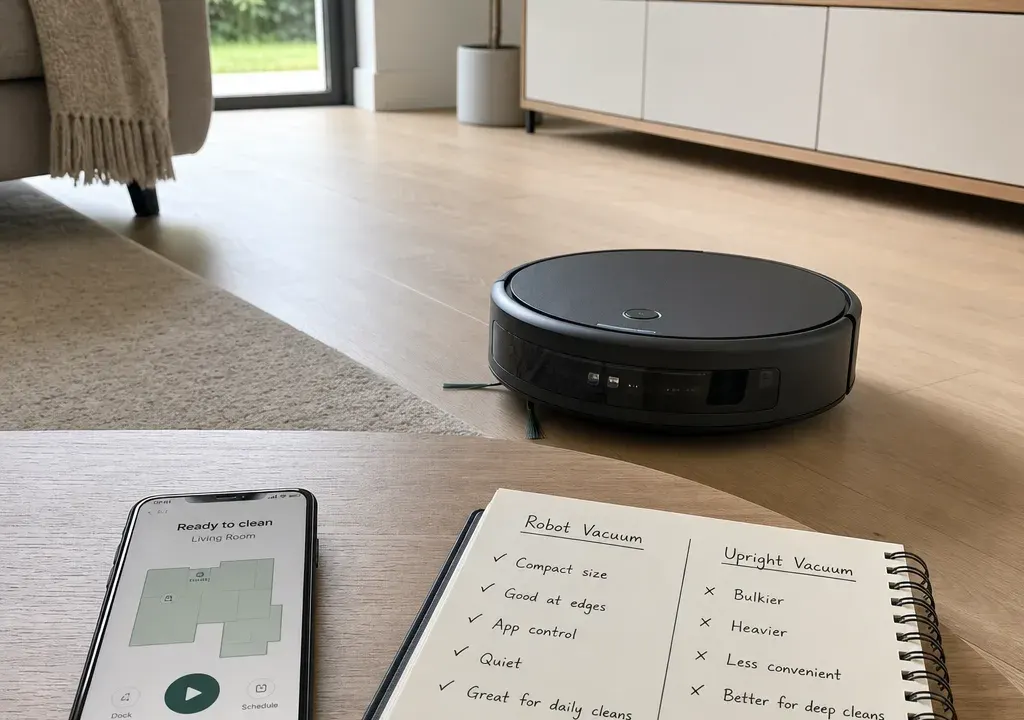
Filtering Robot Vacuum Cleaners by live prices under £200 is a good way to avoid overpaying, but it can also put very different products side by side. One model may focus on high claimed suction, another may add a mop function, while another may be appealing mainly because it is compact or available from a retailer you already trust.
The right budget choice is usually the model with the fewest painful compromises for your home. For a small flat with mostly hard floors, that might be a basic vacuum-mop. For a pet-friendly home with rugs, claimed suction and brush design may matter more. For anyone who wants scheduled cleaning, app control and mapping details should move up the list.
A budget search should begin with the live price filter, not the biggest advertised discount. In the current catalogue context, examples around or below the £200 mark include models such as the Vexilar W9 Robot Vacuum Cleaner 8000Pa, Eufy RoboVac 15C, Eufy L60 Hybrid Robot Black, Liectroux C30B Black, Lefant M210p Robot Vacuum Cleaner, Olsen & Smith Smart Robot Vacuum Cleaner 6500Pa and Sodial Robot Vacuum Cleaner Sweep Mop 6000pa.
That does not mean every one of those will suit the same buyer. Some are close to the top of the £200 ceiling, while others sit much lower and may involve bigger feature trade-offs. When comparing offers, check whether the listed product is the main robot vacuum, a bundle, a variant, or a marketplace listing with limited specification detail.
It is also worth keeping one eye on models just above your limit, such as robot vacuums shown above £200 in the wider Robot Vacuum Cleaners catalogue. They can be useful benchmarks, but if your budget is strict, focus your decision on what is actually available under £200 today.
Claimed suction can be useful for narrowing the list, especially where the product title includes a figure. In the supplied catalogue examples, the Vexilar W9 is listed with 8000Pa, the Olsen & Smith model with 6500Pa, and the Sodial model with 6000pa. Those figures may look compelling for the price, but they should not be the only reason you buy.
A robot vacuum’s real-world usefulness also depends on brush design, dustbin size, how it handles edges, whether it can climb low thresholds, and how intelligently it covers the room. A high suction figure on a basic navigation robot may still miss areas if it moves randomly or struggles around furniture.
For carpets and pet hair, prioritise suction claims alongside brush and filter information. For hard floors, consistent coverage and easy daily scheduling may matter just as much as peak power.
Navigation is one of the biggest differences between cheap robot vacuum cleaners. Some budget models use simple bump-and-turn movement, while others may offer more structured route planning or mapping. The product title alone often will not tell you which system is used, so open the product details and look for terms such as gyroscope navigation, LiDAR, mapping, room selection or no-go zones.
If you have an open-plan living space, lots of chair legs or several rooms, navigation becomes more important. A cheaper robot that wanders inefficiently may need more time and supervision. If you only need it for one simple room, basic navigation may be acceptable if the price is right.
When two models are similar in price, choose the one with clearer navigation information. Vague listings are harder to compare and can lead to disappointment if you expected mapping that is not actually included.
Runtime matters most when the robot has to cover more than one room. Under £200, some products may offer enough battery life for smaller spaces but be less suitable for a larger ground floor. Look for the stated runtime, whether the figure applies to a low-power mode, and whether the robot automatically returns to charge.
Also check what happens after charging. Some robot vacuum cleaners can resume where they left off, while simpler models may not. That difference can be more useful than a small increase in suction if you want regular cleaning with minimal involvement.
For a studio flat, kitchen-diner or single level of hard flooring, a modest runtime may be fine. For multiple rooms, choose the model with the clearest runtime and navigation details rather than the cheapest headline price.
App control can make a budget robot vacuum cleaner far more convenient, but only if the app features are meaningful. At a minimum, look for scheduling, start and stop controls, cleaning modes and battery status. More advanced app features may include maps, zone cleaning and virtual boundaries, but these are not guaranteed at this price point.
The Eufy RoboVac 15C and Eufy L60 Hybrid sit near the £200 line in the supplied examples, so they are natural comparison points for shoppers who want a recognised smart-home style proposition. However, always confirm the exact app functions on the current retailer listing rather than assuming all models from a brand behave the same way.
If you do not want another app on your phone, a simpler remote-controlled or button-operated robot may be enough. Just make sure you are not giving up scheduling if that is the feature that would make the robot genuinely useful day to day.
Robot vacuum mops can be attractive in this price range, especially for kitchens, hallways and hard floors. The Sodial listing explicitly mentions sweep mop, and the Eufy L60 Hybrid name suggests it should be checked carefully for hybrid cleaning functions. Even so, budget mop features are not the same as a full manual mop or a premium robot with advanced mop washing and drying docks.
Before choosing a mop model, compare water tank details, whether the mop pad is removable, what floor types are recommended and whether the robot can avoid carpets while mopping. If those details are missing, assume the mop feature is basic until confirmed otherwise.
For mostly carpeted homes, a mop feature may add little value. For hard floors, it can be worthwhile, but only if the vacuum side of the product still meets your needs.
A low price is more reassuring when the retailer listing is clear, the specification is complete and the product variant is easy to identify. In the supplied catalogue, sub-£200 examples appear across retailers including Joybuy, Very, Geekmaxi, Amazon, Argos, eBay and B&Q. That range gives shoppers choice, but it also means the buying experience and listing detail may vary.
Compare the whole offer, not just the product name. Check what is included in the box, whether spare brushes or mop pads are mentioned, the returns information shown by the retailer, and whether the product image and description match the title. Avoid making a decision solely because an offer shows a large discount from an original price.
If two robot vacuum cleaners look similar, the retailer with clearer product information may be the safer choice. Good listing clarity makes it easier to compare navigation, runtime, app support and consumables before you commit.
For the highest claimed suction under the £200 filter, the Vexilar W9 Robot Vacuum Cleaner 8000Pa is an obvious product to compare, particularly if your priority is power on paper. Check navigation, runtime and dustbin details before treating it as the best overall choice.
For shoppers who want a familiar smart robot vacuum option near the top of the budget, the Eufy RoboVac 15C and Eufy L60 Hybrid Robot Black are worth comparing against each other. Look closely at their navigation, app controls and whether the L60 Hybrid’s cleaning functions match your flooring.
For a lower-cost entry point, the Liectroux C30B Black, Lefant M210p Robot Vacuum Cleaner and Olsen & Smith Smart Robot Vacuum Cleaner 6500Pa may be relevant, depending on availability and specification detail. The Lefant listing’s 7.8 cm height is a useful prompt to measure under sofas, beds and cabinets if low-profile cleaning matters.
For the cheapest-looking listings, be extra careful. A very low price can be tempting, but it increases the importance of checking exactly what is being sold, which accessories are included, and whether the product specification is complete enough to compare with other Robot Vacuum Cleaners.
First, confirm the live price is under £200 and that the exact model in the listing matches the title, image and description. Then compare navigation type, claimed suction, runtime, charging behaviour, app control and mop functions in that order.
Next, think about your flooring. Hard floors make mop features more relevant, while rugs, carpets and pet hair make suction, brush design and dustbin access more important. If you have furniture with low clearance, check the robot height rather than assuming it will fit.
Finally, compare retailer availability and offer clarity. A slightly more expensive budget model can be better value if the specification is clearer and the features match your home more closely.
Yes, but you should expect compromises. Under £200, the best buys are usually straightforward models that suit smaller homes, hard floors or routine maintenance cleaning. Compare navigation, runtime, app features and mop functions carefully rather than choosing on discount alone.
Not always. A higher claimed suction figure can be useful, especially for dust and debris, but coverage, navigation, brush design and bin capacity also affect everyday results. A powerful robot with poor navigation may still miss areas.
Choose a mop model if you have hard floors and want light maintenance between deeper cleans. Check whether the mop pad is removable, whether carpet avoidance is supported and how much detail the retailer gives about the water tank and cleaning modes.
Start with navigation type, because it affects how efficiently the robot covers your space. Then compare suction claims, runtime, app control, mop features, size and retailer availability.
A large discount can flag an offer worth checking, but it should not be the only reason to buy. Compare the current price, product specification, retailer information and whether the features match your home.
The best budget robot vacuum cleaner under £200 is not automatically the cheapest or the one with the largest advertised discount. It is the model that gives you the right balance of navigation, suction, runtime, app convenience, mop capability and retailer clarity for your space.
Use the Robot Vacuum Cleaners catalogue to filter by live prices under £200, then compare the short list feature by feature. If a listing does not clearly explain how the robot navigates, how long it runs or what its mop and app features actually do, keep comparing before you buy.
