
Loading buyer guide
Hurry, don't miss savings on selected furniture & more.* Shop all offers
Choosing a multi-port charger is less about chasing the highest number and more about matching wattage, ports and plug design to how your household actually charges. Here’s how to compare the options sensibly.
Use our barcode scanner to match products instantly to find the best prices, find products with ease using our voice search and build wish lists and your favourites at the click of a button.
2027 foldable phones to watch
Foldable buying in 2027 will be about more than a new hinge or a bigger display. The smarter shortlist will compare book-style and flip formats, listed screen sizes, storage tiers, camera hardware, availability and how each offer sits against conventional Mobile Phones.
New phones coming in 2027: Apple, Samsung, Google and more
Phone launch shopping is easiest when you separate what is actually listed for sale, what has been officially announced, and what is still only expected. For 2027, the smartest shortlist will be built from confirmed Mobile Phones data, retailer availability and comparable specifications rather than brand rumours.
2026 foldable phones compared: Samsung, Google, Honor and rivals
Foldable phones are now split into two very different buying decisions: book-style models for tablet-like space, and flip-style models for pocketability. The smarter shortlist starts by separating those formats before comparing storage, cameras, battery size, weight, retailer availability and the final offer in front of you.
Best 2026 flagship phones from Apple, Samsung and Google
Flagship phone launches can make every handset sound like the obvious upgrade. The smarter approach is to compare the exact Apple, Samsung or Google model by screen size, storage, camera hardware, processor family, charging support, retailer availability and the offer in front of you.
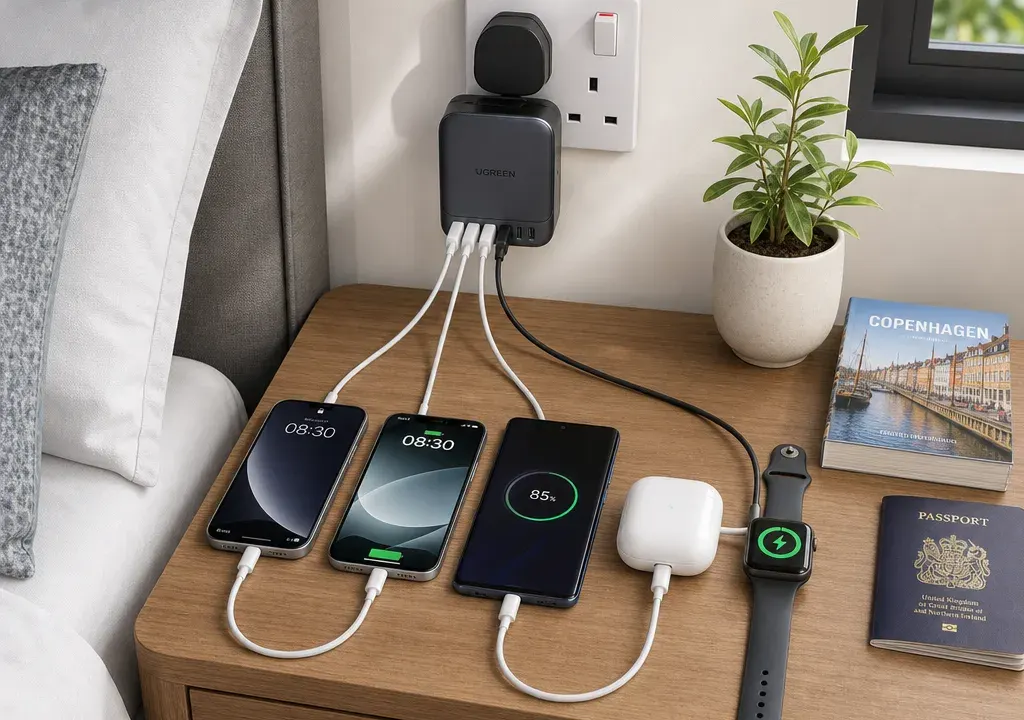
A good multi-port charger solves a simple problem: too many devices and not enough convenient sockets. For families, it can tidy up the kitchen counter or hallway charging spot. For travel, it can reduce the number of plugs in your bag and make hotel room sockets go further.
The main choice is not just USB-A versus USB-C. You also need to compare total wattage, how that power is shared across ports, whether the plug shape suits tight sockets, and whether the current offer represents good value against alternatives in Mobile Phone Accessories.
Before comparing wattage figures, count the devices that typically need power at the same time. A couple may only need two phone ports and one spare for earbuds. A family may want enough ports for several phones, a tablet and a power bank. For travel, two or three reliable ports may be more useful than a bulky charger with more sockets than you need.
If you only charge one phone overnight, a simple single-device plug such as a Samsung 15W Adaptive Fast Charger with USB-C cable may be enough. The reason to step up to a multi-port charger is convenience: fewer plugs, less cable swapping and a more organised charging station.
Be careful not to buy purely on port count. Four low-powered ports can feel less useful than two stronger USB-C ports if you regularly charge newer phones, tablets or compact laptops. Look at both the number of ports and the total wattage available.
Total wattage tells you the maximum power the charger can supply across all ports combined. A higher total can be helpful if several devices are plugged in together, but the detail matters: some chargers reduce the output to each port when multiple devices are connected.
For family use, look for a charger that clearly explains how power is distributed when two, three or more ports are active. If that information is unclear, it is harder to know whether it will suit busy shared charging. A charger that looks powerful on one port may perform more modestly when every port is occupied.
For travel, the sweet spot is often enough power for your essentials without unnecessary bulk. If your kit is mainly phones, earbuds and a watch, you may not need the highest-wattage option. If you also take a tablet or USB-C laptop, higher output and more capable USB-C ports become more important.
The best port mix depends on the cables your household already owns. USB-C is increasingly useful for newer phones and many modern accessories, while USB-A still matters if you have older charging cables, fitness trackers, children’s devices or spare leads in a drawer.
A family charger with both USB-C and USB-A ports can prevent arguments over cable types. For a travel charger, at least one USB-C port is sensible if your phone, tablet or power bank uses it, but a USB-A port can still be handy for older accessories or borrowed cables.
Do not assume every port supports the same charging speed. Product listings should state what each port can deliver, especially when ports are used together. If the listing only gives one large wattage figure and little else, compare it carefully with clearer alternatives before buying.
A multi-port charger may live behind furniture, beside a bed or in a hallway socket, so shape matters. A wide charger can block neighbouring sockets on an extension lead. A tall charger may pull away from loose wall sockets if several cables are attached. For shared charging spots, a stable design with ports facing a convenient direction can be more useful than a marginally smaller one.
For travel, compactness matters, but so does durability in a bag. A folding-pin design can be useful where available, but check the actual plug type and product details rather than assuming it will suit UK sockets or overseas use. If you travel abroad, you may still need the correct travel adaptor for the destination.
In-car charging is a separate use case. A product such as the Anker USB-C Car Charger 75W Max is relevant if your family charges phones on the road, but it is not a replacement for a mains multi-port charger in a hotel room or at home. Compare car chargers and wall chargers separately so you do not buy the wrong format.
Wireless chargers can be convenient on a desk or bedside table, but they do not solve the same problem as a multi-port USB charger. A wireless stand such as the Anker 313 Wireless Charger, or a Google Pixelsnap Wireless Charger 25W Qi2, is designed around placing one compatible device in a specific position rather than sharing several cable ports.
For families, a wireless charger can be a useful extra for one frequently used phone, while the main multi-port charger handles everything else. For travel, wireless pads and stands may add bulk unless you strongly prefer cable-free charging.
When comparing Mobile Phone Accessories, treat wireless charging, power banks and plug chargers as complementary tools. A compact power bank, for example, helps away from sockets, while a multi-port wall charger is about managing mains power efficiently.
Recognisable brands can make shortlisting easier, but brand alone should not replace checking the specification. Compare the total wattage, port layout, included cable if any, plug format and compatibility notes. A cheaper offer may be less useful if it lacks the port mix you need or requires you to buy extra cables.
Retailer availability also matters because accessory stock can move quickly. Rather than relying on one offer, compare similar products across retailers and check the final basket details before buying. Look at whether the product title and images match the specification you expect, especially for chargers with several variants.
Current catalogue examples across Mobile Phone Accessories include single-device plugs, car chargers, wireless chargers, power banks and phone cases. That mix is a useful reminder to filter carefully: if you want a multi-port charger for a family charging station, avoid being distracted by adjacent accessories that solve different problems.
For a family charging station, prioritise a mains charger with enough total wattage for simultaneous use, a balanced USB-C and USB-A port mix, and a shape that works on an extension lead or kitchen socket. Clear power-sharing information is especially important when several people will plug in at once.
For frequent travellers, look for a compact design, useful USB-C output and no more ports than you realistically need. The charger should replace several plugs, not become another awkward item in your bag. If you often hire cars or take long road trips, compare a separate car charger as well.
For occasional use or a spare room, value may matter more than maximum output. A modest charger can be perfectly adequate for overnight phone charging, but check that it has the right port type for your existing cable. If it is mainly for one device, a single-port charger may be the better-value choice.
For most households, three or four ports is a sensible starting point, provided the total wattage is high enough for several devices at once. A mix of USB-C and USB-A ports is useful if family members use different cables.
USB-C is generally the more future-friendly choice and is common on newer phones and accessories. USB-A is still useful for older cables and devices, so many shoppers are best served by a charger that includes both.
Not always. Charging speed depends on the device, cable, port capability and how the charger shares power when multiple ports are in use. Compare the per-port output as well as the total wattage.
They solve different problems. A wall charger is best for hotel rooms and mains sockets, a car charger is useful on road trips, and a power bank helps when no socket is available. Many travellers benefit from comparing all three before deciding.
Wireless chargers are convenient for one compatible device in a fixed spot, but they are not usually a like-for-like alternative to a multi-port USB charger. For shared family charging, cable ports are often more flexible.
The best multi-port charger is the one that matches your real charging habits. Start with the number of devices, then compare total wattage, port mix, plug shape and how clearly the product explains power sharing.
For families, convenience and cable compatibility should lead the decision. For travel, compact design and the right charging format matter most. Compare products and offers across Mobile Phone Accessories, check the latest retailer stock, and choose the charger that removes friction rather than simply offering the biggest headline number.
