
Loading buyer guide
Hurry, don't miss savings on selected furniture & more.* Shop all offers
A charger can look powerful on paper but still be the wrong fit for your phone, bedside table, car or travel bag. Compare the essentials first: wattage, connector type, wireless or wired design, included cable, brand and retailer availability.
Use our barcode scanner to match products instantly to find the best prices, find products with ease using our voice search and build wish lists and your favourites at the click of a button.
2027 foldable phones to watch
Foldable buying in 2027 will be about more than a new hinge or a bigger display. The smarter shortlist will compare book-style and flip formats, listed screen sizes, storage tiers, camera hardware, availability and how each offer sits against conventional Mobile Phones.
New phones coming in 2027: Apple, Samsung, Google and more
Phone launch shopping is easiest when you separate what is actually listed for sale, what has been officially announced, and what is still only expected. For 2027, the smartest shortlist will be built from confirmed Mobile Phones data, retailer availability and comparable specifications rather than brand rumours.
2026 foldable phones compared: Samsung, Google, Honor and rivals
Foldable phones are now split into two very different buying decisions: book-style models for tablet-like space, and flip-style models for pocketability. The smarter shortlist starts by separating those formats before comparing storage, cameras, battery size, weight, retailer availability and the final offer in front of you.
Best 2026 flagship phones from Apple, Samsung and Google
Flagship phone launches can make every handset sound like the obvious upgrade. The smarter approach is to compare the exact Apple, Samsung or Google model by screen size, storage, camera hardware, processor family, charging support, retailer availability and the offer in front of you.
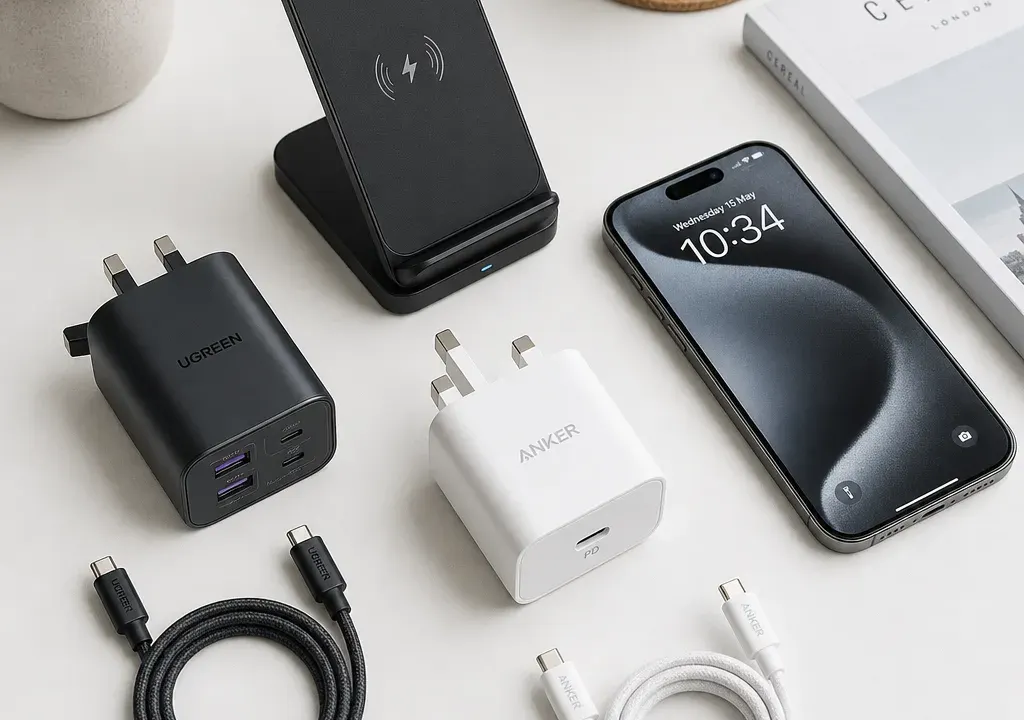
Choosing a fast charger is not just about picking the highest wattage number. Your phone, cable and charger need to support the same charging standard, and the best option depends on where you charge most often: at the wall, on a desk, in the car or overnight by the bed.
The Mobile Phone Accessories category includes everything from mains chargers and wireless stands to powerbanks, cases and waterproof pouches, so it is worth narrowing your search before comparing offers. For fast charging, focus on chargers first, then check whether you also need a compatible cable, stand, car adaptor or portable backup.
Wattage tells you the maximum power a charger can potentially deliver. In the supplied catalogue examples, the Samsung Galaxy 15W Adaptive Fast Charger is clearly positioned around 15W charging, while the Google Pixelsnap Wireless Charger is listed as 25W Qi2. The Anker USB-C Car Charger is listed as 75W max, which suggests a higher-output option for in-car charging rather than a standard wall plug.
The key word is potential. A 25W or 75W charger will not automatically charge every phone at that rate. Your handset must support the relevant charging level, the cable needs to be suitable, and wireless charging can be affected by alignment, case thickness and phone compatibility. If your phone only accepts a lower input, a higher-wattage charger may still work, but you may not see the full benefit.
For most shoppers, the sensible approach is to check your phone maker’s recommended charging range first, then compare chargers that match or exceed that requirement without paying extra for power you will not use.
USB-C is common on newer phones and accessories, but a USB-C connector does not automatically confirm USB-C Power Delivery support. If fast wired charging matters, look for explicit wording such as USB-C Power Delivery, PD, PPS or device-specific fast charging support in the retailer’s product information.
The Samsung 15W Adaptive Fast Charger in the product catalogue is listed with a USB-C cable, which may be useful if you do not already have a suitable lead. The Anker USB-C Car Charger is described as a Type-C fast car charger, making it relevant for shoppers who want charging on the move. However, you should still confirm the exact ports and standards before buying, especially if you intend to charge more than one device.
If you own an iPhone, a recent Samsung Galaxy, Google Pixel or another USB-C phone, do not assume every old cable in a drawer will deliver the same result. Cable quality, connector type and supported power rating can affect charging speed.
A mains charger is usually the simplest choice for fast charging at home or work. It is the right starting point if you want a compact plug for your bedside table, kitchen socket or office bag. If you regularly charge in the same place and want fewer cables, a wireless stand or pad may be more convenient, though wired charging is often the more direct route when speed is the priority.
Wireless options in the supplied product set include the Anker 313 Wireless Charger Stand, the Google Pixelsnap Wireless Charger 25W Qi2 and the Quad Lock Wireless Charging Head V2. These are not like-for-like with a mains plug: they are better compared on phone compatibility, mounting style, desk or vehicle use, case compatibility and whether a separate power adaptor is needed.
For travel or commuting, the Fx 10,000 mAh powerbank offers a different kind of value: backup power rather than wall charging. Meanwhile, the Anker USB-C Car Charger is aimed at drivers who want faster charging from a vehicle socket. Before buying, think about the moment you actually run out of battery. That usually tells you whether you need a wall charger, wireless charger, car charger or powerbank.
Port count matters if you charge a phone, earbuds, smartwatch or tablet from the same socket. A single-port charger can be neater and cheaper, but a multi-port charger may reduce clutter if it supports enough output across all connected devices.
The supplied product titles do not consistently confirm port counts, so this is a detail to verify in the retailer listing rather than guess from the product name. Look for how many USB-C and USB-A ports are included, whether all ports can fast charge at once, and how the total wattage is shared when multiple devices are connected.
If you only charge one phone overnight, a simple single-device charger may be enough. If you travel with several gadgets, a higher-output multi-port charger can be more practical, provided it supports the standards your devices need.
Recognisable accessory brands can make comparison easier because shoppers often have a starting point for build style, device focus or ecosystem fit. In the supplied catalogue, relevant charging brands include Samsung, Google, Anker and Quad Lock, each associated with different use cases across wired, wireless, car and mounting-related charging.
Brand alone should not decide the purchase. A Samsung charger may make sense for some Galaxy owners, while a Google Qi2 wireless charger may appeal to Pixel users looking at wireless options. Anker appears in both wireless and car charging examples, which gives shoppers different formats to compare. Quad Lock’s wireless charging head is more specialised and may suit those already considering compatible mounting accessories.
The safest buying route is to match the charger to your phone first, then compare brand, format, retailer availability and value.
Large discounts can be attractive, but they should not be the only reason to choose a charger. In a catalogue snapshot, the Samsung 15W Adaptive Fast Charger, Google Pixelsnap Wireless Charger, Anker 313 Wireless Charger Stand, Anker USB-C Car Charger, Quad Lock Wireless Charging Head V2 and Fx powerbank all appeared as discounted offers. That makes them worth comparing, but the right choice still depends on compatibility and use case.
When comparing offers, look beyond the headline saving. Check whether a cable is included, whether the charger is wired or wireless, whether it suits mains or car use, and whether the retailer currently has availability. A cheaper option may be better value if it includes the cable you need; a more expensive one may be justified if it replaces two separate chargers or suits a specific setup.
It is also worth comparing Mobile Phone Accessories more broadly. If you are buying a new charger because your current setup no longer works well with a thick case, you may need to compare Mobile Phone Covers, Wallet Cases or Waterproof Cases at the same time. Some cases can affect wireless charging convenience, so checking the accessory combination can prevent a frustrating mismatch.
Choose a wired mains charger if you want straightforward fast charging at home, at work or when travelling. Prioritise the correct wattage range, USB-C Power Delivery support where relevant, and whether the right cable is included.
Choose a wireless charger if convenience matters more than the absolute fastest top-up. Compare Qi or Qi2 compatibility, whether the design is a stand or pad, and whether your phone case will get in the way.
Choose a car charger if your battery often runs low during commutes, long drives or navigation-heavy journeys. Check the socket type, output, port count and whether passengers also need to charge.
Choose a powerbank if you need backup power away from sockets. Compare capacity, output type, size and cable requirements rather than treating it as a direct replacement for a mains charger.
Check your phone’s recommended charging specification first. The best charger is one that supports your phone’s fast charging standard and suitable wattage, rather than simply the highest wattage available.
No. USB-C describes the connector, while USB-C Power Delivery is a charging standard. If fast wired charging is important, look for explicit PD or compatible fast charging information in the product details.
Wireless charging can be very convenient, but speed depends on the phone, charger, alignment, case and power adaptor used. If speed is your main priority, compare wired options first, then consider wireless for convenience.
It can be better value if you do not already own a compatible cable. If a charger does not include one, factor the cost and specification of a suitable cable into your comparison.
Modern phones and chargers are generally designed to negotiate power, but you should still use reputable products and follow your phone maker’s charging guidance. Avoid assuming that higher wattage will always mean faster charging.
The best mobile phone charger is the one that fits your actual charging routine. For most shoppers, that means matching your phone’s charging standard first, then comparing wattage, USB-C support, port count, included cable, brand and retailer availability.
Use the Mobile Phone Accessories range to compare chargers alongside related accessories such as Mobile Phone Covers, Wallet Cases, Waterproof Cases and powerbanks. A good fast charging setup is not just the plug in the wall; it is the full combination of charger, cable, case and everyday use.
